
SCIENTIFIC REPOSITORY
Dinos 101
141 species curated from the paleontological literature. Where they lived, which bones were found, and how our understanding evolved.
EXPLORE BEYOND THE CATALOG
The site is more than a species catalog. Each lens below shows the dinosaurs and reptiles of the Mesozoic from a different angle.
Apex Predators
Cladogram of 53 species at the top of the food chain through time, with map and timeline.
→Birds are Dinosaurs
How a single lineage of flying theropods crossed the K-Pg impact and became the 11,000 birds of today.
→Beyond the Meteor
The 186 million years of the Mesozoic and an analysis of the five great mass extinctions.
→The Great Family
Evolutionary tree of the main dinosaur families and their close relatives.
→Excavation Map
Main excavations of the world and their discoveries, point by point on the globe.
→Paleogeography
How Pangaea broke apart and continents moved during the Mesozoic.
→Mesozoic Climate
Temperatures, CO2 and climate patterns over the 186 million years.
→Dinosaur Biology
Anatomy, physiology and how dinosaurs worked from the inside.
→Plant Evolution
From conifers to flowering plants and the rise of grasses.
→Fossilization
How a dead organism becomes a fossil over millions of years.
→Regional Hubs
Dinosaurs by region: Brazil, Argentina, USA, China, Mongolia, Africa.
→Dino Cards
Card game with real species statistics from the site.
→Glossary
Paleontology terms explained in an accessible way.
→EXPLORE BY PERIOD














































No species found with these filters.
Mesozoic · Non-dinosaurs
Other Animals of the Mesozoic
Not dinosaurs, but they dominated the oceans, the skies, and parts of the continents during the same period.
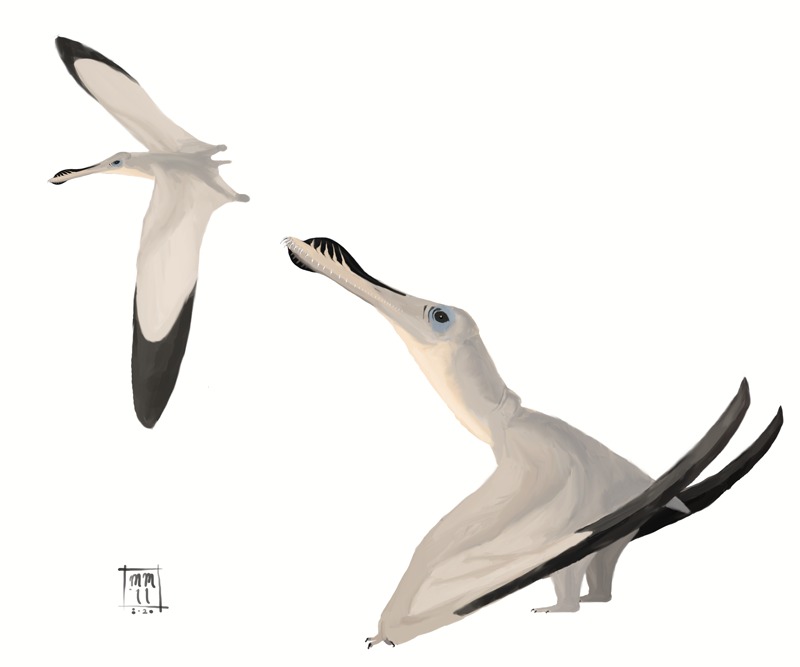
BR · 112–108 Ma
Anhanguera
Anhanguera blittersdorffi
"Blittersdorff's evil spirit"
Anhanguera blittersdorffi is an anhanguerid pterosaur from the Lower Cretaceous of Brazil, described by Campos and Kellner in 1985 from an extraordinarily preserved three-dimensional skull. With an estimated wingspan of 4 to 4.5 meters, it was an aerial predator specialized in fish capture, bearing characteristic premaxillary crests, curved coniform teeth, and a rosette-shaped mandible. Originating from the calcareous nodules of the Romualdo Formation, Araripe Basin, in Ceará, it is one of the most studied Brazilian pterosaurs and an emblem of the Cretaceous fauna of northeastern Brazil.

US · 100–72 Ma
Cretoxyrhina
Cretoxyrhina mantelli
"Mantell's sharp tooth from the Cretaceous"
Cretoxyrhina mantelli, popularly known as the Ginsu shark, was one of the largest and most feared marine predators of the Late Cretaceous. It lived approximately 100 to 72 million years ago in the Western Interior Seaway, a vast body of water that divided North America. Up to 6.5 meters long with anatomy similar to modern mako sharks, it preyed on mosasaurs, plesiosaurs, sea turtles, and pterosaurs. Several near-complete skeletons have been found in the Cretaceous of Kansas, making it one of the best-documented extinct sharks in science.

DE · 157–137 Ma
Dakosaurus
Dakosaurus maximus
"Maximum biter lizard"
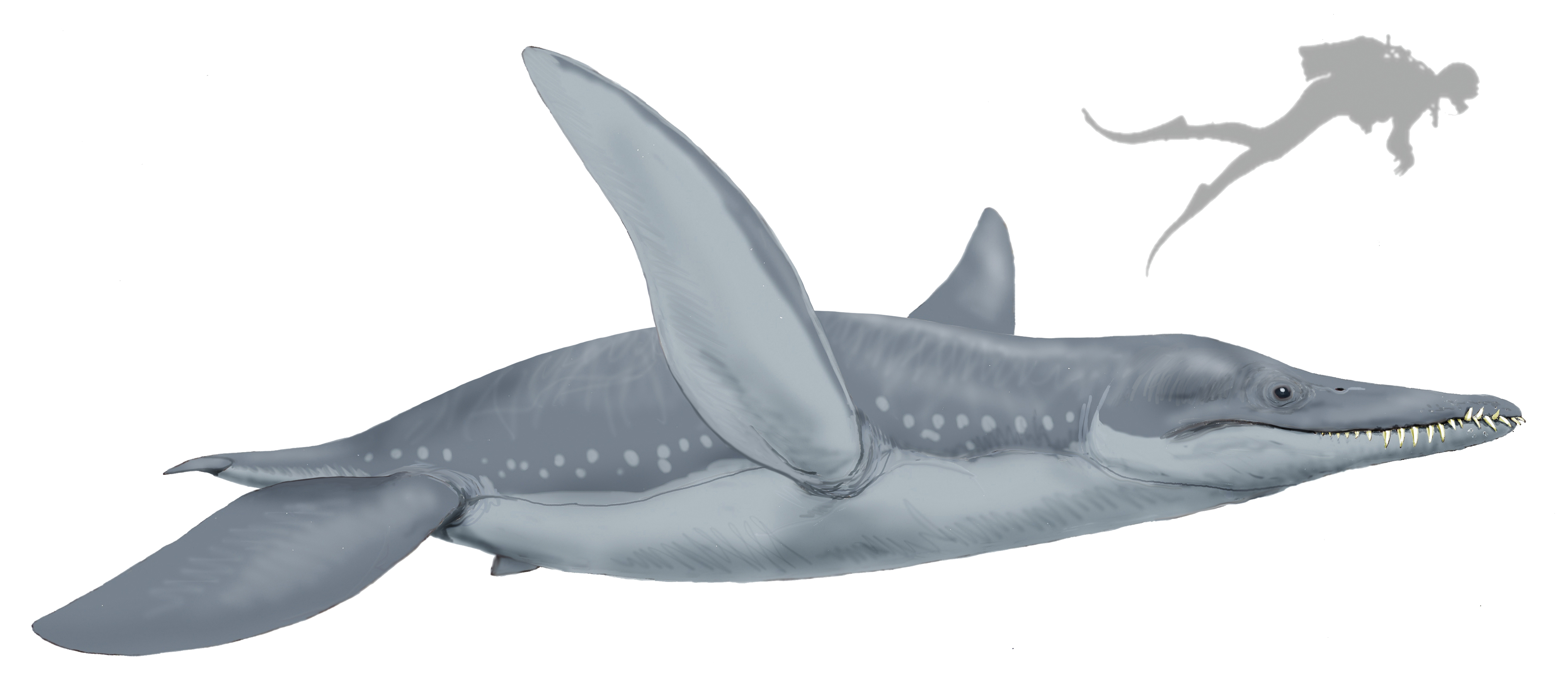
Dakosaurus maximus was the most fearsome marine crocodyliform of the Late Jurassic. Belonging to the family Metriorhynchidae, it stood apart from all other members of the group by possessing laterally compressed, serrated teeth convergent with those of terrestrial theropods, indicating specialization in large prey. Without osteoderm armor and with limbs transformed into flippers and a lunate bifurcated tail, it was fully adapted to pelagic life. Its fossils were found in Europe (France, Germany, Switzerland, Poland, England) and Argentina, where the D. andiniensis specimen was nicknamed 'Godzilla' by Argentine paleontologists. It was the apex predator of the European Jurassic seas.

US · 82–73 Ma
Terror Croc
Deinosuchus riograndensis
"Terrible Rio Grande crocodile"
Deinosuchus riograndensis was one of the largest crocodilians ever to live, reaching about 10 to 12 meters in length and 3,500 to 8,500 kg. Placed in the superfamily Alligatoroidea according to the revision of Cossette and Brochu (2020), it inhabited the coastal plains and estuaries of the Western Interior Seaway during the Campanian, around 82 to 73 million years ago. Its name means, terrible crocodile of the Rio Grande, after the river that bounds Big Bend National Park, Texas, where the most complete specimens were collected. It had banana-sized teeth, thick dorsal osteoderms and a bite force comparable to that of Tyrannosaurus rex, preying on hadrosaurs, ceratopsians and marine turtles. A recent phylogenetic analysis by Walter et al. (2025) proposed repositioning the genus as a stem-crocodylian outside Alligatoroidea.

US · 80.5–77 Ma
Elasmosaurus
Elasmosaurus platyurus
"Thin-plate flat-tailed reptile"
Elasmosaurus platyurus was one of the largest and most distinctive plesiosaurs of the Late Cretaceous, famous for its extraordinarily long neck that accounted for more than half of its total length of approximately 14 meters. With 71 cervical vertebrae, it holds the record for the greatest number of neck vertebrae of any known vertebrate. It was not a dinosaur but a marine reptile of the group Sauropterygia. It lived in the Western Interior Seaway that covered central North America, feeding on fish and cephalopods with sharp teeth. It became famous for a historic error: when Edward Drinker Cope described it in 1868, he assembled the skeleton with the skull at the wrong end, placing it at the tip of the tail. The mistake was corrected in 1870 following the intervention of Joseph Leidy.

DE · 183–174 Ma
Hybodus
Hybodus hauffianus
"Hauff's humped shark"
Hybodus hauffianus is one of the best-documented extinct sharks of the Mesozoic. It lived in the Early Jurassic, approximately 183 to 174 million years ago, in the shallow warm seas that covered central Europe. Up to 2 meters long, it had two types of teeth: pointed at the front for catching slippery prey and flattened toward the back for crushing hard-shelled prey. Exceptional specimens preserved in the Posidonia Shale of Germany reveal rare anatomical details, including stomach contents with belemnite rostra, confirming its diet of cephalopods.

AU · 115–100 Ma
Kronosaurus
Kronosaurus queenslandicus
"Kronos lizard from Queensland"
Kronosaurus queenslandicus was one of the largest pliosaurids of the Early Cretaceous, with an estimated length of 9 to 11 meters and a skull 2.2 meters long, one of the largest of any prehistoric reptile. It was not a dinosaur but a marine reptile of the clade Pliosauridae. It lived in the Eromanga Sea that covered inland Australia during the Aptian-Albian (~115-100 Ma). The nickname 'Plasterosaurus' reflects the controversial Harvard reconstruction (MCZ 1285), where eight extra plaster vertebrae were added to the specimen, inflating the length from 10.5 to 12.8 meters. With conical teeth up to 7 centimeters, it was the dominant apex predator of its environment, capable of attacking plesiosaurs, sea turtles, and large fish.
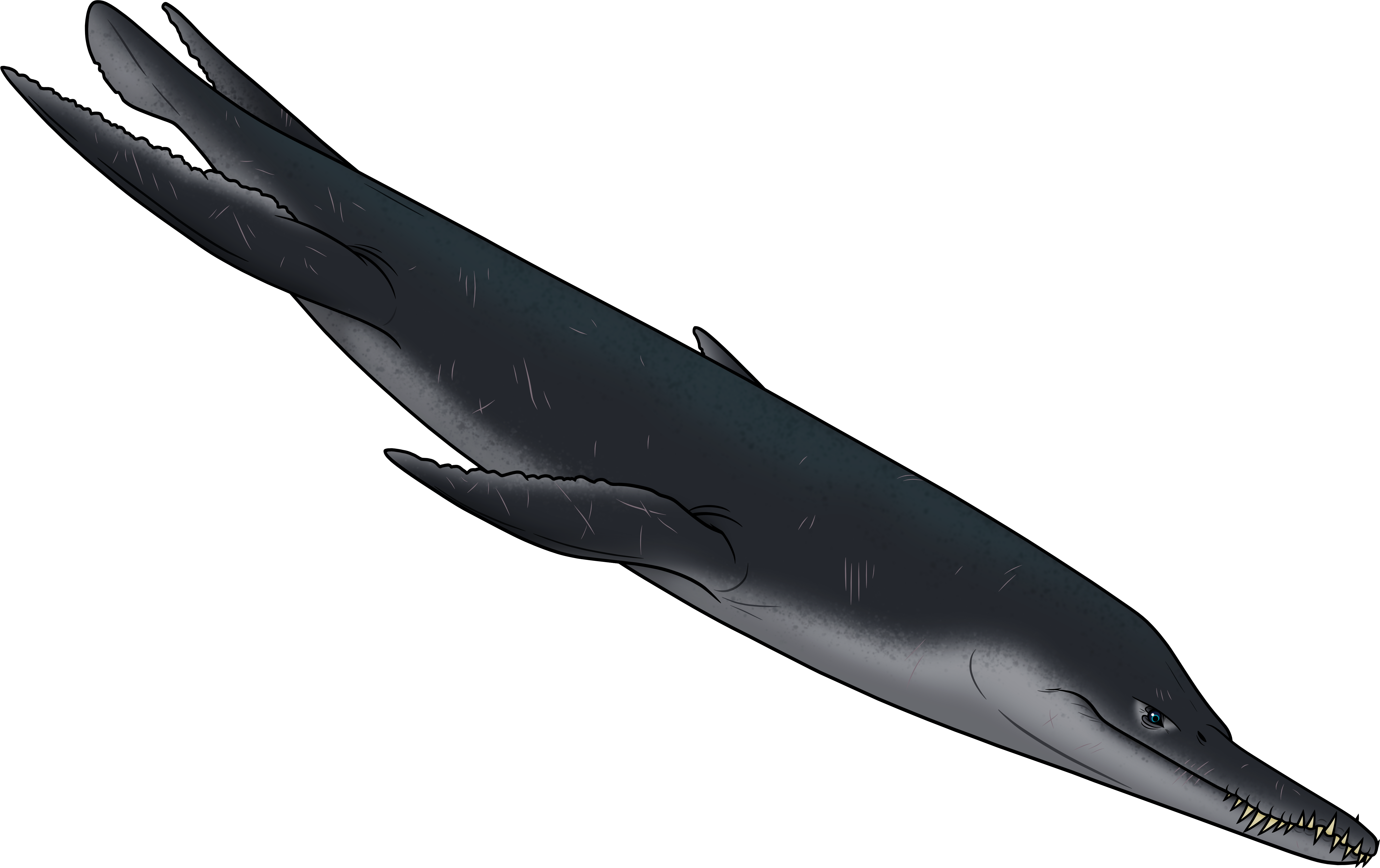
FR · 166–155 Ma
Liopleurodon
Liopleurodon ferox
"Smooth-sided teeth, fierce"
Liopleurodon ferox was a pliosaur, a predatory marine reptile from the Middle to Late Jurassic seas that covered Europe around 166 to 155 million years ago. It was not a dinosaur: it belongs to Sauropterygia, a fully aquatic lineage with four paddle-shaped flippers, a short neck, and an elongated skull. Recent studies estimate a typical body length between 5 and 7 meters, far from the 25 meters depicted in the BBC documentary Walking with Dinosaurs (1999). The name means 'smooth-sided teeth', referring to the enamel ridges on the tooth crown. It was an apex predator of the epicontinental seas, feeding on fish, cephalopods, and other marine reptiles, as shown by preserved stomach contents. The holotype, described by Henri Sauvage in 1873, is a single tooth from the Boulogne-sur-Mer region of France; the species' identity has been progressively refined through decades of taxonomic work.
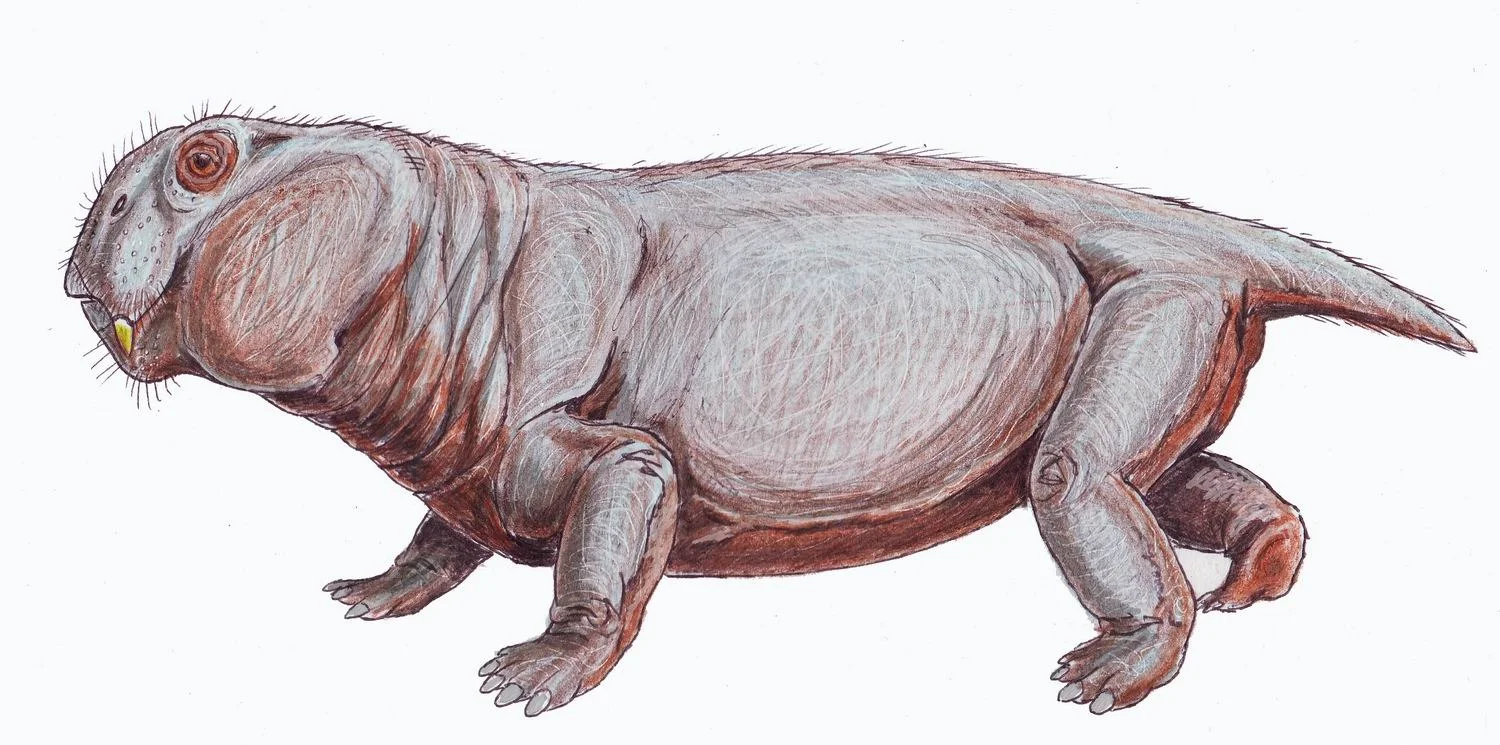
ZA · 252–249 Ma
Lystrosaurus
Lystrosaurus murrayi
"Murray's shovel lizard"
Lystrosaurus murrayi is a dicynodont (non-mammalian synapsid) that survived the greatest mass extinction in the history of life, the end-Permian catastrophe approximately 252 million years ago. In the Early Triassic it constituted more than 90% of terrestrial vertebrates, a dominance unparalleled in tetrapod history. Its massive skull bore a horny beak for cutting vegetation and two small upper tusks. Roughly the size of a medium pig, Lystrosaurus murrayi has become a symbol of post-extinction resilience and continental drift, with fossils found in South Africa, Antarctica, India, China, and Russia.
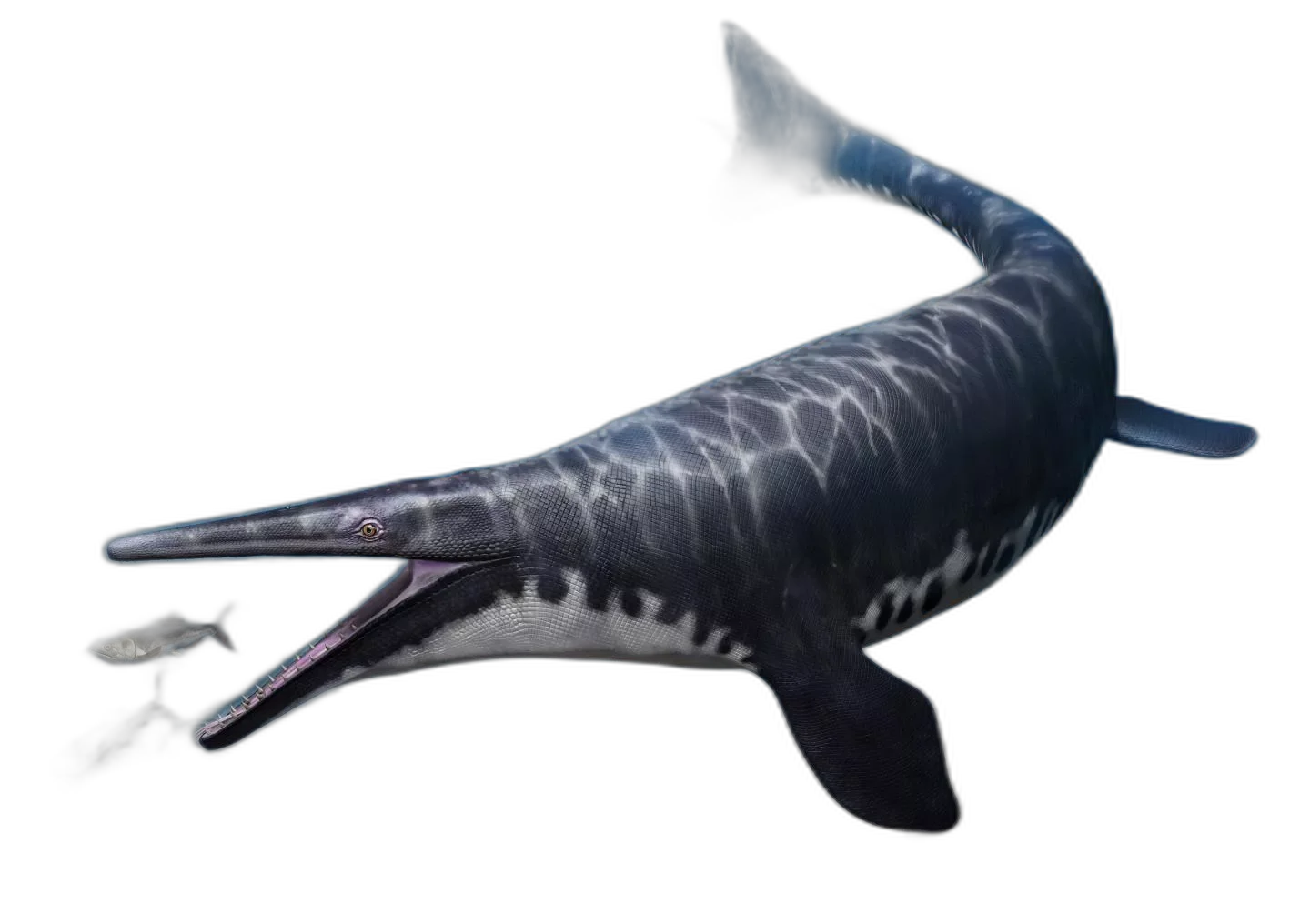
NL · 82–66 Ma
Mosasaurus
Mosasaurus hoffmannii
"Hoffmann's Meuse River lizard"
Mosasaurus hoffmannii was the largest known mosasaur and one of the greatest marine predators of all time. At up to 13 meters long (recent estimates revised from earlier 17-meter values) and an estimated weight of 10 tonnes, it dominated the oceans of the Late Cretaceous. It was not a dinosaur but a squamate reptile (Squamata), closely related to monitor lizards and snakes. It possessed a double-hinged jaw similar to snakes, allowing it to swallow large prey. Its robust, conical teeth were adapted for a generalist diet: fish, sharks, cephalopods, sea turtles, seabirds, and other mosasaurs. The first Mosasaurus fossil, found in Maastricht (Netherlands) in 1764, was one of the first giant marine reptiles described by science, even before Darwin. The holotype skull was confiscated by French soldiers during the Siege of Maastricht in 1794 and taken to Paris, where Georges Cuvier used it as evidence that species could go extinct, a revolutionary concept at the time.
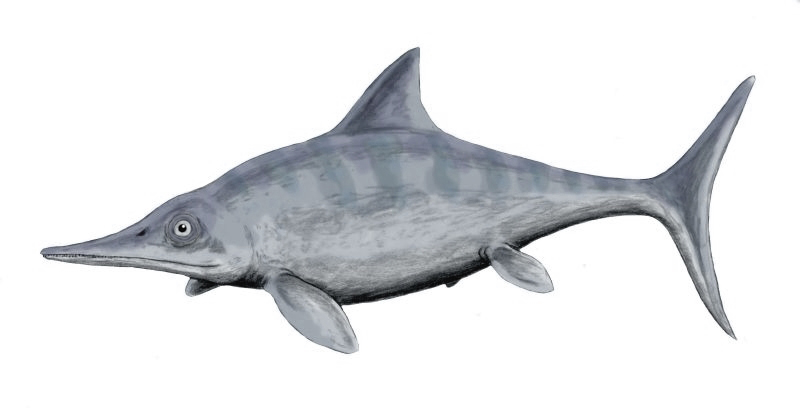
GB · 165–150 Ma
Ophthalmosaurus
Ophthalmosaurus icenicus
"Eye lizard (from Greek: ophthalmos = eye, sauros = lizard)"
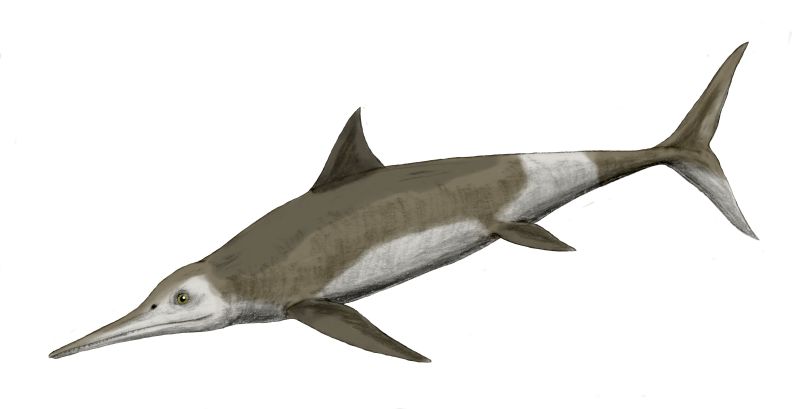
Ophthalmosaurus icenicus was a Middle-Late Jurassic ichthyosaur, famous for having the largest eyes relative to body size of any known vertebrate: the sclerotic ring measured up to 23 centimeters in outer diameter. Found primarily in the Oxford Clay Formation of Peterborough, England, it was an agile oceanic swimmer with a hydrodynamic body of about 6 meters and paddle-shaped fins. Although not a dinosaur, it was strictly contemporary with many of them. Its enormous eyes were adapted for deep dives in dark mesopelagic zones, likely in pursuit of squid and cephalopods. Harry Govier Seeley described the species in 1874, and since then it has become one of the best-documented ichthyosaurs of the Jurassic, with dozens of excellent preserved specimens.

US · 228–201 Ma
Postosuchus
Postosuchus kirkpatricki
"Crocodile from Post (Post, Texas)"
Postosuchus kirkpatricki was one of the largest terrestrial predators of the Late Triassic in North America. A crurotarsal archosaur belonging to the family Rauisuchidae, it was not a dinosaur but rather a distant relative of modern crocodilians. Estimated at 4 to 6 meters in length, it had an erect posture, laterally compressed serrated teeth, and a robust skull. Locomotion was predominantly bipedal in adults, with the forelimbs progressively reduced with growth. It lived in the tropical humid and semiarid environments of the Late Triassic, coexisting with the first dinosaurs and the rhynchosaurs it would eventually replace.

US · 88–80 Ma
Pteranodon
Pteranodon longiceps
"Toothless wing with long head"
Pteranodon longiceps is the most studied pterosaur in the history of paleontology, with over 1,200 known specimens. It flew over the Western Interior Seaway, a shallow waterway that covered the center of North America in the Cretaceous. Adult males reached wingspans of 5.6 to 7.6 meters, while females were smaller, at approximately 3.8 meters. The long backward-pointing head crest was more prominent in males. Despite its imposing appearance, it was a specialized piscivore, capturing fish at the sea surface with its long, toothless beak.

US · 68–66 Ma
Quetzalcoatlus
Quetzalcoatlus northropi
"Feathered serpent of Northrop"
Quetzalcoatlus northropi is the largest known pterosaur and one of the largest flying animals in Earth's history. With a wingspan estimated at 10 to 11 meters, it was as wide as a single-engine aircraft. It lived during the late Maastrichtian, 68 to 66 million years ago, in the Javelina Formation of Texas, in the basin of what is now Big Bend National Park. Despite its colossal size, it weighed only 150 to 250 kg thanks to hollow bones reinforced with internal struts. Biomechanical studies show it was capable of active flight, taking off with a quadrupedal vault using its forelimbs. On land, it walked quadrupedally and hunted small vertebrates in the manner of a giant stork.

CN · 125–123 Ma
Repenomamus
Repenomamus robustus
"Robust reptile mammal"
Repenomamus robustus was one of the largest Mesozoic mammals and living proof that mammals of the Age of Dinosaurs were not all small and harmless. Belonging to the order Eutriconodonta and family Gobiconodontidae, it lived during the Aptian of the Early Cretaceous in Liaoning, China, in the same fauna as Microraptor gui. At approximately 50 cm in body length and an estimated weight of 4.5 kg, it was as large as a modern Virginia opossum. The most notable find is a specimen with bones of a juvenile Psittacosaurus fossilized in the stomach, the only direct evidence of a Mesozoic mammal preying on dinosaurs. The robust mandible and heterodont teeth confirm frankly carnivorous habits.
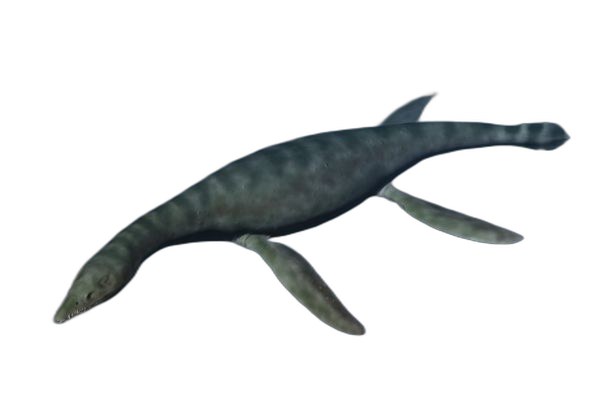
GB · 183–178 Ma
Rhomaleosaurus
Rhomaleosaurus cramptoni
"Crampton's robust lizard"
Rhomaleosaurus cramptoni was a basal pliosauroid of the Early Jurassic, about 7 meters long with a skull roughly 88 centimeters in length. It was not a dinosaur but a marine reptile of the family Rhomaleosauridae, the dominant predatory group of early Jurassic seas. The type skeleton, now in the National Museum of Ireland – Natural History in Dublin, was unearthed in 1848 by alum quarry workers at Kettleness, Yorkshire coast, England. Carte and Baily described it in 1863 as Plesiosaurus cramptoni; Harry Seeley reclassified it in 1874, erecting the genus Rhomaleosaurus. The animal combined the relatively hydrodynamic body of a plesiosaur with the large head and robust jaws of a pliosaur, occupying the niche of a versatile mid-sized apex predator.
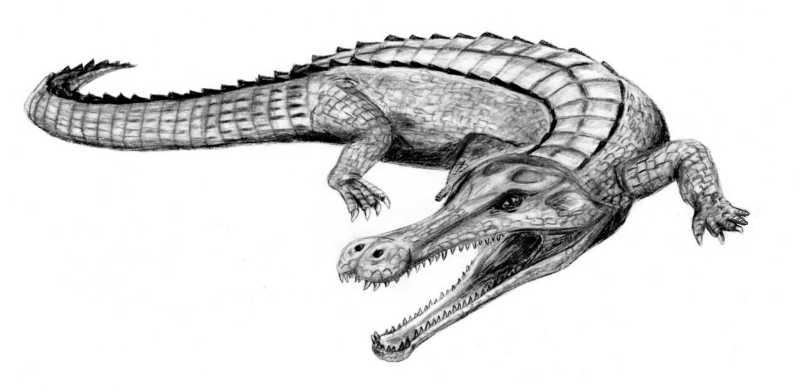
NE · 133–112 Ma
SuperCroc
Sarcosuchus imperator
"Emperor flesh crocodile"
Sarcosuchus imperator was a giant crocodyliform of the family Pholidosauridae that inhabited rivers and humid plains of subcontinental Africa during the Aptian-Albian, around 133 to 112 million years ago. The nearly complete specimen collected in 1964 at Gadoufaoua, in present-day Niger, and formally described by de Broin and Taquet in 1966 provided the first skull of more than one and a half meters of the genus. Sereno and colleagues, in 2001, estimated that adults reached 11 to 12 meters in length and 8 tonnes based on cranial allometry, figures later revised downward by O'Brien and colleagues in 2019, who proposed about 9.5 meters and 4,300 kilos from a phylogenetically informed regression of head width. The name combines the Greek words for flesh, crocodile and emperor, reflecting the exceptional size. It had a wide, robust snout, conical non-interlocking teeth, thick dorsal osteoderms and a hollow bone structure at the tip of the snout called a bulla, present in all adult specimens and still of no clearly established function.

US · 221–205 Ma
Smilosuchus
Smilosuchus gregorii
"Gregory's knife-crocodile (honoring geologist Herbert E. Gregory)"
Smilosuchus gregorii was one of the largest semiaquatic predators of the Late Triassic of North America. Up to 6 meters long, it occupied the same ecological niche as modern crocodiles: ambush predation along the margins of rivers and lakes in the Chinle Formation of what is now Arizona. Its key distinction from true crocodilians lies in nostril position: instead of opening at the tip of the snout, phytosaur nostrils open in a bony mound between the eyes. The skull of S. gregorii can exceed 1.5 meters in length, with heterodontic dentition, large anterior tusks for impaling prey and more blade-like posterior teeth for slicing flesh. The species was originally described by Camp (1930) and transferred to the genus Smilosuchus by Long and Murry (1995).

US · 100–72 Ma
Squalicorax
Squalicorax falcatus
"Falcate crow shark (from the curved, sickle-like teeth)"
Squalicorax falcatus was a medium-sized lamniform shark that inhabited the shallow seas of the Late Cretaceous, including the extensive Western Interior Seaway of North America. About 2.5 meters in length, it had a fusiform body similar to the modern reef shark, but its strongly serrated teeth resembled those of today's tiger shark. The genus Squalicorax, commonly called the crow shark, was a generalist predator and opportunistic scavenger. Fossil evidence includes teeth embedded in bones of terrestrial hadrosaurs, mosasaurs, and sea turtles, revealing that it fed on carcasses washed into the sea. The species S. falcatus is known from nearly complete skeletons found in Kansas, making it one of the best-documented Mesozoic sharks.