
Liopleurodon
Liopleurodon ferox
"Smooth-sided teeth, fierce"
About this species
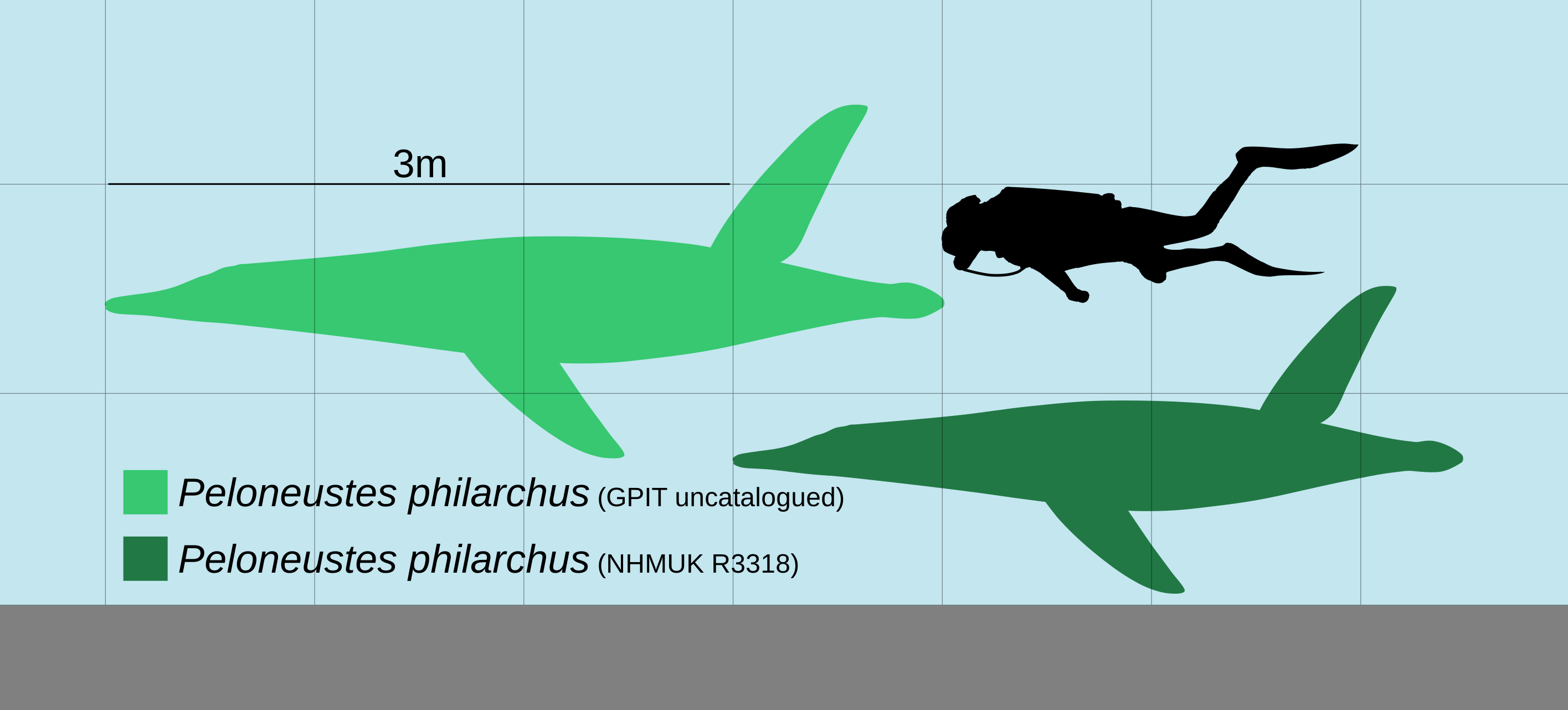
Liopleurodon ferox was a pliosaur, a predatory marine reptile from the Middle to Late Jurassic seas that covered Europe around 166 to 155 million years ago. It was not a dinosaur: it belongs to Sauropterygia, a fully aquatic lineage with four paddle-shaped flippers, a short neck, and an elongated skull. Recent studies estimate a typical body length between 5 and 7 meters, far from the 25 meters depicted in the BBC documentary Walking with Dinosaurs (1999). The name means 'smooth-sided teeth', referring to the enamel ridges on the tooth crown. It was an apex predator of the epicontinental seas, feeding on fish, cephalopods, and other marine reptiles, as shown by preserved stomach contents. The holotype, described by Henri Sauvage in 1873, is a single tooth from the Boulogne-sur-Mer region of France; the species' identity has been progressively refined through decades of taxonomic work.
Geological formation & environment
Liopleurodon ferox is predominantly known from the Oxford Clay Formation (middle to upper Callovian), especially the Peterborough Member, which crops out in eastern England (Peterborough, Yorkshire, Wiltshire). Referred material also comes from northern and central France, Germany, Switzerland, and possibly Russia and Poland. The Oxford Clay is a shallow, epicontinental sea deposit, formed in shallow to medium-depth waters of the ancient northern Tethys Sea, with variable oxygenation that favored the preservation of marine vertebrate fossils. Its paleontological content includes ophthalmosaurid ichthyosaurs (Ophthalmosaurus), long-necked plesiosaurs (Cryptoclidus, Muraenosaurus), other pliosaurs (Peloneustes, Simolestes), marine crocodylomorphs, the giant bony fish Leedsichthys, and abundant ammonites and belemnites. The formation is one of the best windows on the Middle Jurassic marine world in the global record.
Image gallery
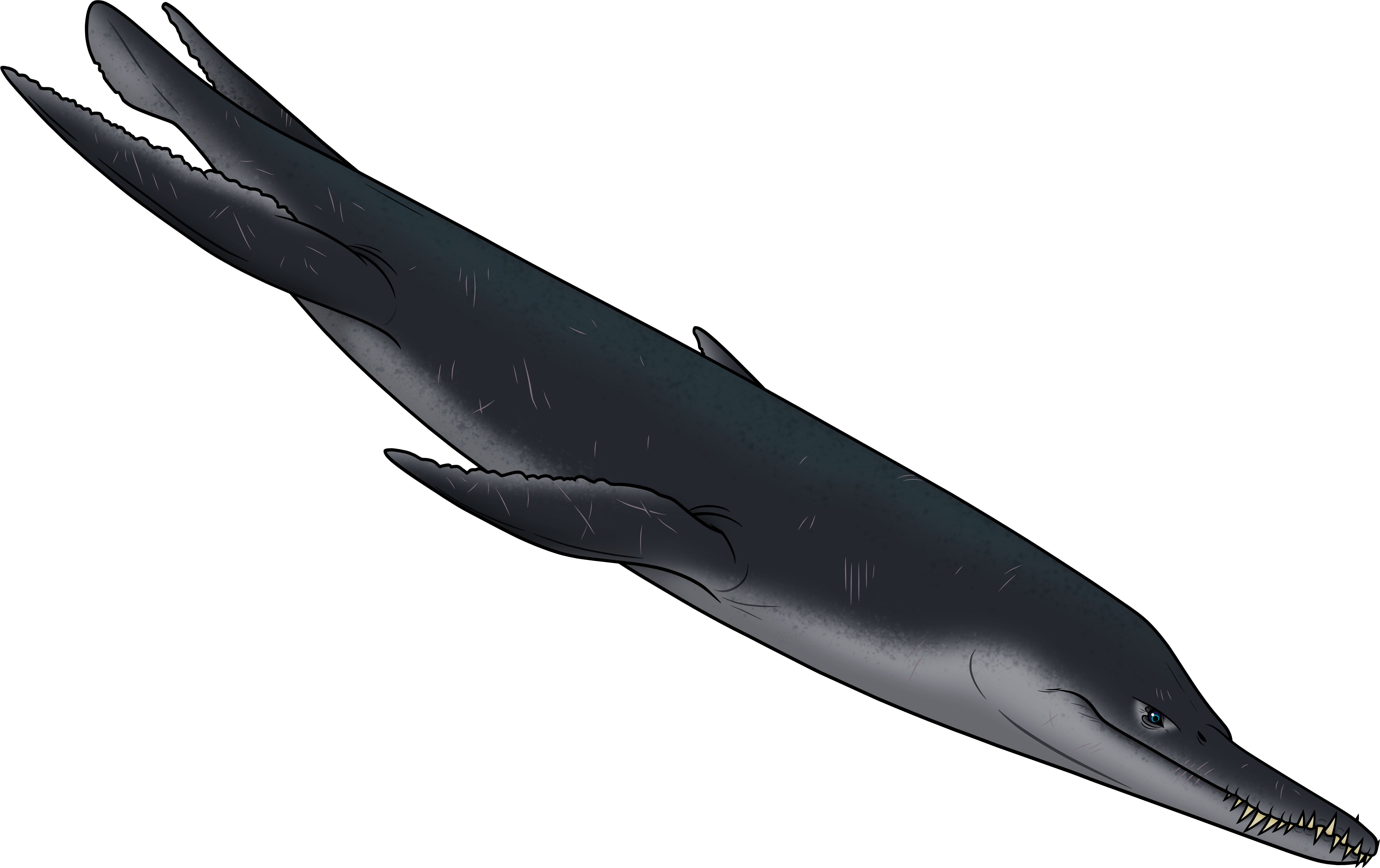
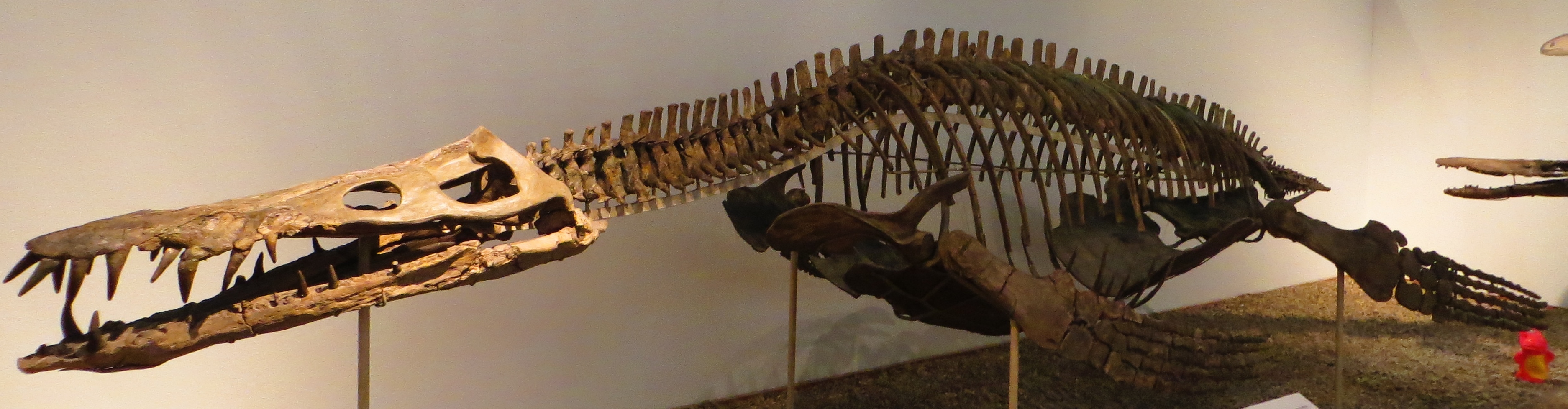


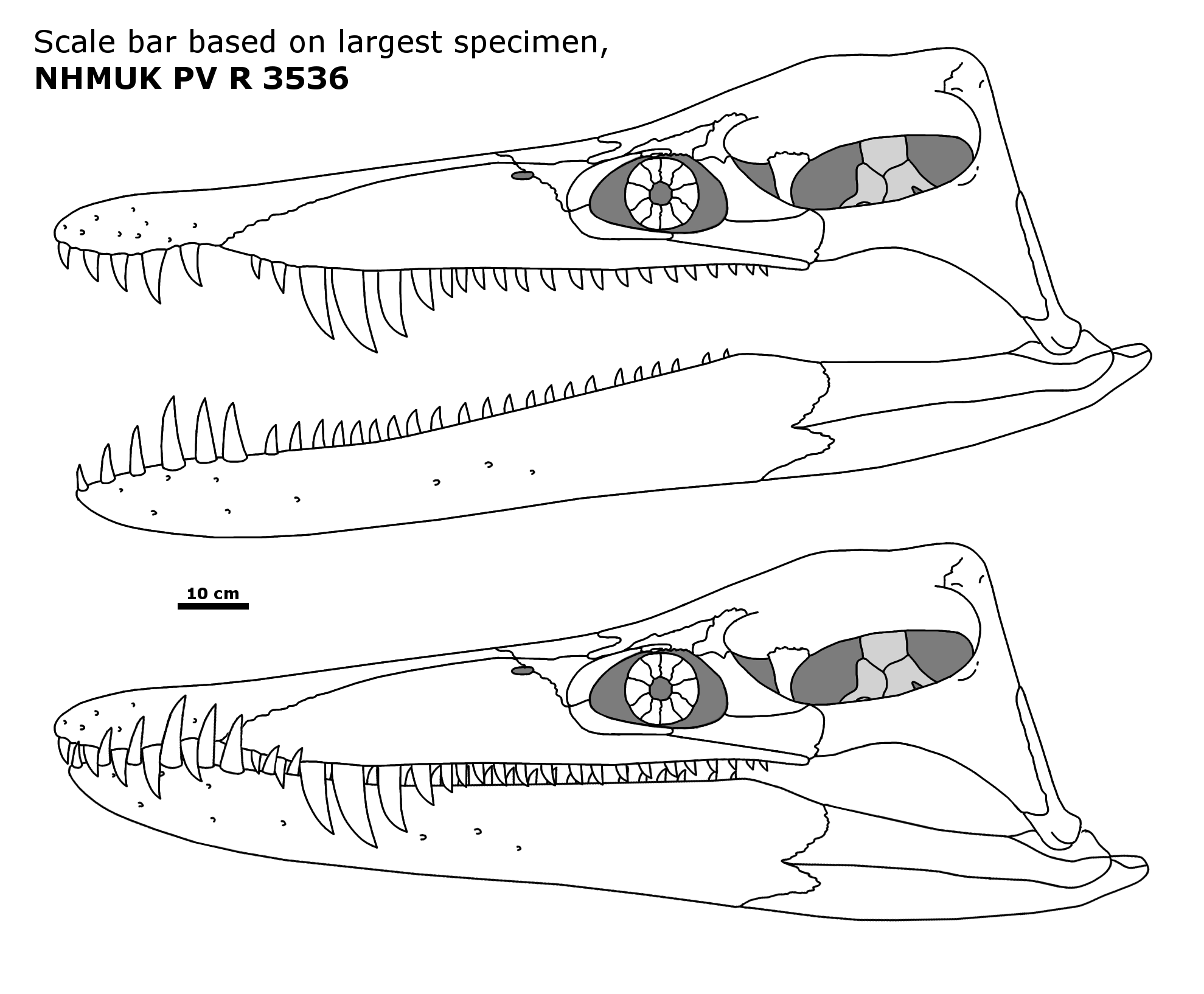
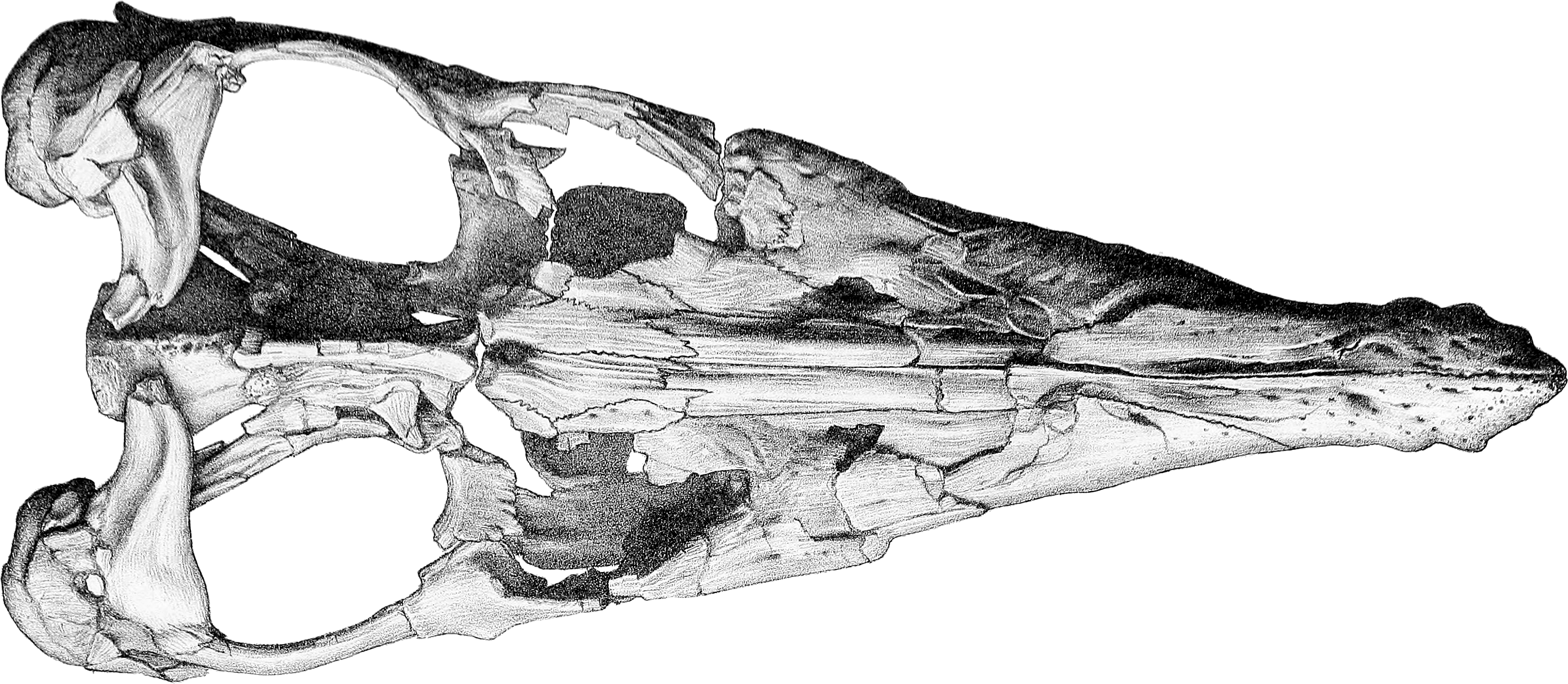


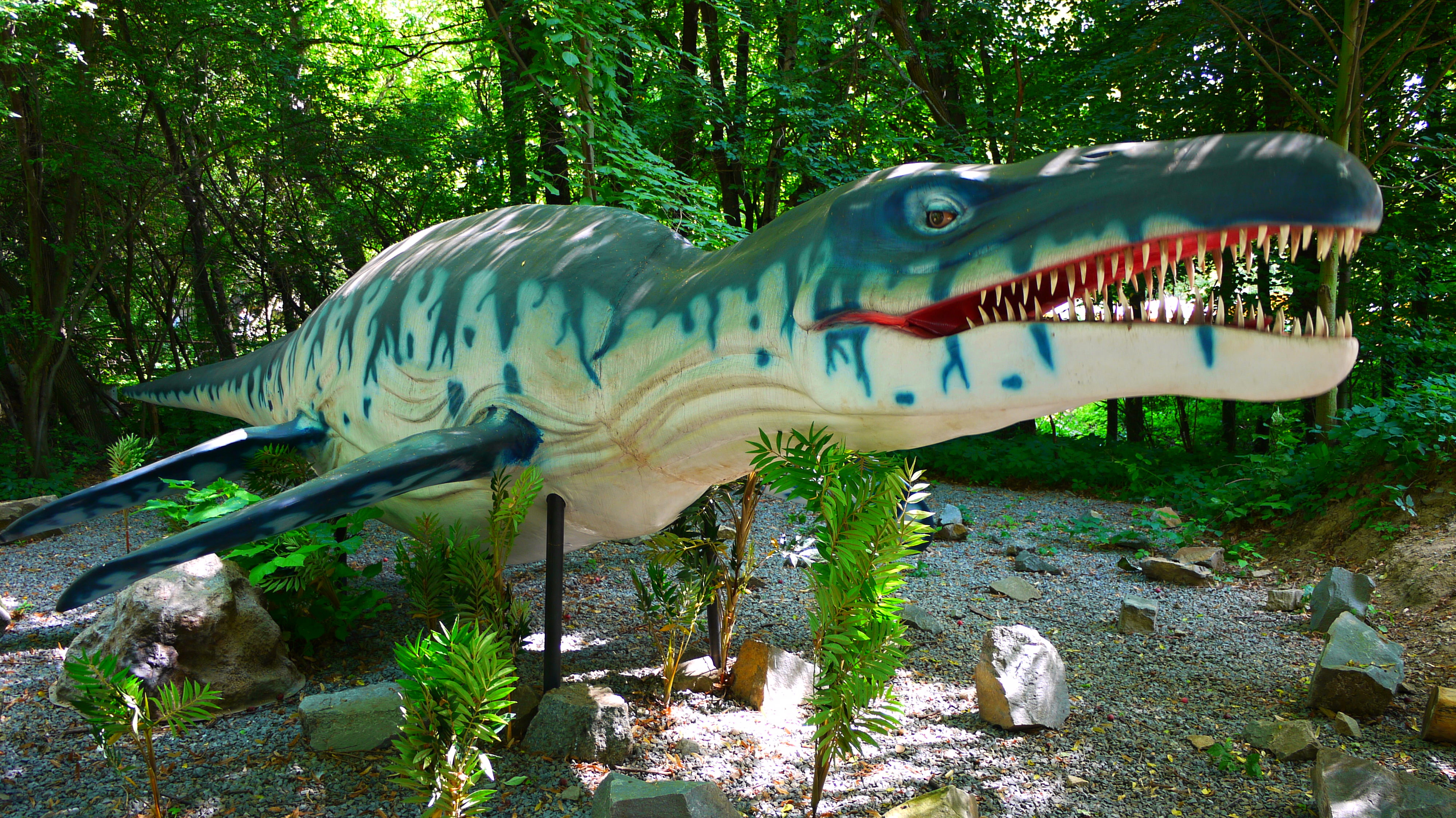


Modern life reconstruction of Liopleurodon ferox by Cody Lake (2025). Proportions based on Oxford Clay specimens and recent taxonomic revisions, with a robust body, elongate skull, and four large flippers.
Cody Lake, CC BY 4.0
Ecology and behavior
Habitat
Liopleurodon ferox lived in shallow, warm epicontinental seas of the Middle to Late Jurassic, which covered much of Europe and formed part of the Tethys Ocean. The main deposits are in the Oxford Clay Formation (England) and in Callovian sediments from France, Germany, Switzerland, and possibly Russia and Poland. It was a warm marine environment, with surface temperatures estimated above 20°C, rich in cephalopods (belemnites, ammonites), large bony fish such as Leedsichthys, ophthalmosaurid ichthyosaurs, long-necked plesiosaurs (Cryptoclidus), small pliosaurs (Peloneustes, Marmornectes), and metriorhynchid marine crocodylomorphs (Metriorhynchus, Cricosaurus) (Martill et al., 1994). Paleogeography places these seas at subtropical latitudes of the ancient Tethys Ocean.
Feeding
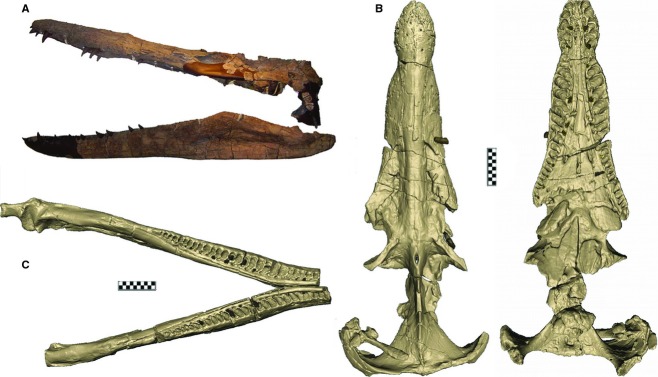
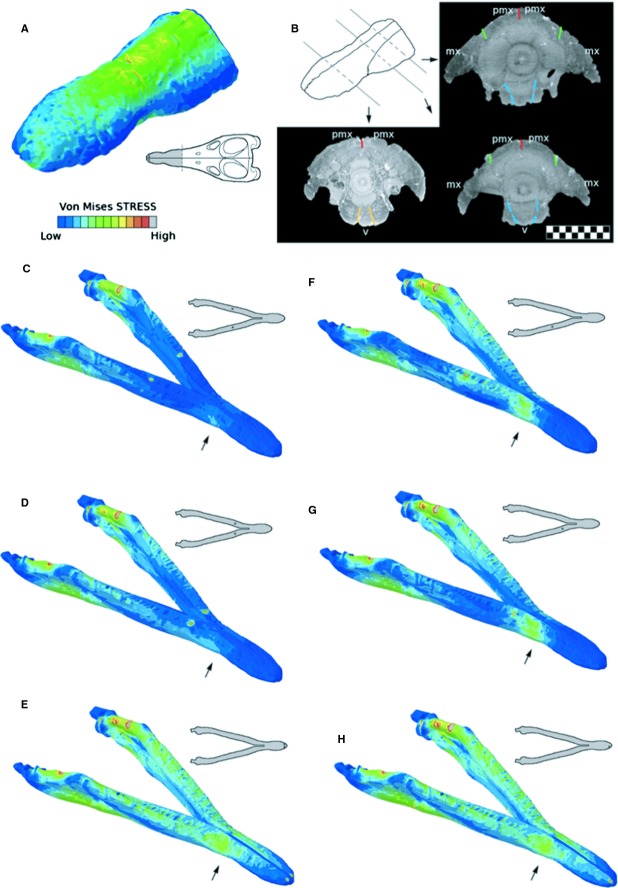
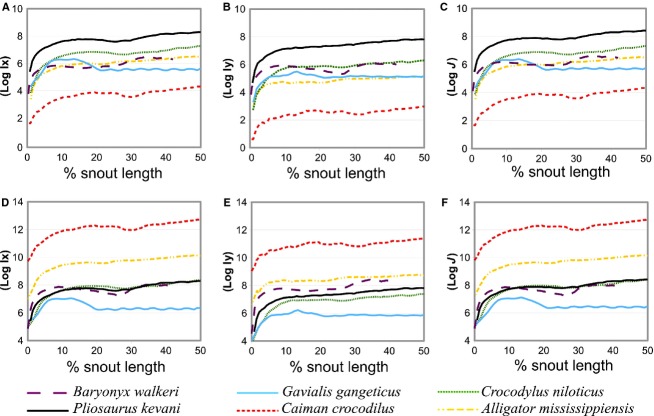
Liopleurodon ferox was a generalist apex predator. Stomach contents directly preserved in specimen PETCM R.296 include keratinous hooklets of teuthoid cephalopods, fish bones, and a reptilian tooth (Martill, 1992). The robust conical dentition with two cutting carinae fits the 'cut' functional guild defined by Massare (1987), indicating the ability to pierce and slice large prey. Jaw biomechanics studied in Pliosaurus kevani, a close phylogenetic relative, yield posterior bite forces of 28,000 to 48,000 N (Foffa et al., 2014), compatible with crushing hard prey. The snout was poorly optimized against torsion, so L. ferox probably did not twist prey like modern crocodilians: it bit and processed near the jaw joint.
Behavior and senses
The behavior of Liopleurodon ferox is inferred from anatomy and modern ecological analogs. Binocular overlap, assessed in general pliosaur studies, indicates some depth perception capability needed for active hunting. The internal nostrils (choanae) have a structure compatible with directional underwater olfaction, taking advantage of water flow during swimming, a feature used as a derived trait of pliosaurids and possibly employed to follow chemical trails from prey. It was probably a solitary, stealthy hunter, using large flippers to accelerate rapidly in short bursts. There is no direct evidence of social or parental behavior preserved in L. ferox specimens; for an aquatic animal, such evidence is rare across the entire group (Ketchum & Benson, 2010).
Physiology and growth
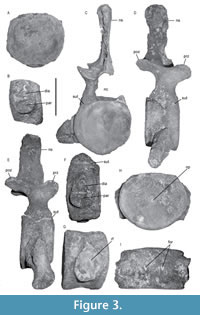
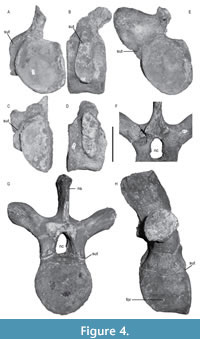
Liopleurodon ferox was fully adapted to aquatic life: fusiform body, four flippers modified into paddles, short neck, and relatively small tail. Locomotion was by 'underwater flight', propulsion via the four flippers moved in alternation, a pattern investigated in pliosaurs and other plesiosaurs. Histological studies on plesiosaurs suggest relatively fast growth and endothermic or mesothermic metabolism, incompatible with modern ectothermic reptiles. Birth was probably viviparous, in direct analogy to other plesiosaurs with preserved embryos. Cervical vertebrae anatomy displays paedomorphosis: the lack of fusion between neural arch and centrum, previously interpreted as juvenile, occurs in adult individuals of the species (Vincent et al., 2024). Typical adult length is 5 to 7 meters, with estimated weight between 1.5 and 2 tonnes (McHenry, 2009).
Paleogeography
Continental configuration

Ron Blakey · CC BY 3.0 · Jurassic, ~90 Ma
During the Caloviano a Oxfordiano (~166–155 Ma), Liopleurodon ferox inhabited the fragmenting Pangea. North America and Europe were still close, and the North Atlantic was just beginning to open. Climate was warm and humid globally, with no polar ice caps.
Bone Inventory
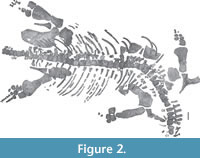
The holotype, BHN 3R 197, is only a single tooth with a 7.5 cm crown, preserved at the Musée d'histoire naturelle de Lille. The ~45% completeness estimate comes from the composite of multiple referred specimens: the Tübingen mounted skeleton (GPIT 1754/2), Leeds Collection material at the Natural History Museum in London, and the new postcranial skeleton described by Vincent et al. (2024) from the Callovian of central France. The fragmentary nature of the type material has led recent researchers to suggest the designation of a neotype to preserve the species' validity (Madzia et al., 2022).
Found elements
Inferred elements
Scientific Literature
15 papers in chronological order — from the original description to recent research.
Notes sur les reptiles fossiles
Sauvage, H.E. · Bulletin de la Société Géologique de France, série 3, vol. 1
The founding paper of the species. Sauvage describes three taxa in the new genus Liopleurodon based on isolated teeth from the Callovian of northern France: L. ferox (type species), L. pachydeirus, and L. grossouvrei. The diagnostic material is a single tooth roughly 7.5 cm long, preserved today as BHN 3R 197 at the Musée de Lille. The genus name references the smooth sides of the tooth crown, in contrast to the faceted teeth of other contemporary pliosaurs. The description is short and sparse by modern standards, but it establishes the genus and type species. The typological basis of a single tooth would generate taxonomic controversy for over 140 years, with later studies reclassifying species and proposing the need for a neotype.
A descriptive catalogue of the marine reptiles of the Oxford Clay, based on the Leeds Collection in the British Museum (Natural History), Part II
Andrews, C.W. · Trustees of the British Museum, London (monografia, 206 páginas, 13 pranchas)
Part II of the catalogue that Charles William Andrews dedicated to the marine reptiles of the British Oxford Clay, based on Alfred Nicholson Leeds' collection. Andrews systematically described several specimens referred to Liopleurodon ferox, with cranial and postcranial bones illustrated in lithographic plates by G. M. Woodward. The monograph became the primary anatomical reference for Callovian English pliosaurs for decades and is still cited in modern taxonomic and phylogenetic work. It popularized the image of L. ferox as a large apex predator of Oxford Clay seas, with a robust skull, conical serrated dentition, and four powerful flippers. Andrews also compared the English material to the French specimens described by Sauvage, confirming the species' presence on both sides of the English Channel.
A review of the Upper Jurassic pliosaurs
Tarlo, L.B. · Bulletin of the British Museum (Natural History), Geology
A systematic review of Upper Jurassic pliosaurs based on British material, published by Lambert Beverly Halstead under the pseudonym Tarlo. The work recognizes Liopleurodon as a genus distinct from Pliosaurus, noting clear differences in mandibular and dental morphology. Tarlo distinguishes L. ferox from L. pachydeirus by tooth cross-section (circular in L. ferox, more pachystyloid in L. pachydeirus) and by cervical vertebral shape. The review established the taxonomic framework that dominated pliosaur systematics for over four decades, until the revisions by Noè (2001) and Madzia et al. (2022). Tarlo also proposes skeletal reconstructions that would influence the visual depiction of L. ferox in museums and documentaries for much of the 20th century.
Tooth morphology and prey preference of Mesozoic marine reptiles
Massare, J.A. · Journal of Vertebrate Paleontology
One of the most cited works in Mesozoic marine reptile paleoecology. Judy Massare analyzed the dental morphology of ichthyosaurs, plesiosaurs, pliosaurs, and mosasaurs, defining seven functional guilds based on tooth shape. Pliosaurs, including Liopleurodon, were placed in the 'cut' guild, characterized by robust conical teeth with two cutting carinae, indicating a diet focused on large, active prey such as fish, cephalopods, and other marine reptiles. The analysis combined tooth shape, wear, and rare stomach contents. The work established a framework replicated in all later studies of marine paleoecology and provided the first functional evidence that L. ferox was a generalist apex hunter, not specialized in any single prey type.

Pliosaur stomach contents from the Oxford Clay
Martill, D.M. · Mercian Geologist
One of the rare paleontology studies providing direct evidence of an extinct predator's diet: David Martill examined stomach contents preserved within pliosaur specimens from the Peterborough Member of the Oxford Clay. Specimen PETCM R.296, attributed to L. ferox, contained abundant keratinous hooklets of teuthoid cephalopods (squid-like), fish bones, and a single reptilian tooth. The evidence indicates L. ferox was not a dietary specialist but a generalist hunter, consuming what it encountered in the Jurassic seas: agile fish, deep-ocean cephalopods, and occasionally other marine reptiles, possibly small long-necked plesiosaurs or juvenile ichthyosaurs. This pattern confirms the functional analysis of Massare (1987) and establishes L. ferox as the apex predator of the European epicontinental seas.
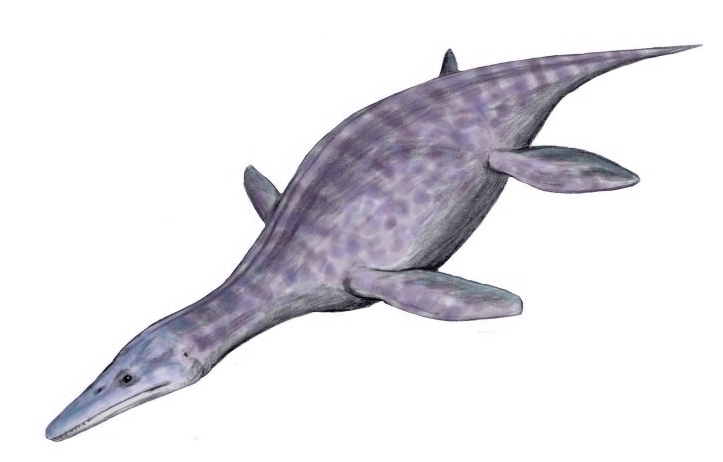
The trophic structure of the biota of the Peterborough Member, Oxford Clay Formation (Jurassic), UK
Martill, D.M., Taylor, M.A., Duff, K.L., Riding, J.B. & Bown, P.R. · Journal of the Geological Society
Quantitative reconstruction of the trophic structure of the Peterborough Member of the Oxford Clay, covering from phytoplankton to large apex reptiles. The authors integrated data from nannoplankton, palynology, invertebrates, fish, and marine reptiles to map the food chain of a Callovian epicontinental marine ecosystem. Liopleurodon ferox is identified as the absolute apex predator, hunting large fish such as Leedsichthys, cephalopods, other marine reptiles (ichthyosaurs, plesiosaurs), and marine crocodylomorphs (Metriorhynchidae). The paper lays the foundation for understanding L. ferox's ecological role: not just a powerful hunter but a key regulator of prey population dynamics in the European Middle Jurassic seas. It became a standard reference for all subsequent work on Oxford Clay paleoecology.


A taxonomic and functional study of the Callovian (Middle Jurassic) Pliosauroidea (Reptilia, Sauropterygia)
Noè, L.F. · PhD Thesis, University of Derby
Highly influential doctoral thesis in pliosaur systematics. Leslie F. Noè conducted the most comprehensive taxonomic revision of the genus Liopleurodon up to that point, based on material from Callovian deposits in England, France, and Germany. Main conclusions: (1) L. pachydeirus is considered a junior synonym of L. ferox; (2) 'L.' macromerus should be returned to Pliosaurus; (3) 'L.' rossicus likely warrants its own genus. Result: Liopleurodon becomes a monospecific genus, with L. ferox as its only valid species. The thesis also includes detailed functional analyses of the skull, jaw mechanics, and feeding behavior. It was never published as a formal paper, but is continuously cited in all modern pliosaur literature. Noè's taxonomic simplification guides all subsequent work on the group.

The first relatively complete exoccipital-opisthotic from the braincase of the Callovian pliosaur, Liopleurodon
Noè, L.F., Liston, J. & Evans, M. · Geological Magazine
The first relatively complete exoccipital-opisthotic of Liopleurodon, a crucial braincase bone, recovered from the Peterborough Member of the Oxford Clay. Before this description, the posterior region of the L. ferox skull was known only from fragments. The element provides new anatomical information on the inner ear region and basicranium, with implications for understanding sensory orientation and underwater hearing in the group. Noè, Liston, and Evans also revisit the functional interpretation of the cranio-cervical joint, important for rapid head movement during hunting. The find reinforces the hypothesis that L. ferox had specific auditory and vestibular adaptations for marine life, essential in an active apex predator in low-visibility environments.
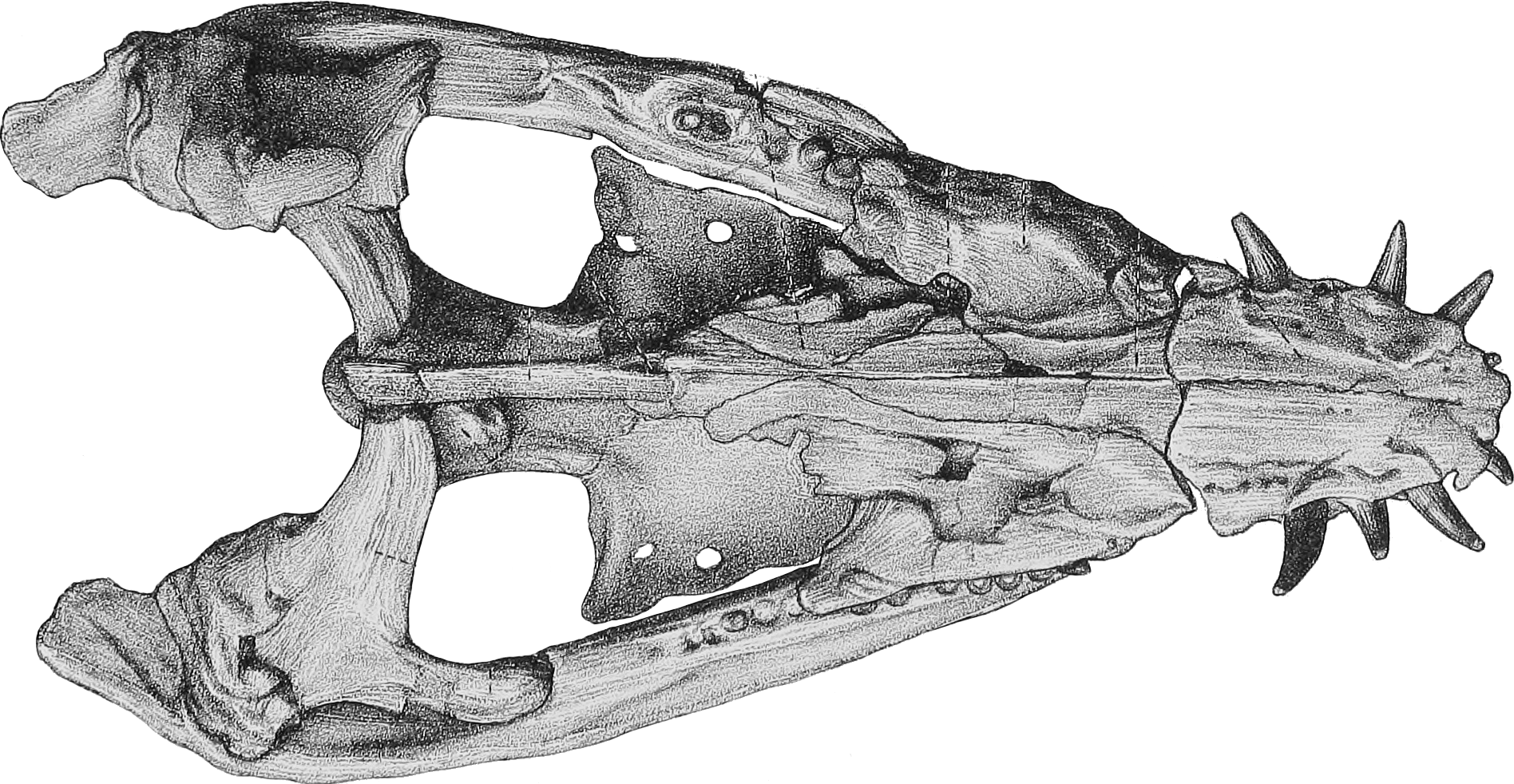

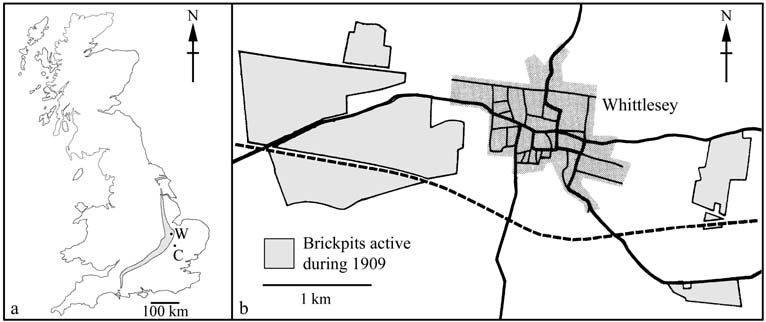
Devourer of Gods: The palaeoecology of the Cretaceous pliosaur Kronosaurus queenslandicus
McHenry, C.R. · PhD Thesis, University of Newcastle, Australia
Colin McHenry's thesis on the Cretaceous pliosaur Kronosaurus queenslandicus that also became the modern reference for size estimates across Pliosauridae. McHenry applied biomechanical methods and allometric scaling to the fragmentary material historically attributed to giant pliosaurs, including L. ferox. Definitive conclusion: L. ferox specimens are typically 5 to 7 meters long. The largest examples may reach around 8 meters. The thesis dismantles the 25 meters popularized by Walking with Dinosaurs (BBC, 1999), which had extrapolated size from misidentified isolated vertebrae. After McHenry, any claim about L. ferox must treat it as a large but not gigantic predator, closer in size to an orca than to a whale.
Global interrelationships of Plesiosauria (Reptilia, Sauropterygia) and the pivotal role of taxon sampling in determining the outcome of phylogenetic analyses
Ketchum, H.F. & Benson, R.B.J. · Biological Reviews
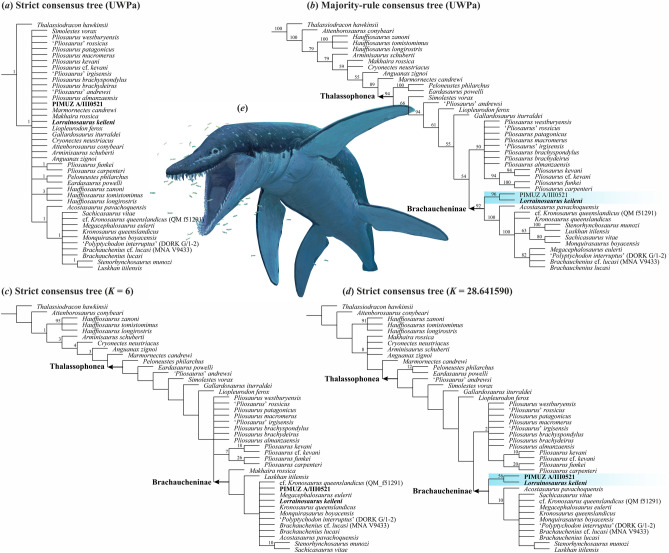
Global phylogenetic analysis of Plesiosauria based on 66 taxa and 178 characters. Ketchum and Benson reconstructed relationships within Plesiosauria, erecting the clade Neoplesiosauria for the Plesiosauroidea + Pliosauroidea pair. Liopleurodon ferox is recovered within a clade of derived thalassophonean pliosaurids, close to Simolestes, Peloneustes, and Pliosaurus. The work demonstrated that differences between previous phylogenetic hypotheses are not caused by genuine character disagreement but by unequal taxon sampling; when sampling is broad and systematic, results converge. The published matrix became the basis for virtually every subsequent plesiosaur phylogenetic analysis, including Benson & Druckenmiller (2014), Sachs et al. (2023), and Vincent et al. (2024).

Faunal turnover of marine tetrapods during the Jurassic-Cretaceous transition
Benson, R.B.J. & Druckenmiller, P.S. · Biological Reviews
Analysis of marine tetrapod faunal turnover across the Jurassic-Cretaceous boundary. Roger Benson and Patrick Druckenmiller expanded the framework of Ketchum and Benson (2010) with new characters and taxa, and erected the clade Thalassophonea to house the derived short-necked pliosaurids. The phylogenetic definition is: 'all taxa more closely related to Pliosaurus brachydeirus than to Marmornectes candrewi'. Liopleurodon ferox is recovered as a central component of the clade, near Peloneustes and Simolestes. The paper documents faunal turnover at the end of the Jurassic: decline of ophthalmosaurid ichthyosaurs, extinction of many plesiosaur lineages, and selective survival of pliosaurids, which would continue dominating Early Cretaceous seas with Kronosaurus and relatives.

Functional anatomy and feeding biomechanics of a giant Upper Jurassic pliosaur (Reptilia: Sauropterygia) from Weymouth Bay, Dorset, UK
Foffa, D., Cuff, A.R., Sassoon, J., Rayfield, E.J., Mavrogordato, M.N. & Benton, M.J. · Journal of Anatomy
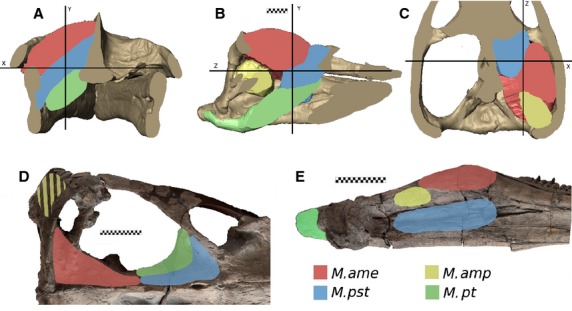
Biomechanical study of the skull of a large Upper Jurassic pliosaur (Pliosaurus kevani), applicable by direct comparison to Liopleurodon ferox. Using computed tomography, finite element modelling, and beam theory, Foffa and colleagues estimated bite force: 9,600 to 17,000 N at the anterior mandible and 28,000 to 48,000 N at the posterior mandible. For comparison, Tyrannosaurus rex exerts between 35,000 and 57,000 N. The authors also found that the pliosaurian snout was poorly optimized against torsion, implying these animals did not twist or shake prey (as modern crocodilians do). They preferred to bite and process near the jaw joint. This result applies directly to L. ferox, whose skull geometry is similar to that of P. kevani, and clarifies the species' feeding mode.

Historical significance and taxonomic status of Ischyrodon meriani (Pliosauridae) from the Middle Jurassic of Switzerland
Madzia, D., Sachs, S. & Klug, C. · PeerJ
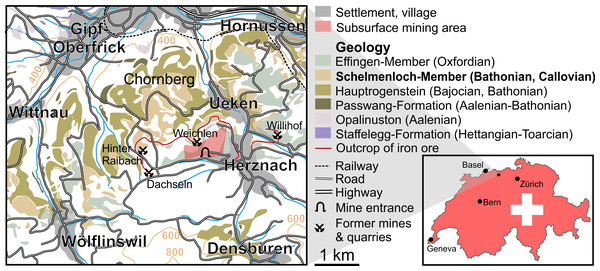
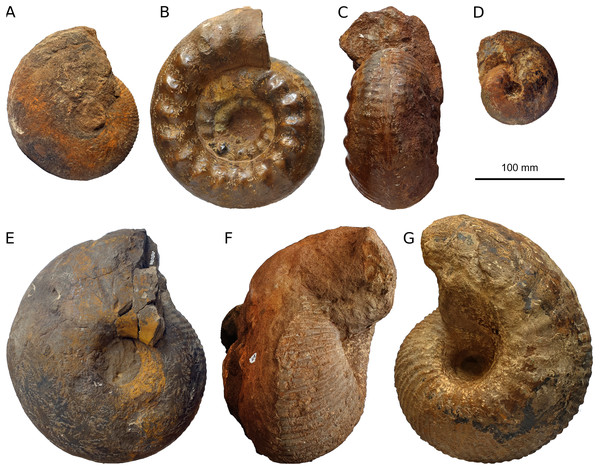
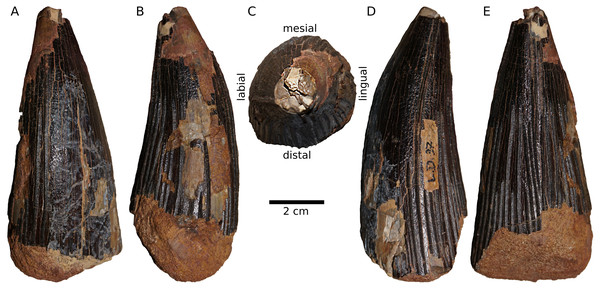
Taxonomic revision of the pliosaurid taxon Ischyrodon meriani from the Callovian of Switzerland, based on a large tooth from the Wölflinswil region. Historically, I. meriani was associated with both Pliosaurus macromerus and Liopleurodon ferox. Madzia, Sachs, and Klug applied multivariate analyses of dental morphology and concluded the taxon is most similar to L. ferox and probably represents the same species. However, the fragmentary type material of both (one tooth each) prevents formal synonymy. The authors explicitly recommend designating a neotype for L. ferox to preserve the species' nomenclatural stability. This is one of the most important points in modern Liopleurodon systematics: the species lacks diagnostic type material, which may lead to future taxonomic problems.


The rise of macropredatory pliosaurids near the Early-Middle Jurassic transition
Sachs, S., Madzia, D., Thuy, B. & Kear, B.P. · Scientific Reports
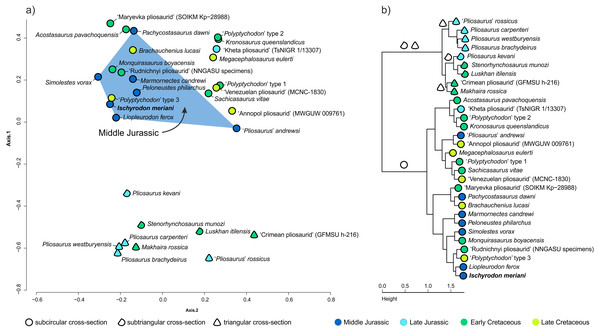
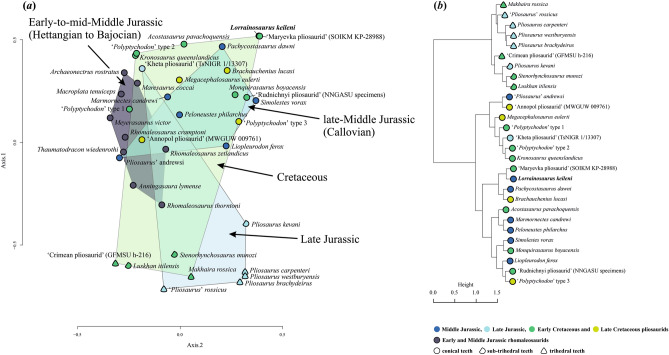
Description of the new genus Lorrainosaurus keileni, a macropredatory pliosaurid from the Bajocian (early Middle Jurassic) of French Lorraine. Sachs and colleagues showed that pliosaurids attained large size and robust dentition as early as the beginning of the Middle Jurassic, around 171 million years ago, much earlier than previously thought. Phylogenetic and dental-morphospace analyses place Lorrainosaurus at the base of the thalassophonean radiation, while Liopleurodon ferox emerges as one of the derived macropredators that inherited this ecomorphospace. The work establishes an ~80-million-year dynasty of pliosaurids at the top of the marine food chain, from the Bajocian to the Turonian. L. ferox is mentioned multiple times as an anatomical reference for the group's skull and dentition and integrates the comparative morphospace analyses.
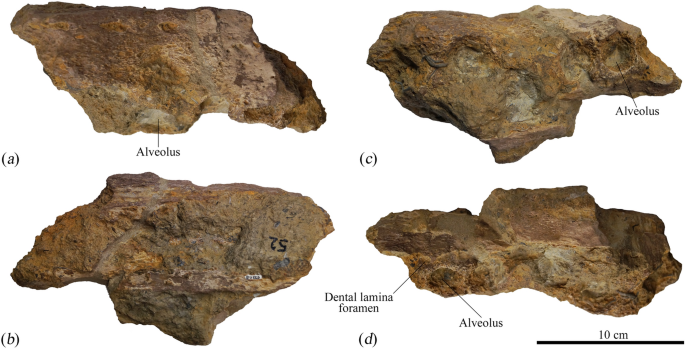
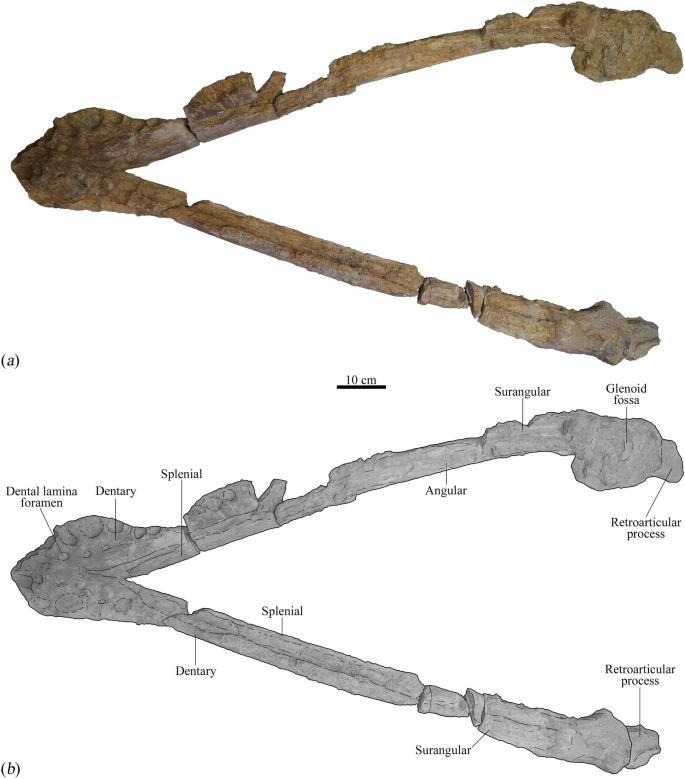
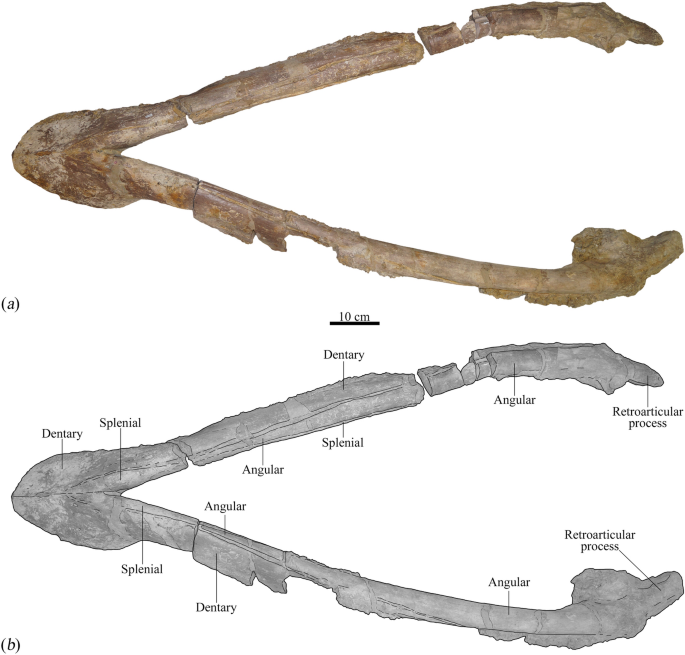
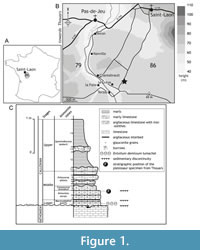
New remains of Liopleurodon (Reptilia, Plesiosauria) from the Middle Jurassic of western France and paedomorphosis within pliosaurids
Vincent, P., Poncet, D., Rard, A., Robin, J.-P. & Allemand, R. · Palaeontologia Electronica
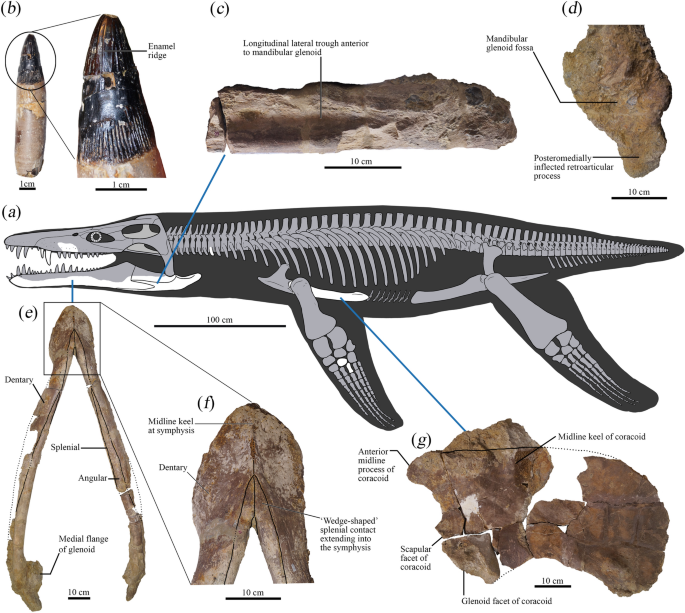
Description of a new Liopleurodon ferox specimen from the Callovian of central France, representing one of the most complete postcranial skeletons ever known for the species. Vincent and colleagues documented vertebrae, girdle bones, and flippers, extending the taxon's geographic distribution southward in France, the southernmost record so far. Osteological analysis yielded an important conclusion for pliosaurian ontogeny: the lack of fusion between cervical neural arches and their centra, traditionally seen as a juvenile indicator, is not a reliable age marker but rather a paedomorphic feature in adults, a juvenile trait retained into adulthood. The paper has significant taxonomic implications: many specimens previously judged juvenile may actually be adults; this should reopen reviews of material previously considered indeterminate.

Famous museum specimens
Holótipo BHN 3R 197 (dente-tipo)
Musée d'histoire naturelle de Lille, França
Tooth crown about 7.5 cm long, basis of Sauvage's original 1873 description. Because it is insufficient for unambiguous species diagnosis, Madzia et al. (2022) formally recommended the designation of a neotype.
GPIT 1754/2 (esqueleto quase completo)
Geologisch-Paläontologisches Institut, Universidade de Tübingen, Alemanha
Discovered in the early 20th century. Mounted as a ~5 meter long skeleton, combining original Oxford Clay bones with restored parts. Main anatomical reference for Liopleurodon ferox for nearly a century and basis for historical reconstructions like Newman and Tarlo (1967).
NHMUK R3536 (esqueleto parcial, Leeds Collection)
Natural History Museum, Londres, Reino Unido
Discovered in the late 19th century. Specimen referred to Liopleurodon ferox preserving cranial and postcranial material from the English Oxford Clay (Peterborough Member, Callovian). Described by Andrews (1913), it is the key Leeds Collection material at the Natural History Museum and the basis of comparison for virtually all subsequent studies of the species.
In cinema and popular culture
Few extinct species have had a pop-culture moment as vivid as Liopleurodon ferox. The turning point came in 1999, when the BBC documentary 'Walking with Dinosaurs' introduced it as a 25-meter, 150-tonne 'super-predator' in the episode 'Cruel Sea'. The image stuck in the collective imagination of an entire generation, even though it was based on extrapolations from misidentified isolated vertebrae. The show's paleo consultant, David Unwin, later admitted the BBC picked the extreme figure because 'it was more spectacular'. Four years later, 'Sea Monsters: A Walking with Dinosaurs Trilogy' (2003) reused the same iconography, with host Nigel Marven diving beside the animal and using a chemical repellent to drive it off. Later series such as 'Monsters Resurrected' (2009) and 'Planet Dinosaur' (2011) reflected scientific progress, showing the animal smaller and more nuanced in behavior, though still above current consensus. The 'You can see Liopleurodon in 3D' meme from the internet cartoon 'Charlie the Unicorn' (2005) helped keep the species relevant in digital culture. In contemporary paleoart, the animal is depicted ever more faithfully to the science: a 5 to 7 meter pliosaur, hydrodynamic body, relatively small eyes, no exposed teeth. L. ferox is, therefore, simultaneously a pop star and a textbook case of the gap between television spectacle and actual fossil data.
Classification
Discovery
Fun fact
The real Liopleurodon ferox was 5 to 7 meters long, not the 25 meters shown in the BBC's 1999 'Walking with Dinosaurs' documentary. The show's own paleontology consultant, David Unwin, later stated that the BBC picked the extreme figure because it was 'more spectacular': the real size was comparable to a large orca, not a blue whale.
Last reviewed: April 24, 2026