
Rhomaleosaurus
Rhomaleosaurus cramptoni
"Crampton's robust lizard"
About this species
Rhomaleosaurus cramptoni was a basal pliosauroid of the Early Jurassic, about 7 meters long with a skull roughly 88 centimeters in length. It was not a dinosaur but a marine reptile of the family Rhomaleosauridae, the dominant predatory group of early Jurassic seas. The type skeleton, now in the National Museum of Ireland – Natural History in Dublin, was unearthed in 1848 by alum quarry workers at Kettleness, Yorkshire coast, England. Carte and Baily described it in 1863 as Plesiosaurus cramptoni; Harry Seeley reclassified it in 1874, erecting the genus Rhomaleosaurus. The animal combined the relatively hydrodynamic body of a plesiosaur with the large head and robust jaws of a pliosaur, occupying the niche of a versatile mid-sized apex predator.
Geological formation & environment
The Rhomaleosaurus cramptoni holotype was found in the Alum Shale Member of the Whitby Mudstone Formation at Kettleness on the Yorkshire coast, England. The Whitby Mudstone is a Toarcian formation (183 to 178 Ma) of the Cleveland Basin, composed of dark marine shales rich in organic matter, deposited in a shallow, low-energy epicontinental sea with an anoxic seafloor. The anoxia prevented invertebrate bioturbation and allowed the exceptional preservation of articulated skeletons of marine vertebrates: ichthyosaurs (Stenopterygius), plesiosaurs (Rhomaleosaurus), marine crocodiles (Teleosaurus), along with ammonites, belemnites, and fish. Historical alum mining from the 17th century, responsible for the discovery of many fossils, ended around 1871 at Kettleness.
Image gallery
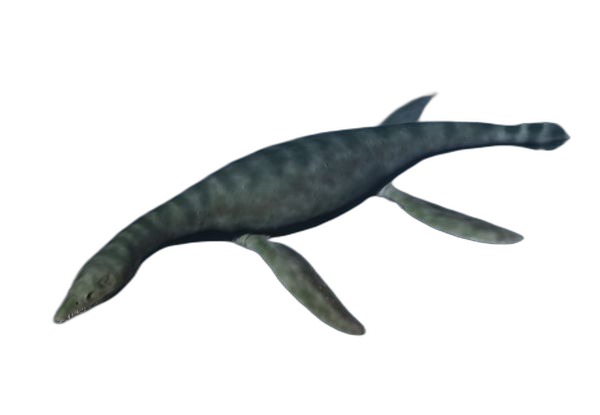


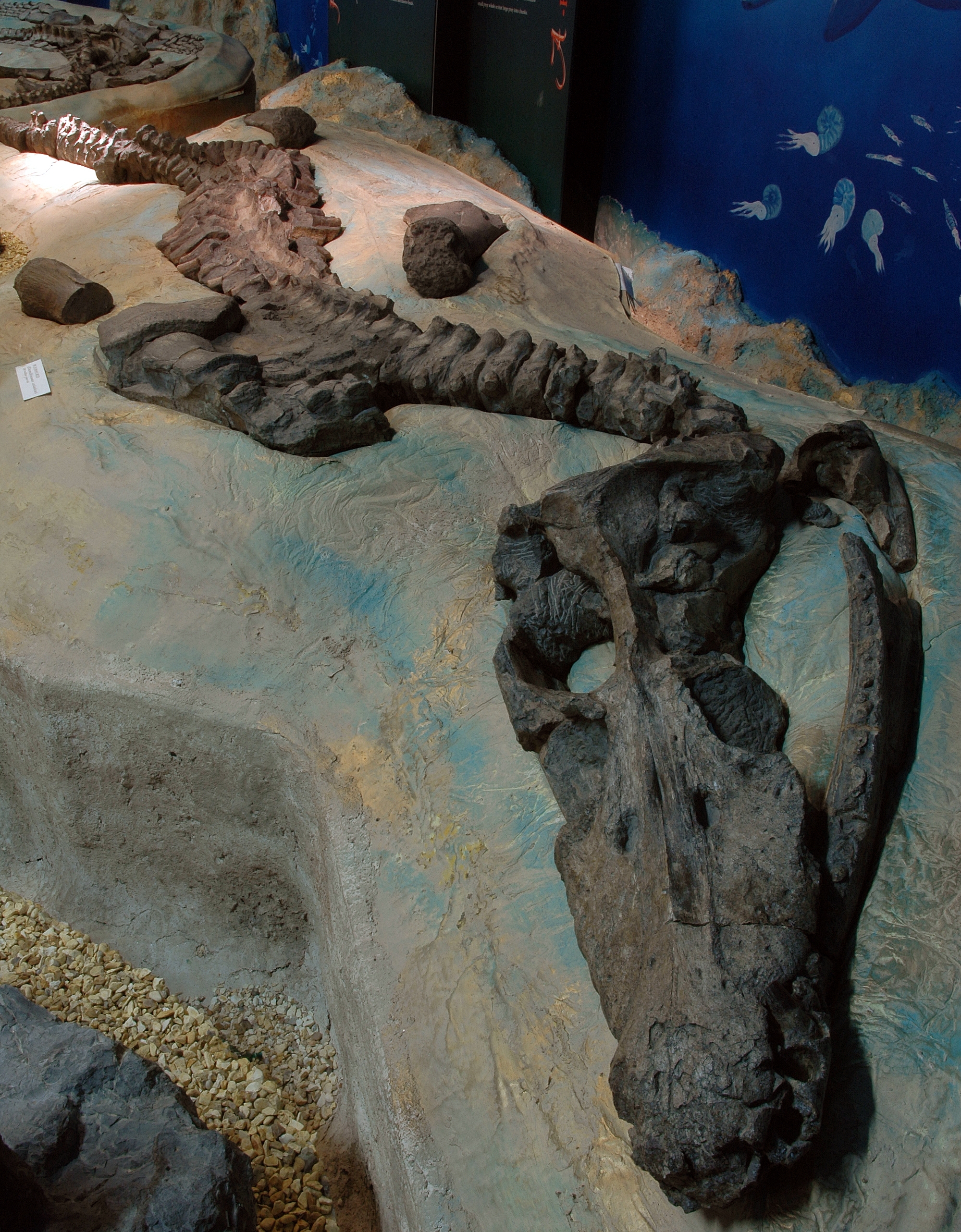


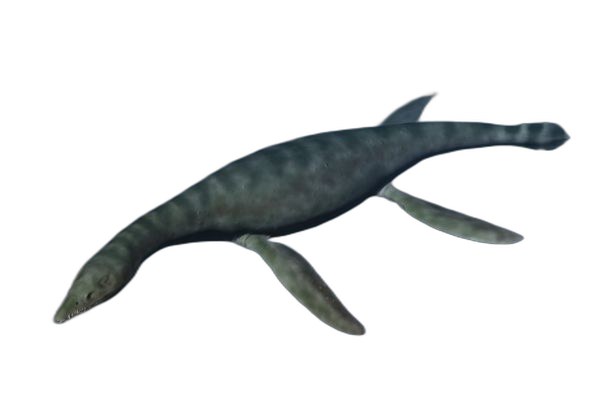
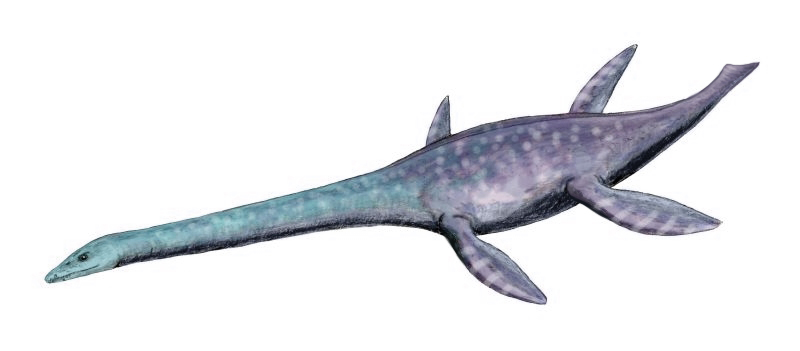
Life reconstruction of Rhomaleosaurus cramptoni by Nobu Tamura, with background removed for hero composition. Highlights the robust body, large head, and paddle-shaped limbs characteristic of rhomaleosaurids, apex predators of the Early Jurassic British seas.
Nobu Tamura, CC BY-SA 3.0
Ecology and behavior
Habitat
Rhomaleosaurus cramptoni lived in the shallow epicontinental sea covering northern and central Europe during the Toarcian (Early Jurassic, 183 to 178 Ma). The Cleveland Basin, in what is now Yorkshire, was a tropical to subtropical sea of moderate depth (a few tens of meters), with an anoxic seafloor most of the time. That anoxia is responsible for the exceptional preservation of marine vertebrates in the Whitby Mudstone Formation and also in the Posidonienschiefer of Holzmaden, Germany, where the close relative Meyerasaurus lived. The associated fauna included ichthyosaurs such as Stenopterygius, other smaller pliosauroids, marine crocodylomorphs of the Teleosaurus type, ammonites (Harpoceras, Dactylioceras), and large fish.
Feeding
R. cramptoni was an active mid-sized predator, probably piscivorous with opportunistic generalization. The elongate jaws, about 88 cm long with conical, slightly recurved teeth, were suited for capturing fish and cephalopods in fast strikes, but could also handle larger prey in ambush, such as small ichthyosaurs and other smaller plesiosaurs. Taylor's (1992) functional study of R. zetlandicus, applicable by extension, shows that skull and mandible operated as box-girder beams, adapted to resist high bending moments, which allows a powerful bite. Smith and Dyke (2008) further describe sensory canals in the snout that may indicate well-developed underwater olfaction.
Behavior and senses
Overall morphology suggests an ambush predator or active hunter in open water, alternating efficient cruising with rapid strikes driven by the four flippers. There is no direct fossil evidence of social behavior in rhomaleosaurids. The preservation of isolated individuals in the Whitby and Holzmaden shales, rather than accumulations, is consistent with a solitary lifestyle. The cranial channels interpreted by Smith and Dyke (2008) as water pathways to olfactory sensory organs suggest the ability to track prey by smell in water, a strategy known in modern sharks.
Physiology and growth
Like other plesiosaurs, R. cramptoni was very likely endothermic or at least mesothermic, as needed to sustain predatory activity in the relatively cool northern European seas. Stable oxygen isotopes in Jurassic plesiosaur teeth support this reading, indicating internal regulation above ambient temperature. Breathing was obligately aerial, as in other marine reptiles, requiring regular surfacing. The four large flippers, driven by underwater flight strokes similar to those of penguins, provided efficient cruising propulsion and rapid attack acceleration.
Paleogeography
Continental configuration

Ron Blakey · CC BY 3.0 · Jurassic, ~90 Ma
During the Toarciano (~183–178 Ma), Rhomaleosaurus cramptoni inhabited the fragmenting Pangea. North America and Europe were still close, and the North Atlantic was just beginning to open. Climate was warm and humid globally, with no polar ice caps.
Bone Inventory
The holotype NMING F8785, at the National Museum of Ireland – Natural History in Dublin, is one of the most complete plesiosauromorphs ever found: an articulated adult skeleton about 7 meters long with an 88-centimetre skull, preserved in a single slab of Whitby shale. The skull was only mechanically prepared in 2006, roughly 158 years after discovery, enabling the modern redescription by Smith and Dyke (2008). A cast of the holotype is on display at the Natural History Museum, London (NHMUK PV R 34).
Found elements
Inferred elements
Scientific Literature
15 papers in chronological order — from the original description to recent research.
Description of a new species of Plesiosaurus, from the Lias, near Whitby, Yorkshire
Carte, A. & Baily, W.H. · Journal of the Royal Dublin Society
Founding paper. Carte and Baily describe an articulated skeleton about 7 meters long recovered in 1848 from an alum quarry at Kettleness on the Yorkshire coast. The fossil had been kept at Mulgrave Castle for five years before being transferred to Dublin in 1853 for display at the British Association annual meeting. The authors name it Plesiosaurus cramptoni in honor of the Irish surgeon and naturalist Sir Philip Crampton. The work documents the large head relative to the body, relatively short neck, and robust limbs, traits that set it apart from other Plesiosaurus known at the time and that, decades later, would lead Harry Seeley to erect the genus Rhomaleosaurus in 1874. It is the mandatory starting point for any study of the species.
On the pectoral arch and fore limb of Ophthalmosaurus, a new ichthyosaurian genus from the Oxford Clay
Seeley, H.G. · Quarterly Journal of the Geological Society of London
In this work on Mesozoic marine reptiles, Harry Govier Seeley erects the genus Rhomaleosaurus (Greek rhomaleos, robust) to accommodate Carte and Baily's Plesiosaurus cramptoni. Seeley argues that cranial proportions, size, and robust limb bones justify the generic separation from Plesiosaurus sensu stricto. The taxonomic decision, though brief in the article, became established and is still used today. Rhomaleosaurus cramptoni became the type species of the genus and, by extension, of the family Rhomaleosauridae, named by Kuhn in 1961, which now includes about 17 genera from the Early and Middle Jurassic of the Northern Hemisphere.
A Descriptive Catalogue of the Marine Reptiles of the Oxford Clay, Part I
Andrews, C.W. · British Museum (Natural History)
Andrews produces the classical descriptive catalogue of Oxford Clay and British Jurassic marine reptiles, on which every later work on Rhomaleosaurus relies. In the volume, Andrews compares material attributed to R. cramptoni, R. zetlandicus and other forms, establishing the morphological framework that would remain the dominant reference throughout the 20th century. The work functions as an anatomical atlas for British collections and defines the basis of comparison used by Cruickshank, Taylor, and Smith in their modern revisions. It is also the first to treat Rhomaleosaurus as part of a coherent group of English Liassic pliosauroids.
Note on the skeleton of a large plesiosaur (Rhomaleosaurus thorntoni, sp. n.) from the Upper Lias of Northamptonshire
Andrews, C.W. · Annals and Magazine of Natural History
Andrews names the second British species of the genus: Rhomaleosaurus thorntoni, known from holotype NHMUK PV R 4853, found at Kingsthorpe Hollow, Northamptonshire. Unlike R. cramptoni and R. zetlandicus, both from Yorkshire, thorntoni is the only British Toarcian rhomaleosaurid found away from the Whitby coast. It preserves most of the skull, mandibles, and postcranial skeleton in three dimensions with little distortion. The work expands knowledge of the genus's geographic distribution in the Early Jurassic and provides diagnostic characters useful for distinguishing the three British species, serving as the basis for Smith and Benson's (2014) modern monograph.
Functional anatomy of the head of the large aquatic predator Rhomaleosaurus zetlandicus (Plesiosauria, Reptilia) from the Toarcian (Lower Jurassic) of Yorkshire, England
Taylor, M.A. · Philosophical Transactions of the Royal Society B
Taylor produces the first detailed functional study of a rhomaleosaurid head, using Rhomaleosaurus zetlandicus (YORYM G503) as a model. It is the first reconstruction of cranial musculature in a plesiosaur. The author treats the skull and mandible as box-and-girder beams and applies bending analysis to estimate the forces exerted during biting, concluding that bone and suture morphology is adapted to resist large bending moments produced by the adductor musculature. The work applies directly to R. cramptoni, whose skull had not yet been prepared in 1992, and became a reference for all subsequent biomechanical studies of pliosauroids, including McHenry (2009) on Kronosaurus.


Cranial anatomy of the Lower Jurassic pliosaur Rhomaleosaurus megacephalus (Stutchbury) (Reptilia: Plesiosauria)
Cruickshank, A.R.I. · Philosophical Transactions of the Royal Society B
Cruickshank produces the detailed cranial osteology of a large basal Lower Jurassic pliosauroid from Barrow upon Soar, Leicestershire, at the time assigned to Rhomaleosaurus megacephalus. The work expands cranial knowledge of the genus sensu lato and provides direct comparative basis for the skull of R. cramptoni, which would only be prepared in 2006. Cruickshank documents diagnostic characters that, two decades later, would allow Smith (2015) to segregate the material into a new genus, Atychodracon, removing it from Rhomaleosaurus and refining the composition of the genus. It remains essential reading to understand the lineage of R. cramptoni and the comparative framework of modern revisions.

Anatomy and systematics of the Rhomaleosauridae (Sauropterygia, Plesiosauria)
Smith, A.S. · Ph.D. Thesis, University College Dublin
Adam S. Smith conducts, in his University College Dublin Ph.D. thesis, the first complete modern revision of Rhomaleosauridae. Because the R. cramptoni holotype skull was finally prepared in 2006, after 158 years under shale matrix, Smith was able to redescribe diagnostic characters previously inaccessible. The thesis suggests that R. propinquus is a junior synonym of R. zetlandicus and that R. megacephalus and R. victor do not belong to the genus. The work redefines the family and positions R. cramptoni as the central type species of a distinct lineage within Pliosauroidea. The thesis served as the basis for Smith and Dyke (2008) and Smith and Benson (2014), consolidating the modern systematics of the group.


The skull of the giant predatory pliosaur Rhomaleosaurus cramptoni: implications for plesiosaur phylogenetics
Smith, A.S. & Dyke, G.J. · Naturwissenschaften
Smith and Dyke publish the first modern paper exclusively devoted to R. cramptoni. The skull, preserved in three dimensions within the Whitby shale, had remained inaccessible for 158 years until its mechanical preparation in 2006 at the National Museum of Ireland – Natural History. The authors describe new cranial characters, including the configuration of the choanae, braincase, and snout sensory canals, and conduct the first in-group phylogenetic analysis devoted to pliosauroids. The results separate Rhomaleosauridae, Pliosauridae, and Plesiosauroidea as distinct lineages, correlated with patterns of marine biogeography and paleoecology of the Early Jurassic. A seminal work and mandatory reference for any subsequent study of the species.


Global interrelationships of Plesiosauria (Reptilia, Sauropterygia) and the pivotal role of taxon sampling in determining the outcome of phylogenetic analyses
Ketchum, H.F. & Benson, R.B.J. · Biological Reviews
Ketchum and Benson produce the first modern global phylogenetic analysis of Plesiosauria, with 66 taxa and 178 characters. One of the central results is that Rhomaleosauridae, along with four other basal taxa, does not fit within the classical Plesiosauroidea versus Pliosauroidea dichotomy. The authors erect the new clade Neoplesiosauria (Plesiosauroidea plus Pliosauroidea) and place rhomaleosaurids outside it, as a more basal lineage. This result repositions R. cramptoni: the type species is no longer a pliosauroid sensu stricto but a representative of a separate lineage, precursor to Neoplesiosauria. It is a fundamental taxonomic change for the evolutionary understanding of the group.
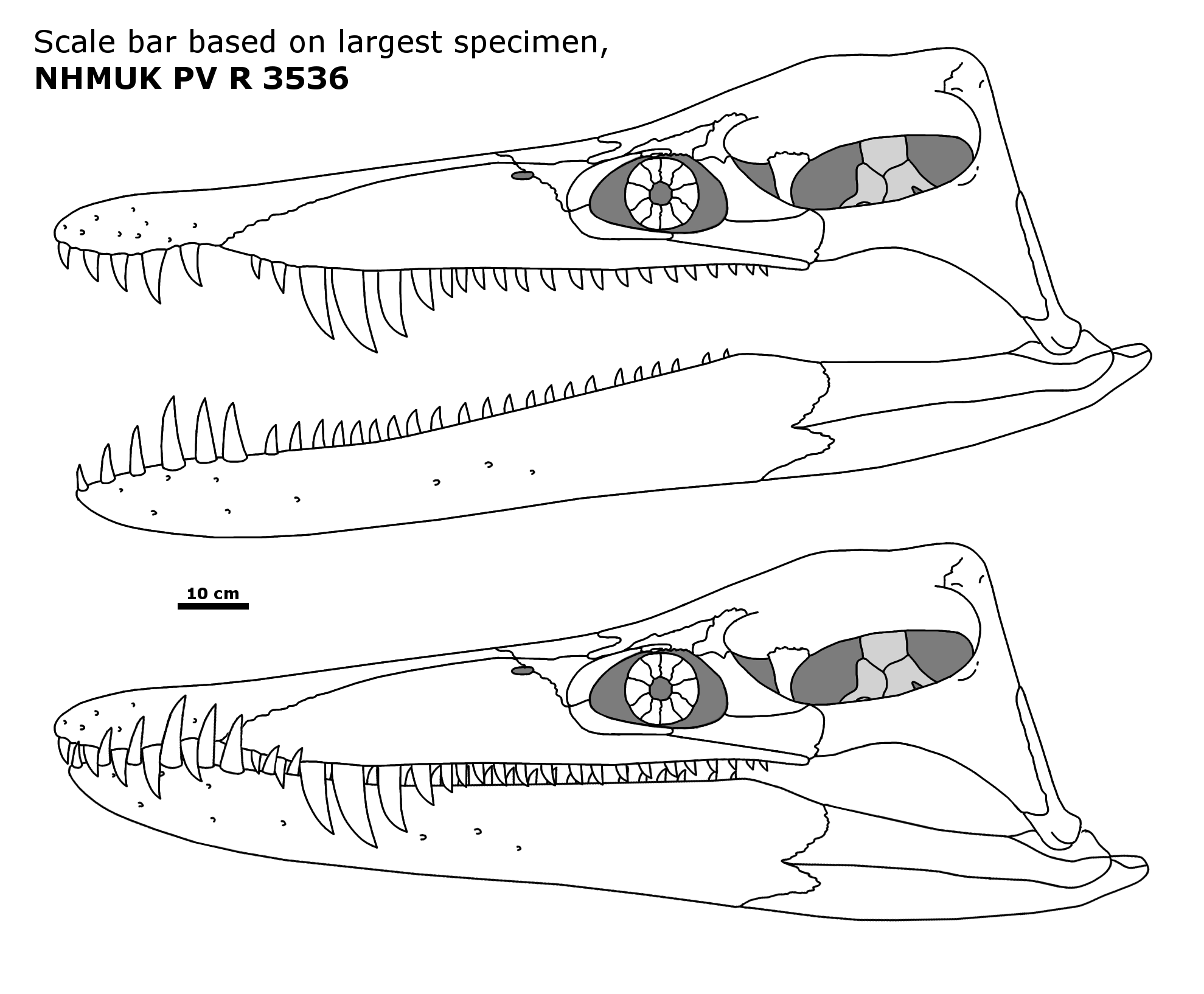
A new genus of pliosaur (Reptilia: Sauropterygia) from the Lower Jurassic of Holzmaden, Germany
Smith, A.S. & Vincent, P. · Palaeontology
Smith and Vincent erect the new genus Meyerasaurus for a complete Toarcian skeleton from Holzmaden, Germany, previously assigned to Rhomaleosaurus. The work is part of the effort by Smith and colleagues to refine the generic content of Rhomaleosauridae: as new species are analyzed in detail, it becomes clear that Rhomaleosaurus strict sense includes only cramptoni (type species), zetlandicus, and thorntoni, all British. This taxonomic refinement makes R. cramptoni even more central, since the genus in strict sense becomes much more restricted. It is an important milestone in stabilizing the systematic framework used in all subsequent studies of the family.


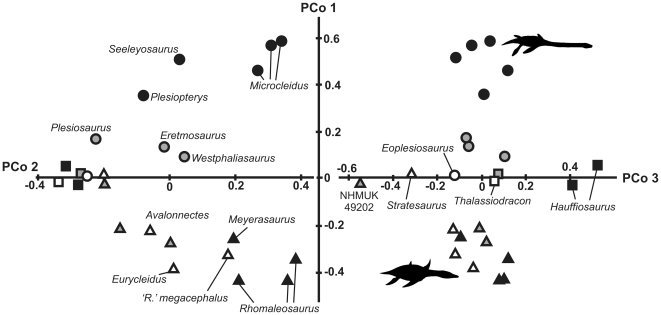
High diversity, low disparity and small body size in plesiosaurs (Reptilia, Sauropterygia) from the Triassic–Jurassic boundary
Benson, R.B.J., Evans, M. & Druckenmiller, P.S. · PLOS ONE
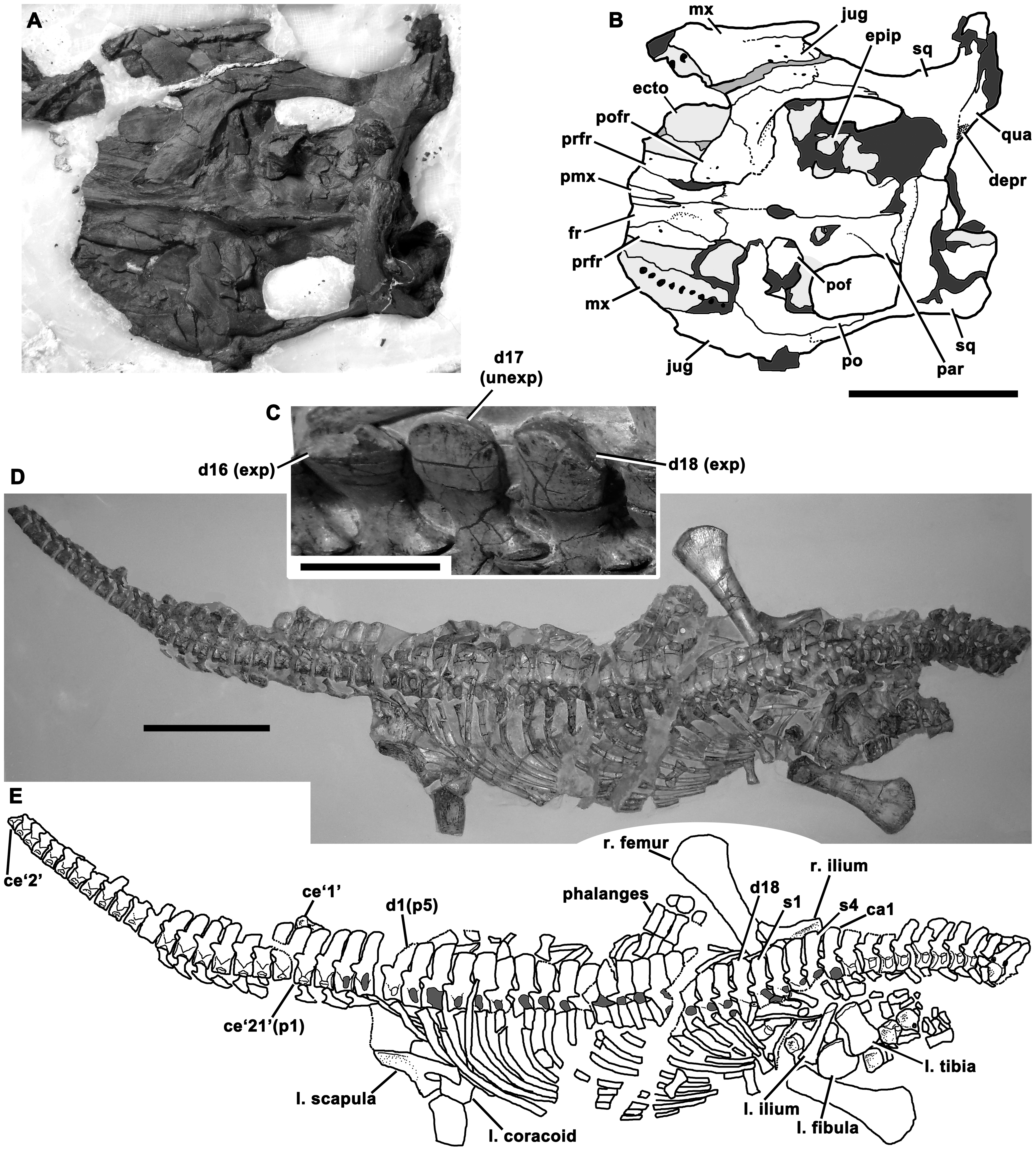
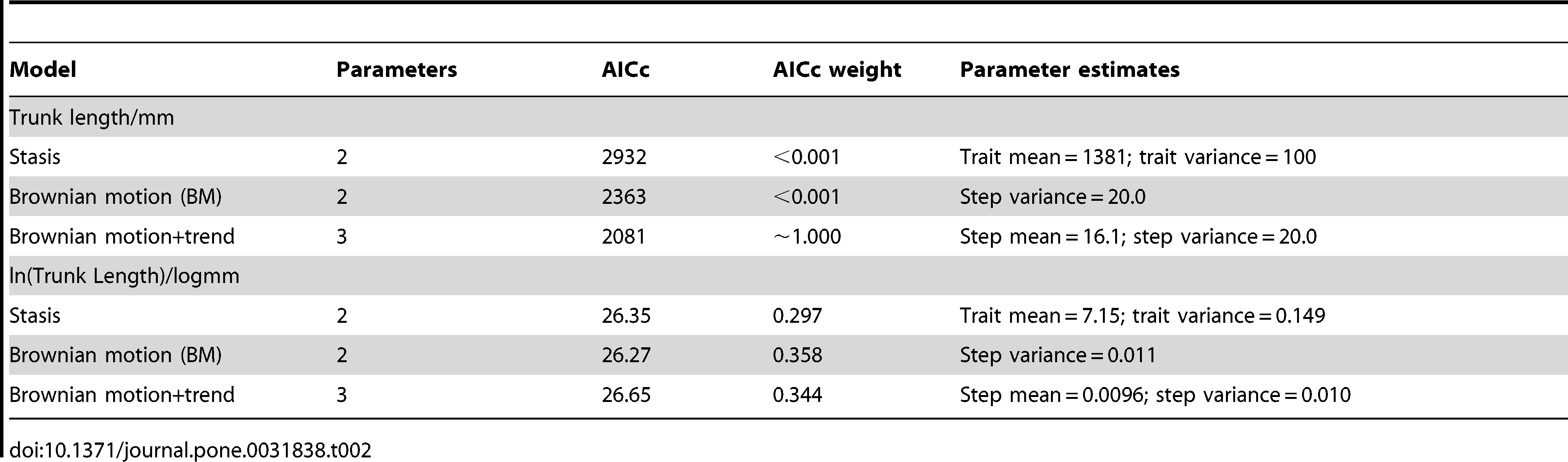
Benson, Evans, and Druckenmiller conduct a phylogenetic and morphometric analysis of plesiosaurs spanning the Triassic-Jurassic boundary, showing high taxonomic diversity but low morphological disparity and relatively small body sizes. The work again recovers Rhomaleosauridae as a lineage outside Neoplesiosauria, corroborating Ketchum and Benson (2010), and documents the initial radiation of the group in early Jurassic seas, which precedes the appearance of R. cramptoni by about 20 million years. Among the new species described in the paper are Stratesaurus and Avalonnectes, basal relatives within Rhomaleosauridae, fundamental to understanding the evolutionary context leading to large and robust forms like R. cramptoni in the Toarcian.
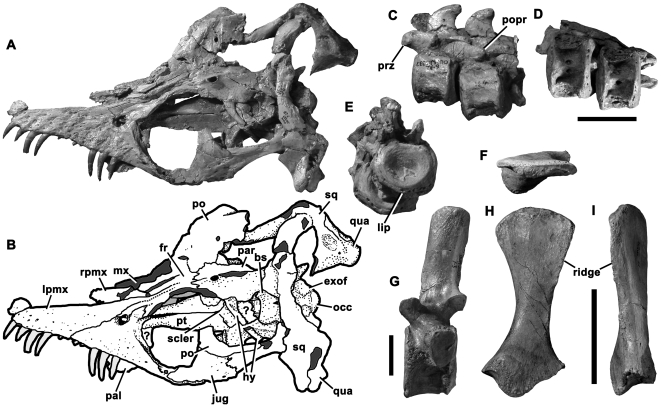
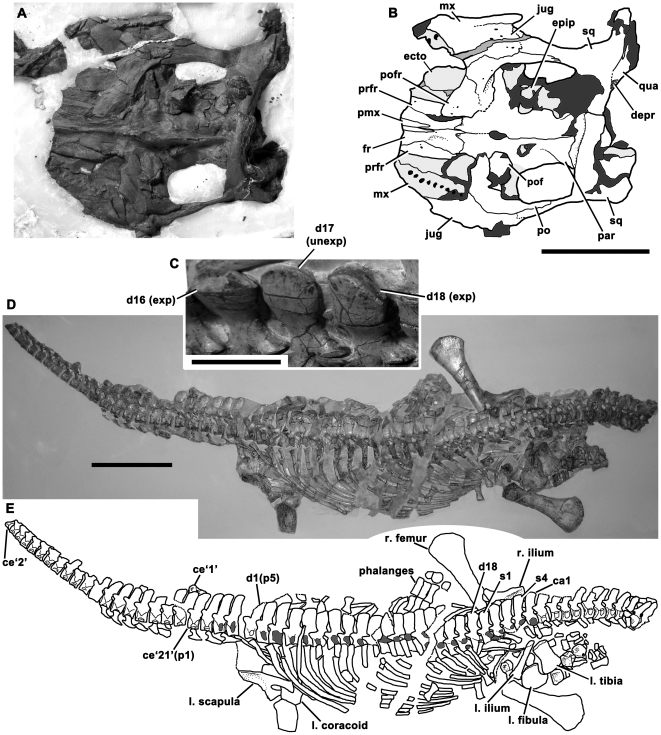
![Table 1. Revised taxonomy of plesiosaurian specimens from the earliest Jurassic of Street, Somerset, UK, and Watchet (TTNCM 8348) (modified from [35] , table 1 ). Abbreviation: NMING, National Museum of Ireland, Dublin, Ireland.](/images/species/rhomaleosaurus-cramptoni/papers/641a54db65-00.png)
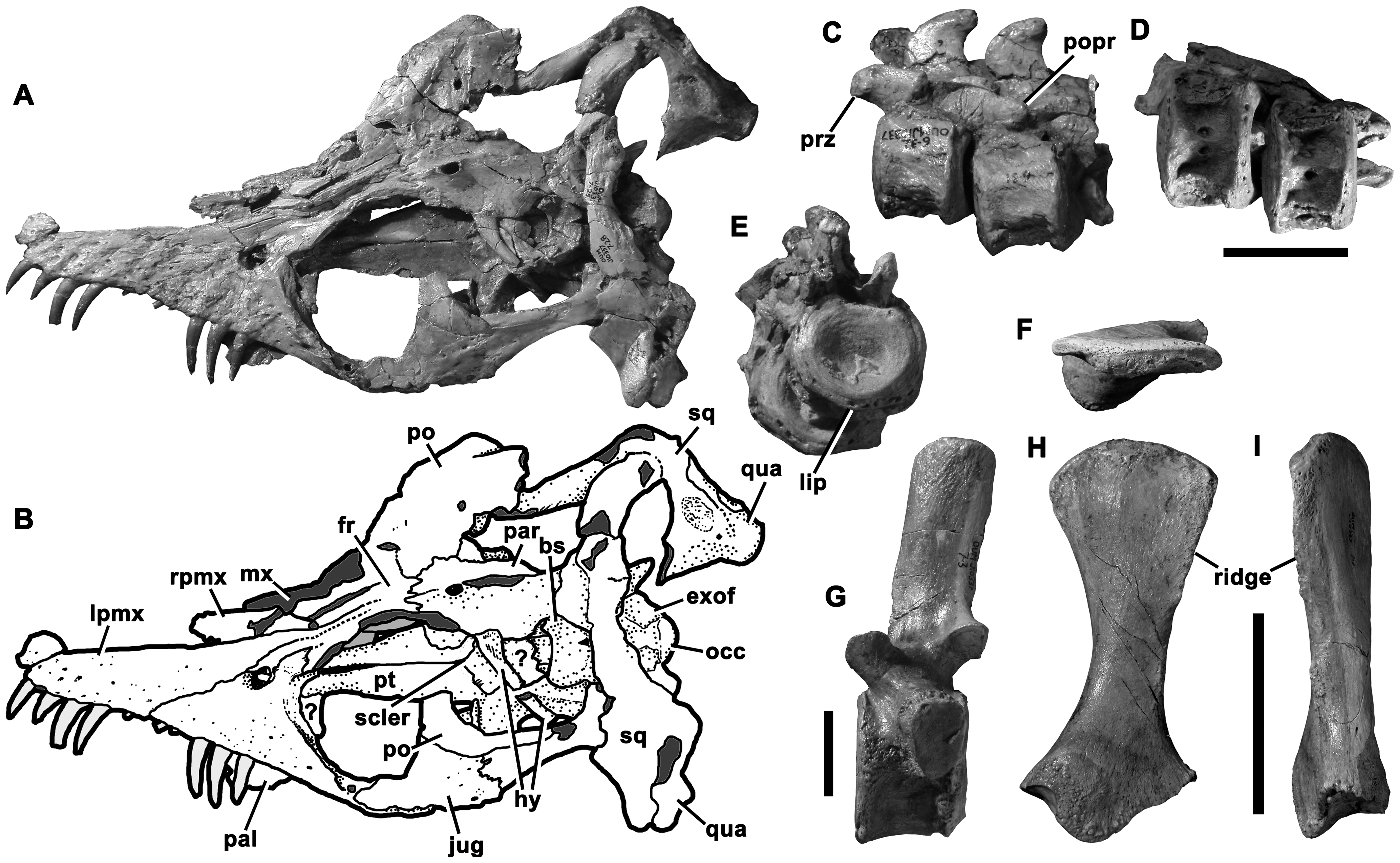
Thaumatodracon weidenrothi, a morphometrically and stratigraphically intermediate new rhomaleosaurid plesiosaurian from the Lower Jurassic (Sinemurian) of Lyme Regis
Smith, A.S. & Araújo, R. · Palaeontographica Abteilung A
Smith and Araújo describe Thaumatodracon weidenrothi, a new rhomaleosaurid from the Sinemurian (Early Jurassic, about 195 Ma) of Lyme Regis, England. The species fills a morphometric and stratigraphic gap between the older, smaller Early Jurassic rhomaleosaurids and the larger, more robust Toarcian forms such as R. cramptoni. The work is important for understanding the evolution of the group that culminates in R. cramptoni: it shows a progressive increase in body size and cranial robustness over about 15 million years within the family. The phylogenetic analysis confirms R. cramptoni in a derived position within Rhomaleosauridae.
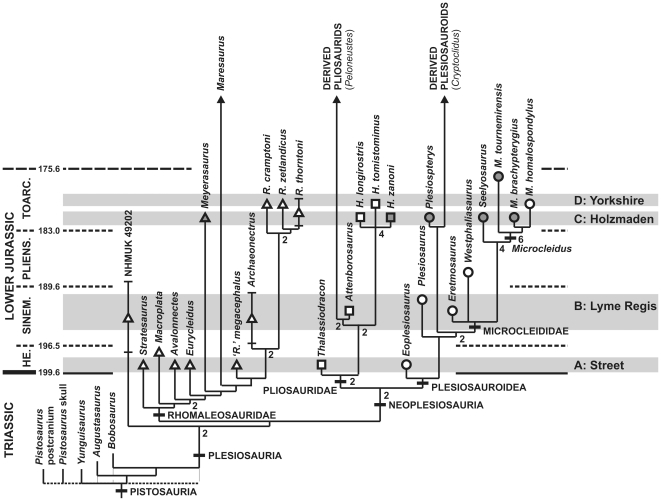
Osteology of Rhomaleosaurus thorntoni (Sauropterygia: Rhomaleosauridae) from the Lower Jurassic (Toarcian) of Northamptonshire, England
Smith, A.S. & Benson, R.B.J. · Monographs of the Palaeontographical Society
Smith and Benson publish a detailed osteological monograph of Rhomaleosaurus thorntoni (NHMUK PV R 4853) in 40 pages of the Monographs of the Palaeontographical Society. It is the most complete rhomaleosaurid skeleton preserved in three dimensions and therefore the new anatomical reference of the genus. The monograph refines, through direct comparison, the diagnosis of R. cramptoni and consolidates the distinction between the three British species of the genus. It includes complete descriptions of skull, spine, pectoral and pelvic girdles, flippers, and preliminary histology, and presents a phylogenetic analysis placing R. cramptoni and R. thorntoni as sister species within Rhomaleosaurus sensu stricto. It is the current canonical anatomical reference.
Reassessment of 'Plesiosaurus' megacephalus (Sauropterygia: Plesiosauria) from the Triassic-Jurassic boundary, UK
Smith, A.S. · Palaeontologia Electronica
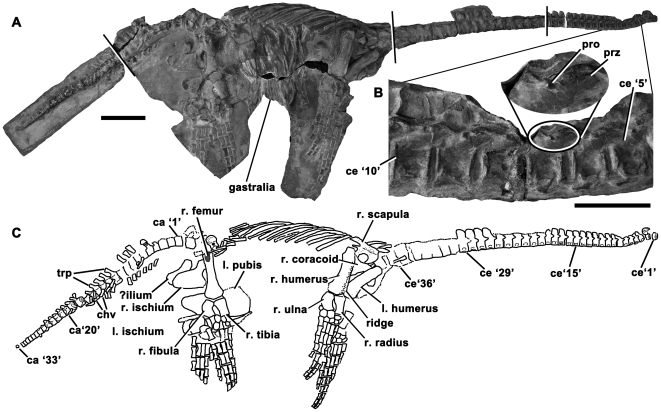
Smith reassesses the holotype of Plesiosaurus megacephalus Stutchbury, 1846, destroyed in a Bristol air raid in 1940, using plaster casts of the skull and right forelimb made before the destruction, historical photographs, and original descriptions. The analysis shows that the material is distinct from Rhomaleosaurus strict sense and from Eurycleidus arcuatus and justifies a new genus: Atychodracon, from Greek atychis, unfortunate, referring to the loss of the holotype. The reduction in the generic content of Rhomaleosaurus reinforces the centrality of R. cramptoni as type species and once again refines the composition of the family, in direct continuity with the works of Smith (2007) and Smith and Benson (2014).
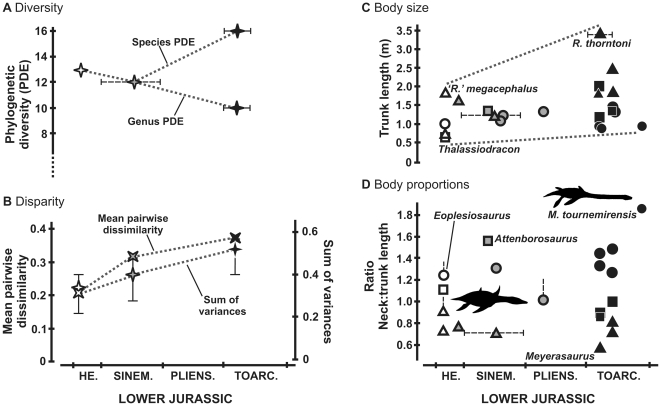

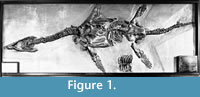
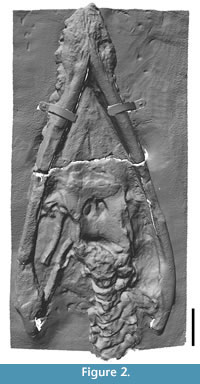
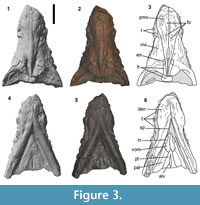
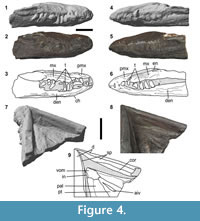
Exquisite skeletons of a new transitional plesiosaur fill gap in the evolutionary history of plesiosauroids
Sachs, S., Eggmaier, S. & Madzia, D. · Frontiers in Earth Science
Sachs, Eggmaier, and Madzia describe Franconiasaurus brevispinus, a new plesiosaur from the late Toarcian of Germany, about 175 Ma, nearly contemporaneous with the R. cramptoni holotype. The phylogenetic analysis includes R. cramptoni and confirms the placement of Rhomaleosauridae as a basal lineage within Plesiosauria, outside Neoplesiosauria, consolidating results from Ketchum and Benson (2010) and Benson et al. (2012). The work also documents the diversity of the plesiosaurid fauna of the European epicontinental sea in the late Toarcian, the direct context in which R. cramptoni lived. It is the most recent reference to the phylogenetic placement of the species and shows that, even more than 160 years after its description, R. cramptoni remains pivotal to the systematics of basal plesiosaurs.
Famous museum specimens
NMING F8785 (holótipo)
National Museum of Ireland – Natural History, Dublin, Irlanda
Type skeleton of Rhomaleosaurus cramptoni, one of the most complete plesiosaurs ever found, about 7 meters long with an 88-centimetre skull. It was unearthed in 1848 at Kettleness, Yorkshire, and kept for five years at Mulgrave Castle before arriving in Dublin in 1853. Scientifically described by Carte and Baily in 1863 and reclassified by Seeley in 1874. The skull was only mechanically prepared in 2006, after 158 years, enabling the modern redescription by Smith and Dyke (2008). The specimen is not on public display; it has been stored at the Museum Storage Complex (MSC) in Dublin since 1983.
NHMUK PV R 34 (molde do holótipo)
Natural History Museum, Londres, Reino Unido
Plaster cast of the holotype skeleton, on permanent display in the fossil marine reptile gallery of the Natural History Museum in London. Because the original fossil is in Dublin storage and inaccessible to the public, this cast is the main point of public contact with R. cramptoni. It also served as the basis for the 3D surface model published on MorphoSource in 2025 and as a comparative reference in several publications, including Smith and Dyke (2008).
YORYM G503 (holótipo de R. zetlandicus, congênere)
Yorkshire Museum, York, Reino Unido
Holotype of Rhomaleosaurus zetlandicus, sister species to R. cramptoni also from the Alum Shale Member of the Whitby Mudstone in Yorkshire. Dundas donated the specimen to the Yorkshire Philosophical Society in 1852, and the material was the subject of Taylor's (1992) classic functional study. It serves as a direct comparative reference for the anatomy of R. cramptoni and illustrates the Toarcian diversity of the genus in the same epicontinental sea.
In cinema and popular culture
Rhomaleosaurus has a very modest presence in pop culture, especially compared to more famous pliosaurs like Liopleurodon or Kronosaurus. That is not an accident: the genus only received a modern redescription in 2008, while Liopleurodon became a star thanks to the BBC's Walking with Dinosaurs and Sea Monsters trilogy (1999-2003), which deliberately exaggerated its size. Rhomaleosaurus appears only in brief cameos in that same BBC franchise, usually as part of the European Toarcian marine fauna, without narrative focus. In video games and toys it is very rare. The absence also reflects the fact that R. cramptoni is a mid-sized pliosauroid (about 7 meters), not a spectacular giant, and that its research history stayed frozen for over a century until the skull was prepared in 2006. The appeal is restricted to British and Irish museology: the cast at the Natural History Museum in London and the very rare public exhibition of the Dublin holotype are the main points of public contact with the species. Paleontological pop culture still owes Rhomaleosaurus a role worthy of its taxonomic importance.
Classification
Discovery
Fun fact
The Rhomaleosaurus cramptoni holotype had its skull encased in shale for 158 years after its discovery in 1848. Only in 2006 did technicians at the National Museum of Ireland – Natural History mechanically prepare it, exposing the cranial anatomy for study. That means the first modern anatomical description of the species, by Smith and Dyke, did not appear until 2008, more than a century and a half after Carte and Baily published the original description in 1863.
Last reviewed: April 24, 2026