
Wonderchicken
Asteriornis maastrichtensis
"Bird of Asteria, from Maastricht"
About this species
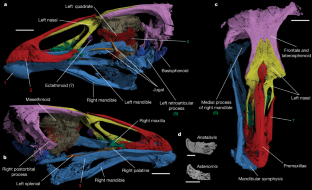
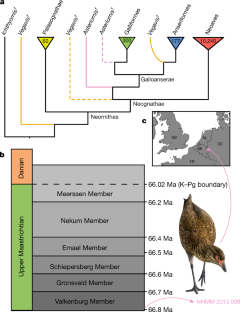
Asteriornis maastrichtensis is the oldest known modern bird with a robust cranial fossil, described in 2020 by Daniel Field and colleagues in Nature. It lived on the tropical coastal plains of Late Cretaceous Europe around 67 million years ago, some 700 thousand years before the impact that extinguished non-avian dinosaurs. The holotype NHMM 2013-008 was collected around 2000 by amateur paleontologist Maarten van Dinther at a quarry near Eben-Emael in Belgian Limburg, and donated to the Maastricht Natural History Museum. For nearly two decades the material remained in seemingly unimportant limestone blocks, until CT scans in 2018 revealed an almost complete skull hidden inside the rock. The bird was small, about 40 centimetres long and an estimated 394 grams, and its skull combines features reminiscent of both chickens and ducks, hence the global Wonderchicken nickname adopted by the press.
Geological formation & environment
The Maastricht Formation is a sequence of shallow marine platform limestones and marls of the latest Maastrichtian, between about 67 and 66 million years old, exposed along the Belgian-Dutch border around the city of Maastricht. It is the type locality of the Maastrichtian stage of the international geological scale. Quarries such as ENCI, Romontbos and Eben-Emael have preserved a rich marine fauna, including the giant mosasaur Mosasaurus hoffmannii, plesiosaurs, turtles and ammonites, together with rare terrestrial remains, such as the holotype of Asteriornis maastrichtensis. Field et al. (2024) describe in detail the stratigraphic context of the avian material associated with the formation.
Image gallery


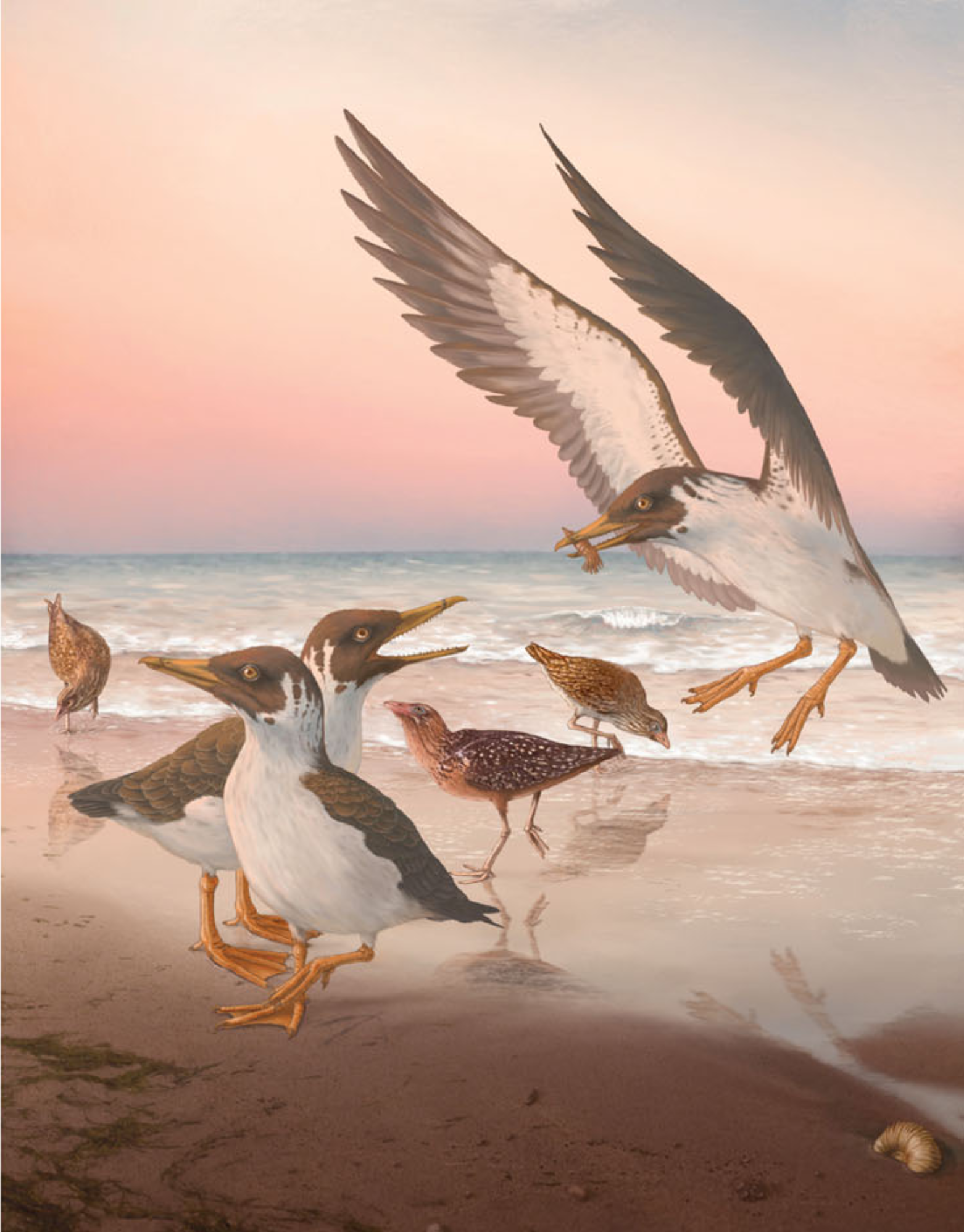


Life reconstruction of Asteriornis maastrichtensis by BipedalSarcopterygian201.3, the most widespread paleoart of the taxon. The short beak and terrestrial posture align with the anatomical interpretation of Field et al. (2020).
BipedalSarcopterygian201.3 / Wikimedia Commons, CC BY-SA 4.0
Ecology and behavior
Habitat
Asteriornis maastrichtensis lived on a shallow marine coastal plain in latest Cretaceous Western Europe, in a tropical to subtropical setting. The region corresponded to a low archipelago, with coasts, islands and a carbonate platform, bathed by the epicontinental sea that covered part of Europe in the Maastrichtian. The associated marine fauna included mosasaurs such as Mosasaurus hoffmannii, plesiosaurs and turtles, as well as shallow-water invertebrates such as inoceramids and Maastrichtian ammonites. On low dry land, Asteriornis shared the scene with late pterosaurs and rare non-avian dinosaurs, in communities documented by Field et al. (2024).
Feeding
The diet of Asteriornis maastrichtensis is inferred from the morphology of the short, robust beak and the hindlimb proportions described by Field et al. (2020, 2024). The generalist beak, without extreme specialization for filtering as in modern ducks or for hard seeds as in galliforms, suggests opportunistic omnivory, with likely consumption of small aquatic invertebrates, seeds and plant matter gathered along margins and pools. The interpretation as a long-legged bird with possibly wading habits is consistent with prey capture in shallow waters, similar to modern shorebirds.
Behavior and senses
Asteriornis was probably a terrestrial to coastal bird, active near the sea and along the margins of pools and channels, in a style comparable to modern shorebirds such as plovers and sandpipers. The long legs relative to the body, described in Field et al. (2024), support this hypothesis. As a basal Galloanserae, it is unlikely it lived in tree canopies, a rare habit in that large branch. Social behavior is unknown, but, if analogous to living Galloanserae, it is reasonable to infer life in small groups and at least brief parental care, although this cannot be confirmed by the fossil record.
Physiology and growth
Asteriornis was a small bird, about 40 centimetres long and around 394 grams estimated from the skull and limb bones, according to Field et al. (2020) and the revision in Field et al. (2024). Like any modern bird, it was endothermic, an active flier and feathered, although the preserved material does not include plumage impressions. The anatomy mixes features today associated with Galliformes (robust head, short beak) and Anseriformes (palatine), and that morphological generality is what gives strength to the hypothesis that generalist lineages had an advantage crossing the K-Pg boundary, as discussed by Field et al. (2018, 2020) and Larson et al. (2016).
Paleogeography
Continental configuration

Ron Blakey · CC BY 3.0 · Cretáceous, ~90 Ma
During the Maastrichtiano (~67–66.7 Ma), Asteriornis maastrichtensis inhabited Laramidia, the western half of present-day North America, separated from the east by the Western Interior Seaway, a shallow sea dividing the continent. The continents were in very different positions: India was drifting toward Asia, Antarctica was still connected to Australia, and South America was an isolated island.
Bone Inventory
The holotype of Asteriornis maastrichtensis (NHMM 2013-008) is essentially a nearly complete skull preserved in four associated limestone blocks, recovered through CT scanning in 2018. There are also limited postcranial elements, in particular parts of the hindlimbs and some vertebrae, described in detail by Field et al. (2024) in the Netherlands Journal of Geosciences. No substantial postcranial skeleton is preserved, and most of the anatomical knowledge of the taxon comes from the skull, mandible and quadrate.
Found elements
Inferred elements
Scientific Literature
15 papers in chronological order — from the original description to recent research.
Preliminary description of Hesperornis regalis, with notices of four other new species of Cretaceous birds
Marsh, O.C. · American Journal of Science (Series 3) 3(17)
Othniel Charles Marsh published the preliminary description of Hesperornis regalis and four other Cretaceous birds collected from the limestones of the western United States, opening the systematic study of Mesozoic birds. Although it deals with North American taxa not directly related to Asteriornis, this article is the historical starting point of the field. For more than a century, Cretaceous bird paleontology would be dominated by Marsh's Hesperornis and Ichthyornis, with little cranial material of crown-group birds preserved. The discovery of Asteriornis in 2020 finally provided the missing skull that connects that North American lineage described by Marsh to the modern bird group.

Odontornithes: A Monograph on the Extinct Toothed Birds of North America
Marsh, O.C. · Memoirs of the Peabody Museum of Yale University, Volume 1
Othniel Charles Marsh published the Odontornithes monograph through the Peabody Museum, consolidating nearly a decade of work on North American Cretaceous toothed birds. The volume is the classic anatomical reference that dominated Mesozoic bird paleontology until the end of the 20th century and directly influenced how Hope, Clarke, Field and later authors compared new discoveries. Asteriornis maastrichtensis was placed by Field et al. (2020) in a phylogenetic framework that still uses Marsh's Ichthyornis and Hesperornis as anchor taxa, showing how the tradition established in 1880 remains operative. The monograph also fixed the osteological vocabulary still applied to the description of Cretaceous bird skulls.

Explosive evolution in tertiary birds and mammals
Feduccia, A. · Science 267(5198)
Alan Feduccia published in Science the influential argument for an explosive post-K-Pg radiation, according to which modern birds diversified almost entirely after the mass extinction, with little or no Cretaceous fossil record of crown-group birds. This hypothesis dominated discussions for nearly two decades and contrasted with molecular estimates that pushed the origin of modern clades back into the Cretaceous. Asteriornis maastrichtensis, described by Field et al. in 2020, is precisely the kind of fossil whose existence Feduccia considered unlikely, and its discovery therefore forces a direct revision of this 1995 paper. The work is a required citation in any discussion of the temporal origin of modern birds.


The Mesozoic radiation of Neornithes
Hope, S. · Mesozoic Birds: Above the Heads of Dinosaurs (University of California Press), capítulo 15
Sylvia Hope published one of the most cited chapters of the book Mesozoic Birds, synthesizing the fossil record of Neornithes (crown birds) in the Cretaceous. The author compiled isolated cranial and postcranial fragments attributed to modern birds, mostly small elements without clear articulation, and defended that the diversification of modern clades was already underway in the Mesozoic, in contrast with Feduccia (1995). This work was the reference used by Field, Ksepka and colleagues to place Asteriornis maastrichtensis in 2020 within a broader narrative about the Cretaceous fossil record of modern birds. The chapter remains the standard entry point on the topic in the specialized literature.
Definitive fossil evidence for the extant avian radiation in the Cretaceous
Clarke, J.A., Tambussi, C.P., Noriega, J.I., Erickson, G.M. & Ketcham, R.A. · Nature 433
Julia Clarke and colleagues described in Nature the postcranial skeleton of Vegavis iaai, from Vega Island, Antarctica, as the first undisputed record of a crown bird from the Cretaceous, assigned to Anseriformes. Before this paper, all claims of modern birds in the Mesozoic relied on ambiguous isolated fragments. Vegavis opened the path for the full acceptance of pre-K-Pg modern birds and was the most important reference for the impact that Asteriornis maastrichtensis would cause in 2020. Field et al. (2020) compared Asteriornis directly with Vegavis and argued that the Belgian skull, together with the Antarctic postcranium, fixes the presence of Galloanserae already in the latest Cretaceous, some 700 thousand years before the impact.

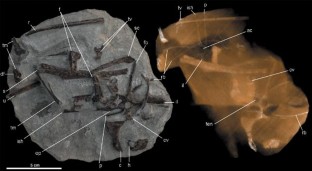
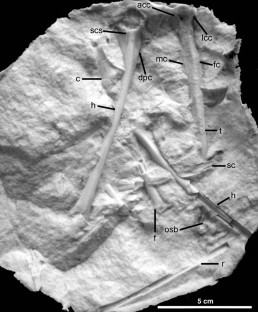
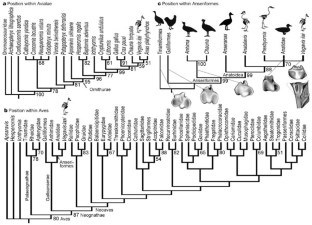
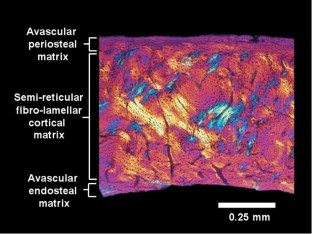
Mass extinction of birds at the Cretaceous-Paleogene (K-Pg) boundary
Longrich, N.R., Tokaryk, T. & Field, D.J. · Proceedings of the National Academy of Sciences 108(37)
Nicholas Longrich, Tim Tokaryk and Daniel Field quantitatively analyzed isolated bird fragments from the Maastrichtian of the Hell Creek Formation and demonstrated that there was an abrupt mass extinction of birds at the Cretaceous-Paleogene boundary, with majority loss of avian diversity. The paper is one of the central references for understanding the evolutionary bottleneck that only a few crown-group bird lineages crossed, among them the one Asteriornis represents. Field et al. (2020) used this work directly to argue that the survival of the lineage that gave rise to Galloanserae was exceptional. The senior author of the 2011 paper is the same Daniel Field who described Asteriornis in 2020, showing the direct continuity of the research.

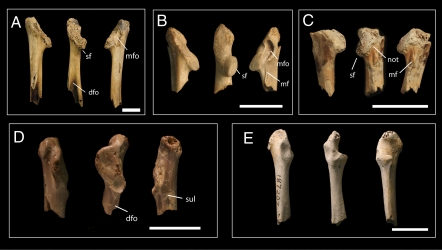
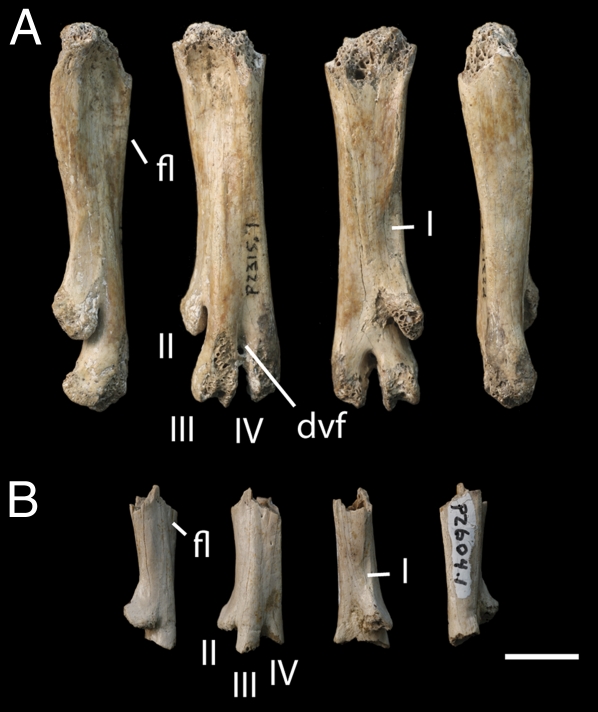
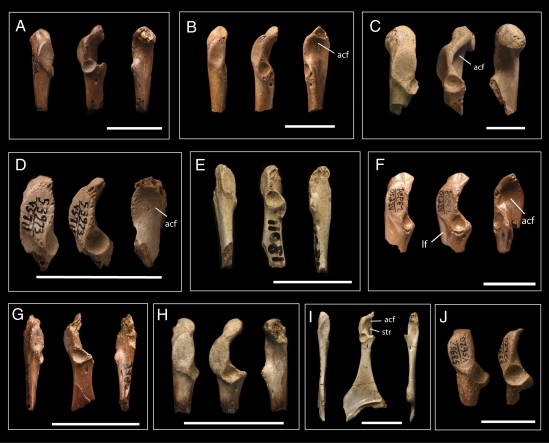
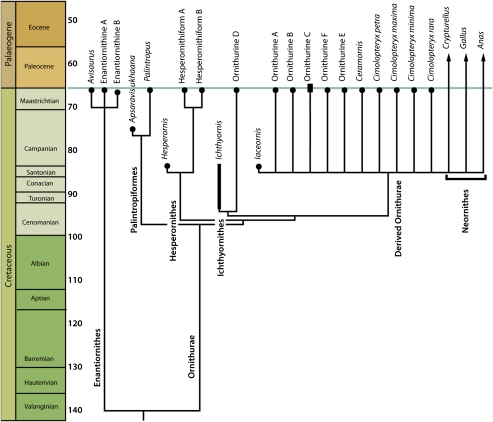
The origins of crown group birds: molecules, fossils, and beyond
Mayr, G. · Zoologica Scripta 43(5), capítulo em livro também publicado
Gerald Mayr published a critical review on the origin of crown birds, integrating molecular dates and the then known Cretaceous fossil record, mostly ambiguous isolated fragments. Mayr argued that, in the absence of complete cranial fossils, it was difficult to distinguish true Cretaceous Neornithes from derived stem-Aves, and called for caution in accepting reports such as that of Vegavis. Asteriornis maastrichtensis, described six years later by Field et al., is exactly the kind of fossil Mayr explicitly requested to resolve the impasse, with a nearly complete skull that allows confident assignment to basal Galloanserae. The article is a required reference when discussing evidence criteria for modern birds in the Mesozoic.

Avian diversification patterns across the K-Pg boundary: Influence of calibrations, datasets, and model misspecification
Ksepka, D.T. & Phillips, M.J. · Annals of the Missouri Botanical Garden 100(4)
Daniel Ksepka and Matthew Phillips reanalyzed molecular dates for the divergence of crown birds, with revised fossil calibrations, and discussed in detail the effect of the K-Pg boundary on avian diversification. The authors recovered scenarios compatible with both a Cretaceous origin and a strong Paleogene radiation, depending on the calibrations used. Asteriornis maastrichtensis, described five years later with Ksepka as co-author, provides a hard fossil calibration for the Galloanserae split in the latest Cretaceous, exactly the kind of data discussed in this paper. The article is a direct methodological reference for the estimation of divergence times using the Asteriornis record.

A comprehensive phylogeny of birds (Aves) using targeted next-generation DNA sequencing
Prum, R.O., Berv, J.S., Dornburg, A., Field, D.J., Townsend, J.P., Lemmon, E.M. & Lemmon, A.R. · Nature 526
Richard Prum and colleagues, including Daniel Field, published in Nature the most influential genomic phylogeny of modern birds, based on hundreds of nuclear loci and more than 198 species. Divergence estimates placed most modern orders in the latest Cretaceous, with Galloanserae splitting from Neoaves around 88 million years ago. Asteriornis maastrichtensis, described five years later by the same Field, is one of the first cranial fossils to empirically anchor those deep divergence times. The 2015 paper is the molecular backdrop against which the 2020 find acquires meaning: Asteriornis confirms with bone what DNA had already indicated on a statistical basis.


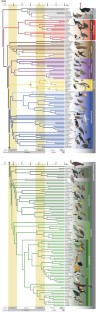
Early evolution of modern birds structured by global forest collapse at the end-Cretaceous mass extinction
Field, D.J., Bercovici, A., Berv, J.S., Dunn, R., Fastovsky, D.E., Lyson, T.R., Vajda, V. & Gauthier, J.A. · Current Biology 28(11)
Daniel Field and colleagues demonstrated, based on palynology and paleobotanical analysis, that the Cretaceous-Paleogene boundary was marked by global forest collapse, with replacement by a fern-dominated ecology for some tens of thousands of years. The article argued that this devastation favored the survival of bird lineages with terrestrial or coastal habits, to the detriment of arboreal birds dependent on canopies. Asteriornis maastrichtensis, described by Field two years later, is precisely a bird of likely coastal wading habit, which fits the survivor profile expected by this model. The paper is the explicit ecological frame used to interpret Asteriornis in 2020.

Late Cretaceous neornithine from Europe illuminates the origins of crown birds
Field, D.J., Benito, J., Chen, A., Jagt, J.W.M. & Ksepka, D.T. · Nature 579
Daniel Field, Juan Benito, Albert Chen, John Jagt and Daniel Ksepka published in Nature, on 18 March 2020, the original description of Asteriornis maastrichtensis. The holotype NHMM 2013-008 comes from a quarry in Belgian Limburg, near Eben-Emael, and was collected around 2000 by amateur paleontologist Maarten van Dinther, who donated the blocks to the Maastricht Natural History Museum. CT scans in 2018 revealed an almost complete skull hidden inside four seemingly ordinary limestone blocks. The authors name the new genus after the titaness Asteria, mother of the quail-goddess Leto, and describe features that mix Galliformes (chickens) and Anseriformes (ducks). They place Asteriornis as the oldest known representative of Galloanserae, with an age of around 67 Ma. The paper establishes that modern birds already existed before the K-Pg impact.
Cretaceous ornithurine supports a neognathous crown bird ancestor
Benito, J., Kuo, P.-C., Widrig, K.E., Jagt, J.W.M. & Field, D.J. · Nature 612
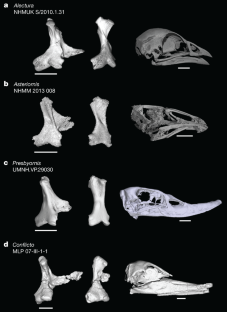
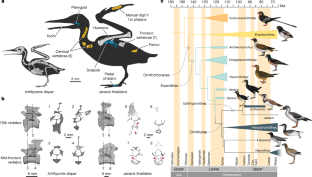
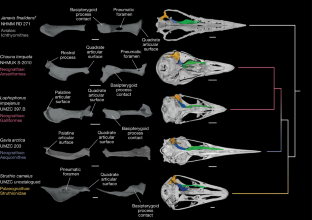
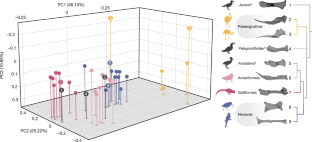
Juan Benito and colleagues, including Daniel Field, described in Nature Janavis finalidens, a latest Cretaceous bird from the Maastricht Formation, close to the same stratigraphic batch as Asteriornis. The analysis of the Janavis palate showed that derived stem-Aves already exhibited a neognathous configuration, contradicting the classic hypothesis that the neognathous palate was an exclusive synapomorphy of modern Neognathae. The paper reorganizes the anatomical interpretation of the Asteriornis maastrichtensis skull, shifting some characters previously seen as exclusive to crown birds to the base of Ornithurae. It is the reference work for understanding how Asteriornis compares, in cranial detail, with neighboring forms such as Janavis and Ichthyornis in the same depositional system.

Mesozoic Birds: Above the Heads of Dinosaurs
Chiappe, L.M. & Witmer, L.M. (eds.) · University of California Press
Luis Chiappe and Lawrence Witmer edited the volume Mesozoic Birds: Above the Heads of Dinosaurs, a seminal and still widely cited synthesis on Mesozoic birds. The book gathers chapters on Archaeopteryx, Enantiornithes, basal Ornithurae, Hesperornithiformes, Ichthyornithes and the fragmentary record of Cretaceous Neornithes, including Sylvia Hope's chapter. It is the encyclopedic backdrop against which the impact of Asteriornis maastrichtensis in 2020 is understood. Before this volume, knowledge on Cretaceous birds was scattered across dozens of articles. After this book, any new discovery, including Asteriornis, is evaluated against the framework established in 2002.


Dental disparity and ecological stability in bird-like dinosaurs prior to the end-Cretaceous mass extinction
Larson, D.W., Brown, C.M. & Evans, D.C. · Current Biology 26(10)
Derek Larson, Caleb Brown and David Evans analyzed the dental disparity of non-avian maniraptoran theropods and Cretaceous birds near the K-Pg boundary, showing that lineages with toothless beaks maintained ecological stability before the extinction, while toothed lineages were in decline. The paper suggests that tooth reduction and replacement by beaks may have been a critical evolutionary advantage for surviving the impact. Asteriornis maastrichtensis, with an already well-defined beak and generalist morphology between Galliformes and Anseriformes, is exactly the kind of taxon for which Larson et al. (2016) predicted ecological advantage. Field et al. (2020) directly cite this paper in their discussion of the profile of surviving birds.
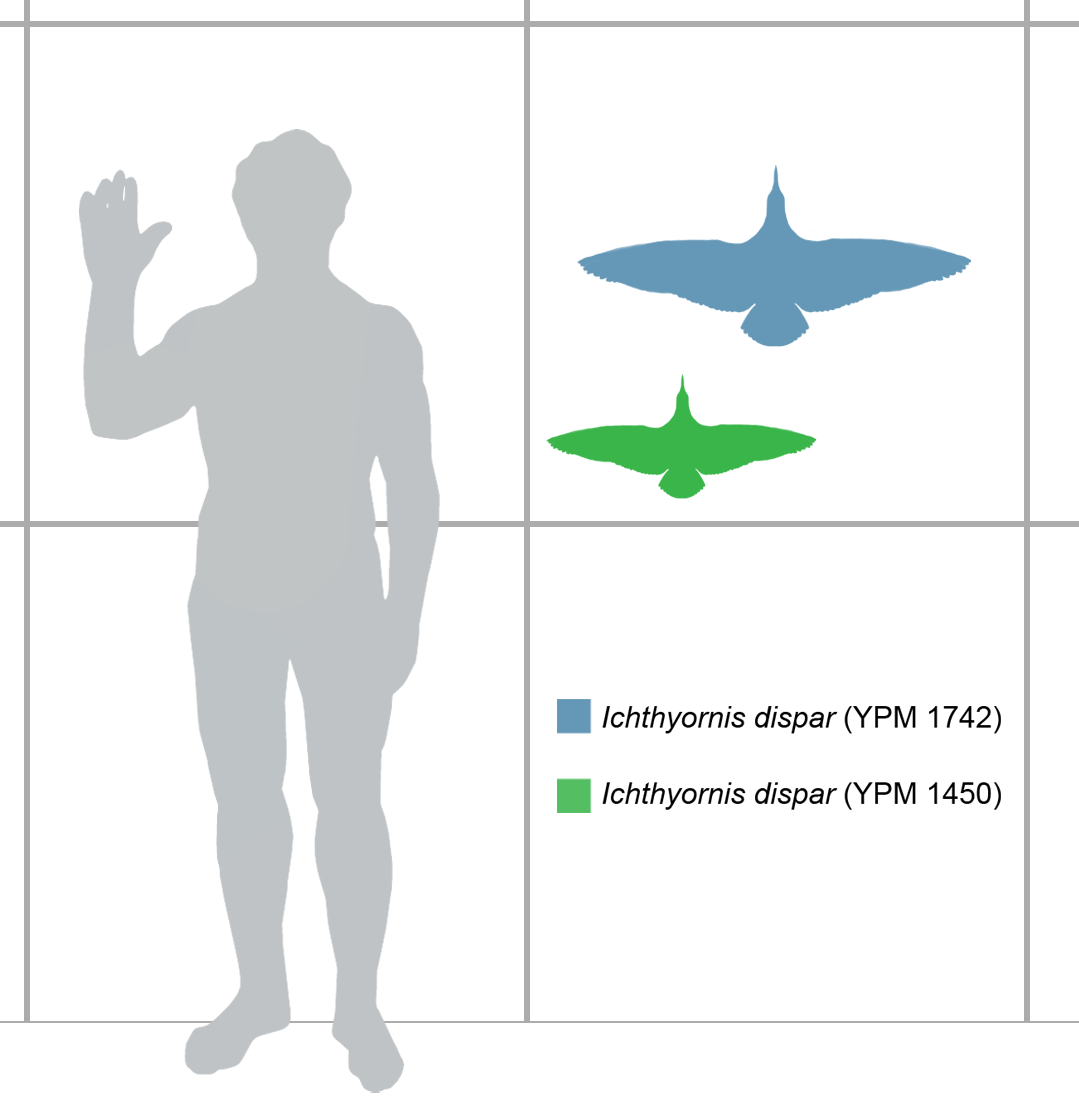
Remarkable insights into modern bird origins from the Maastrichtian type area, northeast Belgium, southeast Netherlands
Field, D.J., Benito, J., Werning, S., Chen, A., Kuo, P.-C., Crane, A., Widrig, K.E., Ksepka, D.T. & Jagt, J.W.M. · Netherlands Journal of Geosciences 103
Daniel Field, Juan Benito, Sarah Werning and colleagues published in 2024, in the Netherlands Journal of Geosciences, the most detailed reanalysis ever made of the holotype of Asteriornis maastrichtensis and the associated material of Janavis finalidens. The paper includes new CT scans, bone histology and revision of skeletal proportions, with the conclusion that Asteriornis was a long-legged bird, possibly a wader, in a tropical coastal setting. Femur histology indicates that the holotype had likely reached skeletal maturity. This article is the current most complete reference on the anatomy, paleobiology and stratigraphic context of Asteriornis, and supplies nearly all the public domain images available on the taxon.
Famous museum specimens
NHMM 2013-008 (holótipo)
Maastricht Natural History Museum, Maastricht, Países Baixos
Holotype of Asteriornis maastrichtensis, preserved in four associated limestone blocks. It remained unidentified until 2018, when CT scans revealed an almost complete skull. Described in Field et al. (2020) and reanalyzed in detail in Field et al. (2024).
Material referido associado (membros posteriores e mandíbula)
Maastricht Natural History Museum, Maastricht, Países Baixos
Set of postcranial and mandibular elements associated with the holotype, described by Field et al. (2024). The leg bones support the interpretation of Asteriornis as a long-legged bird with possibly wading ecology, distinct from most modern Galloanserae.
In cinema and popular culture
Asteriornis maastrichtensis was first described on 18 March 2020, in the middle of the early COVID-19 pandemic, and still managed to become a global headline. The combination of the almost complete skull, the Wonderchicken nickname and the narrative of a modern bird surviving the impact that killed the dinosaurs was irresistible to the science press. BBC, The New York Times, National Geographic, Nature News and Brazilian outlets such as Folha de S. Paulo and Estadão covered the discovery prominently, and the term Wonderchicken began to appear in textbooks and educational material. The presence of the taxon in audiovisual productions, however, is still limited. Species described in 2020, with still limited media presence, mainly in short technical documentaries about the origin of modern birds. There is no record, as of April 2026, of an appearance in blockbuster series such as Prehistoric Planet or in mainstream films.
Classification
Discovery
Fun fact
The skull of Asteriornis maastrichtensis has beak features simultaneously of a chicken (robust head, short beak) and of a duck (palatine), which is why the global press nicknamed it the Wonderchicken. It is the perfect Easter egg for the history of birds: it proves with bone that crown birds, meaning modern birds, already existed before the K-Pg meteor, some 700 thousand years before the extinction of non-avian dinosaurs. And the material was kept for almost two decades inside an apparently unimportant slab of stone, in a provincial museum, until in 2018 a CT scan revealed the skull hidden in the rock.
Last reviewed: April 25, 2026