252 to 66 Ma
Timeline
Dinosaurs ruled the land, but the Mesozoic was much more than that. In the seas, giant reptiles competed with sophisticated sharks. In the skies, pterosaurs had wingspans larger than small airplanes. And on the margins, the ancestors of mammals waited for their turn.
Click any bar to see details
252 to 201 Ma Triassic ▸
The origin of dinosaurs. Pangaea united, hot and dry climate. The top predators were rauisuchids, not theropods. The period begins with the largest extinction in history and ends with the second largest.
Geological events
Siberian Traps +
The largest volcanic event in Earth's history. The Siberian Large Igneous Province (LIP) covered more than 7 million km² of basalt in under 1 My. Eruptions released colossal amounts of CO2, SO2, and halogenated compounds, plus methane liberated from clathrate reservoirs destabilized by warming.
Correlation with nearby event
Siberian Traps + Permian-Triassic Extinction
The Siberian Traps are the causal agent of the Permian-Triassic extinction, the largest in Earth's history. The temporal correspondence is virtually exact: high-precision U-Pb geochronology (Burgess et al., 2014; 2017) shows that the onset of eruptions coincides with the beginning of the biological collapse. The result was 8 to 10°C of warming in the tropics, severe ocean acidification, ozone layer destruction, and widespread marine anoxia. Ecosystem recovery took between 5 and 10 My.
Permian-Triassic Extinction +
The largest extinction in Earth's history: ~96% of marine species and ~70% of terrestrial vertebrates eliminated. Caused by the catastrophic volcanism of the Siberian Traps, which released CO2, SO2, and methane over ~1 My. Tropical ocean temperatures may have exceeded 40°C. Ecosystems took 5 to 10 My to recover. It created the ecological vacuum that allowed the rise of archosaurs and, later, dinosaurs.
Correlation with nearby event
Siberian Traps + Permian-Triassic Extinction
The Siberian Traps are the causal agent of the Permian-Triassic extinction, the largest in Earth's history. The temporal correspondence is virtually exact: high-precision U-Pb geochronology (Burgess et al., 2014; 2017) shows that the onset of eruptions coincides with the beginning of the biological collapse. The result was 8 to 10°C of warming in the tropics, severe ocean acidification, ozone layer destruction, and widespread marine anoxia. Ecosystem recovery took between 5 and 10 My.
Carnian Pluvial Episode +
A global mega-rainy season lasting ~2 My, linked to the volcanism of the Wrangellia Province. It radically changed terrestrial ecosystems: conifer forests replaced arid vegetation. It accelerated dinosaur diversification as they began occupying new niches opened by the climate shift.
CAMP Volcanism +
Central Atlantic Magmatic Province: the largest flood basalt event of the Mesozoic in area (>11 million km²). Eruptions injected massive amounts of CO2 into the atmosphere, causing global warming and ocean acidification. Direct trigger of the end-Triassic extinction.
Correlation with nearby event
CAMP + Triassic-Jurassic Extinction
The CAMP volcanism is the causal agent of the Triassic-Jurassic extinction. Eruptions of the Central Atlantic Magmatic Province began a few thousand years before the extinction peak, and the temporal correspondence between volcanic pulses and biodiversity collapses is virtually exact in the geological record.
Triassic-Jurassic Extinction +
Elimination of ~76% of species. On land, rauisuchids, phytosaurs, rhynchosaurs, and dicynodonts went extinct, along with many non-dinosaurian tetrapods. A relatively rapid event (<10,000 years). Opened the way for dinosaurs to become the dominant terrestrial vertebrates of the Jurassic.
Correlation with nearby event
CAMP + Triassic-Jurassic Extinction
The CAMP volcanism is the causal agent of the Triassic-Jurassic extinction. Eruptions of the Central Atlantic Magmatic Province began a few thousand years before the extinction peak, and the temporal correspondence between volcanic pulses and biodiversity collapses is virtually exact in the geological record.
Groups of this period
Hybodus Mesozoic shark 252–66 Ma

The most successful shark of the Mesozoic. It had two types of teeth: pointed ones for fish and flat ones for crustaceans, a rare versatility. It reached ~2.5m. It coexisted with ichthyosaurs, plesiosaurs, and mosasaurs. It was progressively replaced by modern sharks (Lamniformes) in the Cretaceous and went extinct at the K-Pg boundary.
Dicynodonts † Tr-J tusked herbivores 252–201 Ma

Synapsids with a horny beak and tusks. Lystrosaurus dominated the early Triassic after surviving the Permian. Placerias (hippo-sized) was one of the last; it briefly coexisted with the first dinosaurs in North America before disappearing in the end-Triassic extinction.
Ichthyosaurs dolphin-like reptiles 250–90 Ma

They appeared in the Triassic, dominated Jurassic seas, and declined in the Cretaceous. Extraordinary convergence with dolphins and sharks, but they were reptiles that gave live birth at sea. Shonisaurus (Triassic) reached 21m. Ophthalmosaurus (Jurassic) had the largest proportional eyes of any known vertebrate, likely hunting in deep, dark waters.
Rauisuchids † Tr-J Triassic top predators 247–201 Ma

While dinosaurs were still small, the rauisuchids were the top predators. Saurosuchus (7m, Argentina), Postosuchus (6m, North America), Fasolasuchus (8-10m, the largest of all). Erect posture, serrated teeth, skull convergent with theropods. Extinct at the Triassic-Jurassic boundary; their extinction is what opened the way for the large theropods.
Phytosaurs † Tr-J crocodile analogs 245–201 Ma

Perfect convergence with modern crocodiles, but with no close relationship. They inhabited rivers and lakes, ambushing prey at the water's edge. Key difference: nostrils almost between the eyes (in crocodiles they are at the tip of the snout). Extinct alongside the rauisuchids at the end of the Triassic.
Crocodyliforms terrestrial and marine 240–66 Ma

In the Mesozoic they were far more diverse than today. Bipedal terrestrial forms in the Triassic. Pelagic marine forms in the Jurassic/Cretaceous: Dakosaurus (theropod-like skull, serrated teeth, swam in open sea), Geosaurus (forked tail like a shark, no armor). The semi-aquatic crocodiles we know today are just what survived.
Pterosaurs flying reptiles 228–66 Ma
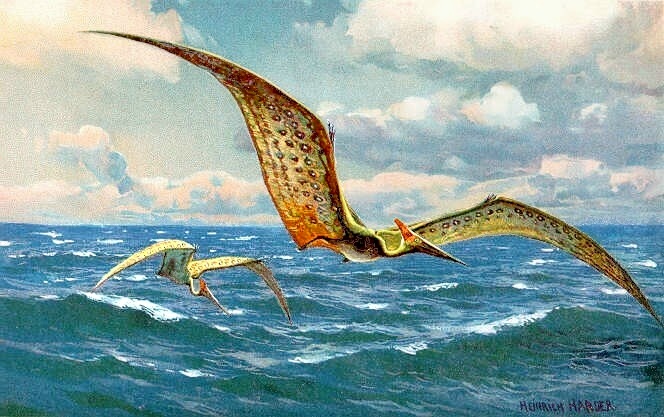
They were not dinosaurs; they were their sister group. They had fur (pycnofibers) and were probably endothermic. Eudimorphodon (Triassic) was already a sophisticated flyer. Quetzalcoatlus northropi (Cretaceous) had a 10-11m wingspan and stood 2.5m tall on the ground, the largest flying animal of all time. Extinct at the K-Pg boundary.
Mesozoic mammals small, in the shadows 225–66 Ma
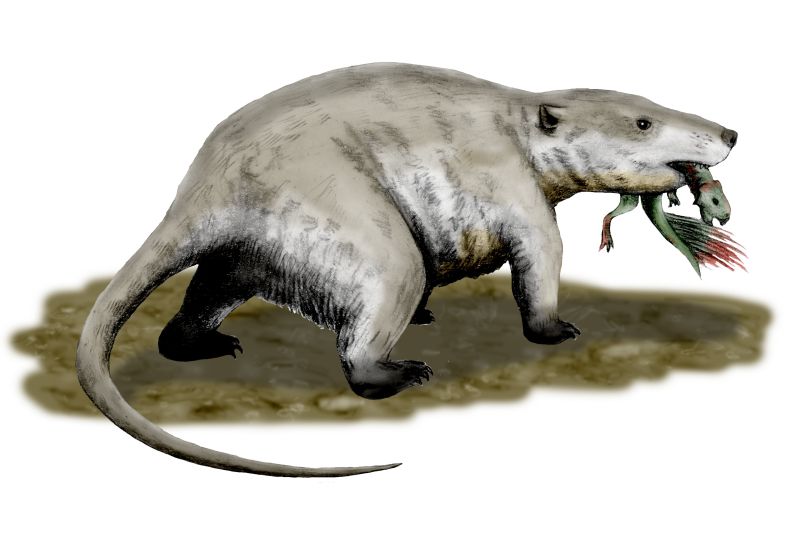
Small, probably nocturnal, living on the margins. But there was real diversity: Castorocauda (semi-aquatic, 164 Ma, beaver-sized), Volaticotherium (glider, 160 Ma), Repenomamus robustus (fossil found with a baby dinosaur in its stomach). The K-Pg extinction freed all ecological niches at once.
Plesiosaurs long-necked 203–66 Ma

Elasmosaurus had a ~14m neck with 72 cervical vertebrae, more than half the animal's total length. They swam with four large flippers in a kind of "underwater flight." They likely captured individual fish with quick neck strikes. Extinct at the K-Pg boundary.
201 to 145 Ma Jurassic ▸
The age of giants. Sauropods dominated landscapes, the first large theropods emerged, pterosaurs diversified. Pangaea begins to fragment and oceans fill with ichthyosaurs, plesiosaurs, and pliosaurs.
Geological events
Karoo-Ferrar Volcanism +
Eruptions in southern Gondwana (South Africa and Antarctica) released enormous quantities of CO2. It caused the Toarcian Oceanic Anoxic Event (OAE-T): widespread ocean anoxia, extinction of ~25% of marine families. Bivalves and brachiopods were particularly affected.
Groups of this period
Hybodus Mesozoic shark 252–66 Ma
The most successful shark of the Mesozoic. It had two types of teeth: pointed ones for fish and flat ones for crustaceans, a rare versatility. It reached ~2.5m. It coexisted with ichthyosaurs, plesiosaurs, and mosasaurs. It was progressively replaced by modern sharks (Lamniformes) in the Cretaceous and went extinct at the K-Pg boundary.
Dicynodonts tusked herbivores 252–201 Ma
Synapsids with a horny beak and tusks. Lystrosaurus dominated the early Triassic after surviving the Permian. Placerias (hippo-sized) was one of the last; it briefly coexisted with the first dinosaurs in North America before disappearing in the end-Triassic extinction.
Ichthyosaurs dolphin-like reptiles 250–90 Ma
They appeared in the Triassic, dominated Jurassic seas, and declined in the Cretaceous. Extraordinary convergence with dolphins and sharks, but they were reptiles that gave live birth at sea. Shonisaurus (Triassic) reached 21m. Ophthalmosaurus (Jurassic) had the largest proportional eyes of any known vertebrate, likely hunting in deep, dark waters.
Rauisuchids Triassic top predators 247–201 Ma
While dinosaurs were still small, the rauisuchids were the top predators. Saurosuchus (7m, Argentina), Postosuchus (6m, North America), Fasolasuchus (8-10m, the largest of all). Erect posture, serrated teeth, skull convergent with theropods. Extinct at the Triassic-Jurassic boundary; their extinction is what opened the way for the large theropods.
Phytosaurs crocodile analogs 245–201 Ma
Perfect convergence with modern crocodiles, but with no close relationship. They inhabited rivers and lakes, ambushing prey at the water's edge. Key difference: nostrils almost between the eyes (in crocodiles they are at the tip of the snout). Extinct alongside the rauisuchids at the end of the Triassic.
Crocodyliforms terrestrial and marine 240–66 Ma
In the Mesozoic they were far more diverse than today. Bipedal terrestrial forms in the Triassic. Pelagic marine forms in the Jurassic/Cretaceous: Dakosaurus (theropod-like skull, serrated teeth, swam in open sea), Geosaurus (forked tail like a shark, no armor). The semi-aquatic crocodiles we know today are just what survived.
Pterosaurs flying reptiles 228–66 Ma
They were not dinosaurs; they were their sister group. They had fur (pycnofibers) and were probably endothermic. Eudimorphodon (Triassic) was already a sophisticated flyer. Quetzalcoatlus northropi (Cretaceous) had a 10-11m wingspan and stood 2.5m tall on the ground, the largest flying animal of all time. Extinct at the K-Pg boundary.
Mesozoic mammals small, in the shadows 225–66 Ma
Small, probably nocturnal, living on the margins. But there was real diversity: Castorocauda (semi-aquatic, 164 Ma, beaver-sized), Volaticotherium (glider, 160 Ma), Repenomamus robustus (fossil found with a baby dinosaur in its stomach). The K-Pg extinction freed all ecological niches at once.
Plesiosaurs long-necked 203–66 Ma
Elasmosaurus had a ~14m neck with 72 cervical vertebrae, more than half the animal's total length. They swam with four large flippers in a kind of "underwater flight." They likely captured individual fish with quick neck strikes. Extinct at the K-Pg boundary.
Pliosaurs giant head 200–90 Ma

Sister group to plesiosaurs, but with a short neck and enormous head. Kronosaurus (Cretaceous, Australia) had a 2.7m skull. Predator X (Jurassic, Norway) may have reached 15m. Liopleurodon was probably ~6-7m in reality (documentaries exaggerate). Top predators in Jurassic oceans.
145 to 66 Ma Cretaceous ▸
T. rex, triceratops, mosasaurs, giant pterosaurs. Continents near modern positions. The era ends in the Chicxulub impact (66 Ma) and Deccan volcanism, closing the Mesozoic.
Geological events
Parana-Etendeka LIP +
The Parana-Etendeka Large Igneous Province is the largest flood basalt event of the Cretaceous. In Brazil, the flows form the Serra Geral Formation, covering more than 1.2 million km² across the south and southeast. The volcanism coincides with the beginning of the opening of the South Atlantic.
OAE-2 Anoxic Event +
Massive submarine volcanism (Caribbean oceanic plateau) caused global ocean anoxia. Coincides with the final disappearance of ichthyosaurs and the decline of several plesiosaur groups. Ocean temperatures rose significantly. One of the most severe events of the Cretaceous.
Deccan Traps +
Eruptions in India over ~3 My, covering 500,000 km² of basalt. Prolonged release of CO2 and SO2 had already stressed ecosystems before the Chicxulub impact.
Correlation with nearby event
Deccan + Chicxulub
The Deccan acted as a chronic stressor: 2 to 3°C of warming and gradual ocean acidification that weakened ecosystems. Chicxulub was the decisive blow. Hull et al. (2020) in Science concluded that Deccan warming had stabilized before the impact, and the biological collapse coincides exclusively with Chicxulub.
Chicxulub Impact +
A ~10 km diameter asteroid strikes the Yucatan Peninsula (Mexico). Energy equivalent to 10 billion Hiroshima bombs. Global tsunami, continental wildfires, impact winter (dust and aerosols blocked sunlight for months). K-Pg Extinction: ~75% of all species, including all non-avian dinosaurs, pterosaurs, mosasaurs, and ammonites.
Correlation with nearby event
Deccan + Chicxulub
The Deccan acted as a chronic stressor: 2 to 3°C of warming and gradual ocean acidification that weakened ecosystems. Chicxulub was the decisive blow. Hull et al. (2020) in Science concluded that Deccan warming had stabilized before the impact, and the biological collapse coincides exclusively with Chicxulub.
K-Pg Extinction +
The Cretaceous-Paleogene boundary (K-Pg) marks the end of the Mesozoic and the beginning of the Cenozoic. As a consequence of the Chicxulub impact and Deccan volcanism, ~75% of species went extinct: all non-avian dinosaurs, pterosaurs, mosasaurs, plesiosaurs, ammonites, and rudists.
Correlation with nearby event
Deccan + Chicxulub
The Deccan acted as a chronic stressor: 2 to 3°C of warming and gradual ocean acidification that weakened ecosystems. Chicxulub was the decisive blow. Hull et al. (2020) in Science concluded that Deccan warming had stabilized before the impact, and the biological collapse coincides exclusively with Chicxulub.
Groups of this period
Hybodus † K-Pg Mesozoic shark 252–66 Ma
The most successful shark of the Mesozoic. It had two types of teeth: pointed ones for fish and flat ones for crustaceans, a rare versatility. It reached ~2.5m. It coexisted with ichthyosaurs, plesiosaurs, and mosasaurs. It was progressively replaced by modern sharks (Lamniformes) in the Cretaceous and went extinct at the K-Pg boundary.
Ichthyosaurs † 90 Ma dolphin-like reptiles 250–90 Ma
They appeared in the Triassic, dominated Jurassic seas, and declined in the Cretaceous. Extraordinary convergence with dolphins and sharks, but they were reptiles that gave live birth at sea. Shonisaurus (Triassic) reached 21m. Ophthalmosaurus (Jurassic) had the largest proportional eyes of any known vertebrate, likely hunting in deep, dark waters.
Crocodyliforms terrestrial and marine 240–66 Ma
In the Mesozoic they were far more diverse than today. Bipedal terrestrial forms in the Triassic. Pelagic marine forms in the Jurassic/Cretaceous: Dakosaurus (theropod-like skull, serrated teeth, swam in open sea), Geosaurus (forked tail like a shark, no armor). The semi-aquatic crocodiles we know today are just what survived.
Pterosaurs † K-Pg flying reptiles 228–66 Ma
They were not dinosaurs; they were their sister group. They had fur (pycnofibers) and were probably endothermic. Eudimorphodon (Triassic) was already a sophisticated flyer. Quetzalcoatlus northropi (Cretaceous) had a 10-11m wingspan and stood 2.5m tall on the ground, the largest flying animal of all time. Extinct at the K-Pg boundary.
Mesozoic mammals small, in the shadows 225–66 Ma
Small, probably nocturnal, living on the margins. But there was real diversity: Castorocauda (semi-aquatic, 164 Ma, beaver-sized), Volaticotherium (glider, 160 Ma), Repenomamus robustus (fossil found with a baby dinosaur in its stomach). The K-Pg extinction freed all ecological niches at once.
Plesiosaurs † K-Pg long-necked 203–66 Ma
Elasmosaurus had a ~14m neck with 72 cervical vertebrae, more than half the animal's total length. They swam with four large flippers in a kind of "underwater flight." They likely captured individual fish with quick neck strikes. Extinct at the K-Pg boundary.
Pliosaurs † 90 Ma giant head 200–90 Ma
Sister group to plesiosaurs, but with a short neck and enormous head. Kronosaurus (Cretaceous, Australia) had a 2.7m skull. Predator X (Jurassic, Norway) may have reached 15m. Liopleurodon was probably ~6-7m in reality (documentaries exaggerate). Top predators in Jurassic oceans.
Cretoxyrhina † 72 Ma Cretaceous ginsu shark 100–72 Ma

One of the largest sharks of the Cretaceous, reaching ~7 meters. Smooth teeth without serrations, high speed, morphology similar to the modern great white shark. Fossils show mosasaur vertebrae with marks from its teeth, and a Pteranodon inside its stomach. It competed with and lost ground to the expanding mosasaurs.
Squalicorax † K-Pg scavenger shark 100–66 Ma

A ~5m shark with heavily serrated teeth, similar to the modern tiger shark. Fossil evidence shows it fed on dinosaur carcasses that fell into rivers and seas. Adapted to tear through tough flesh and bone, filling a deep-sea scavenger niche that no other animal occupied.
Mosasaurs † K-Pg marine lizards 98–66 Ma

Relatives of monitor lizards and snakes, not crocodiles. They appeared ~98 Ma and in very little geological time dominated all oceans. Mosasaurus reached 17m. Tylosaurus hunted sharks, other mosasaurs, plesiosaurs, and seabirds. Prognathodon specialized in shelled mollusks. Extinct at the K-Pg boundary with no living descendants.