
Cymbospondylus
Cymbospondylus youngorum
"Young's cupped vertebrae (from Greek: kymbe, cup; spondylos, vertebra; youngorum honors Tom and Bonda Young)"
About this species
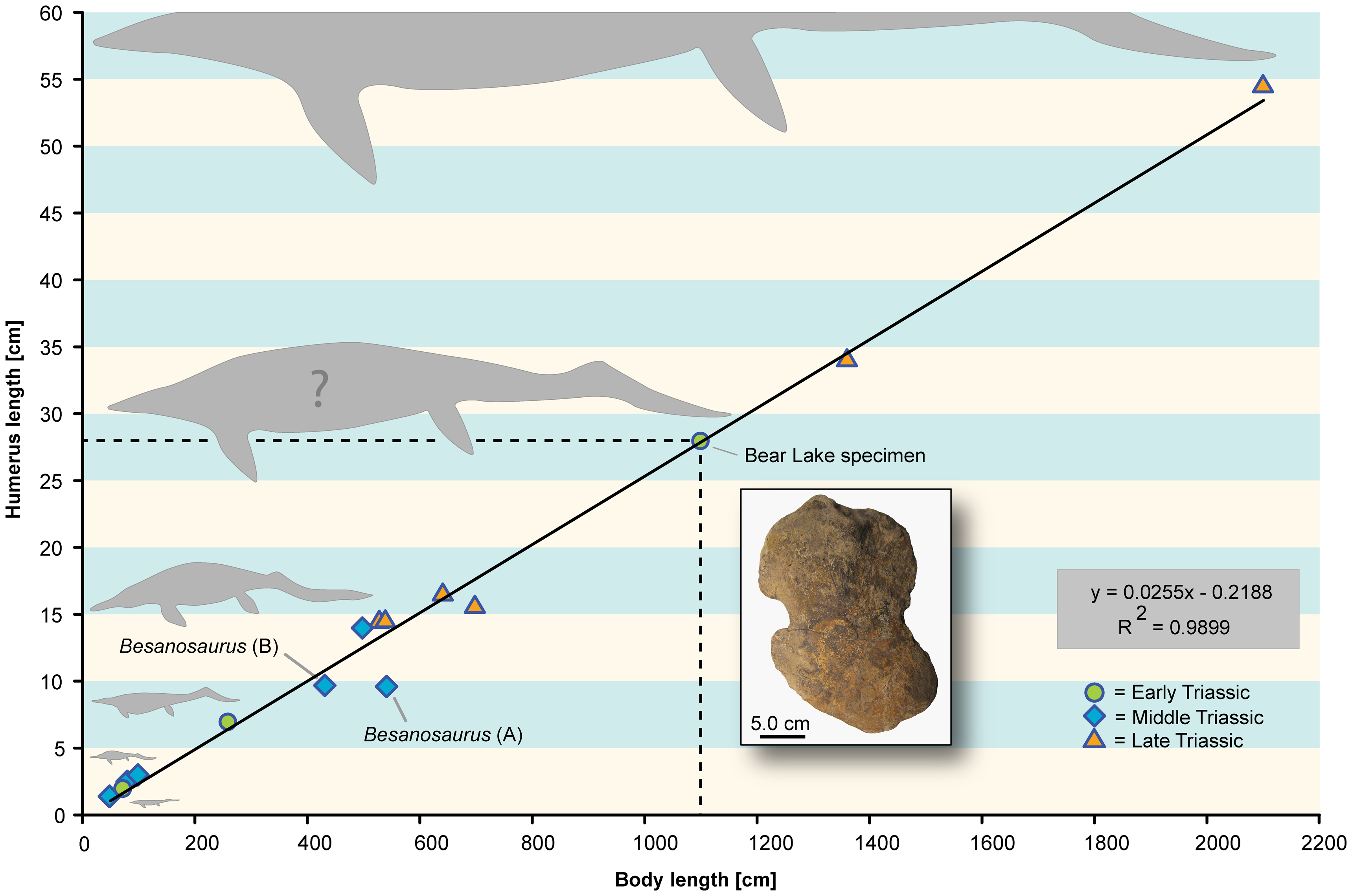
Cymbospondylus youngorum is a giant ichthyosaur from the Middle Triassic, described in 2021 by Sander and colleagues in Science. At roughly 17.65 meters long and an estimated 44.7 metric tons, it was the largest vertebrate of its time, on land or sea, and is considered the first true giant of the Mesozoic oceans. Its nearly 2-meter-long skull is elongated and filled with conical teeth bearing longitudinal ridges, suggesting a generalist diet of squid, fish, and possibly other marine reptiles. It was found in the Fossil Hill Member of the Favret Formation in the Augusta Mountains of Nevada, around 246 million years ago. The most striking aspect is evolutionary: the species appeared only about 3 million years after the first ichthyosaurs, showing that the lineage reached gigantism far faster than modern whales, which took tens of millions of years to achieve comparable size.
Geological formation & environment
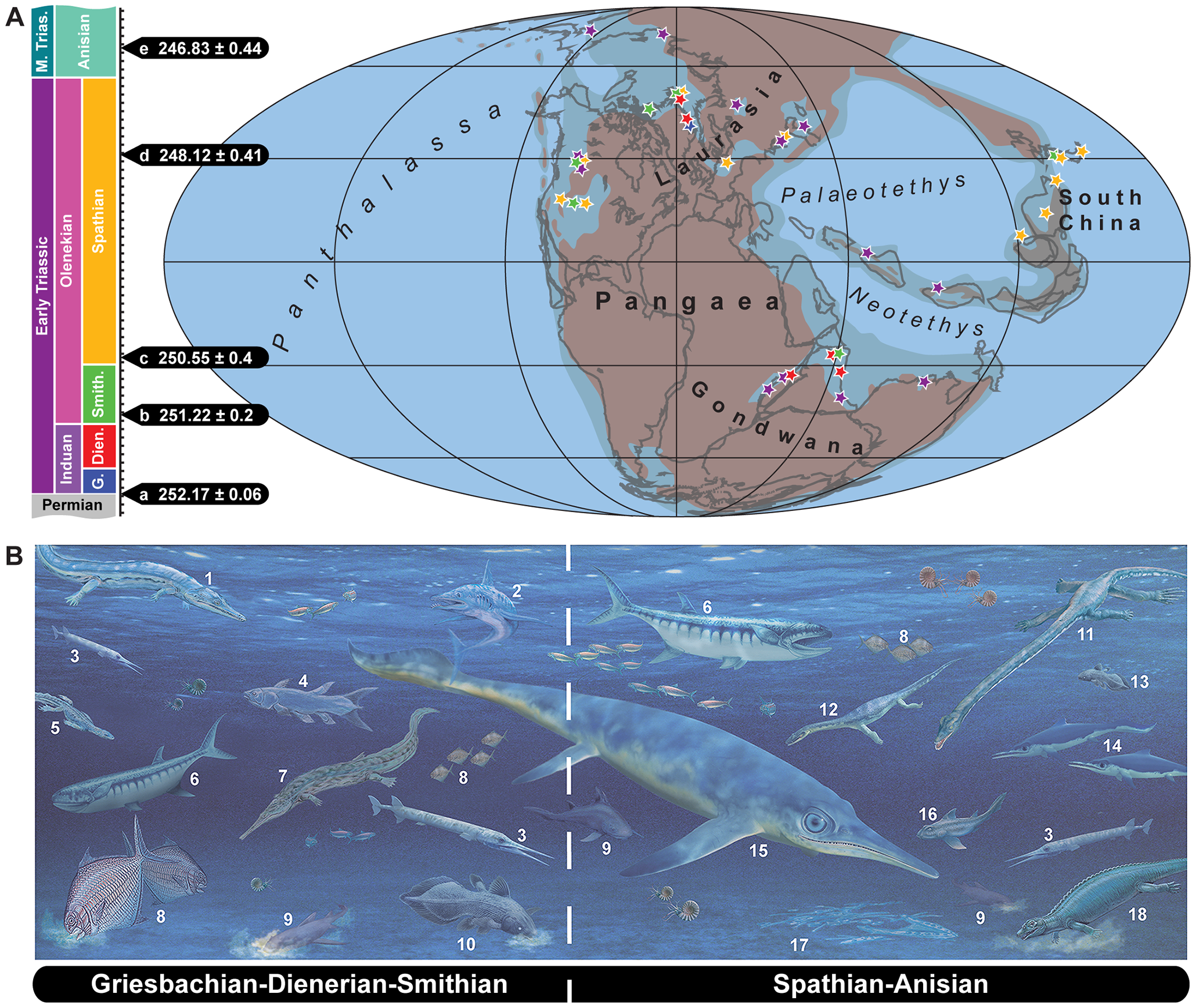
The Fossil Hill Member is a Middle Triassic (Anisian) unit that crops out in Nevada as part of the Favret and Prida formations. It represents a deep pelagic marine environment, deposited tens of kilometers from the eastern paleocoast of the Panthalassa Ocean, with carbonate mud sediments below wave base. The unit is famous for preserving an entire marine ecosystem, with abundant ceratitid ammonoids, bony fishes, hybodont sharks, pistosaurs, and, most importantly, several large-bodied ichthyosaurs. In addition to C. youngorum, the site has also yielded the macropredator Thalattoarchon saurophagis, the ichthyosaur Phalarodon, and the enigmatic Omphalosaurus. The Augusta Mountains, where the holotype was found, are today a mandatory reference for any research on the early evolution of giant ichthyosaurs.
Image gallery
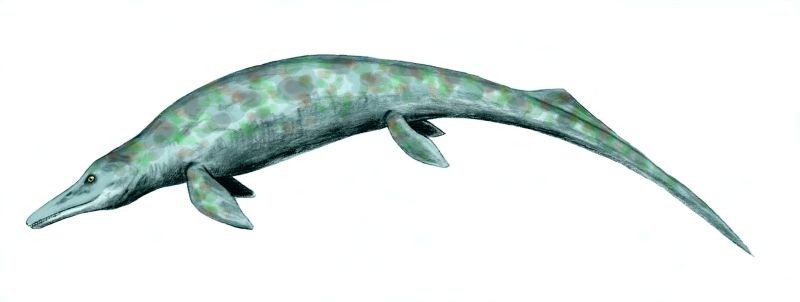


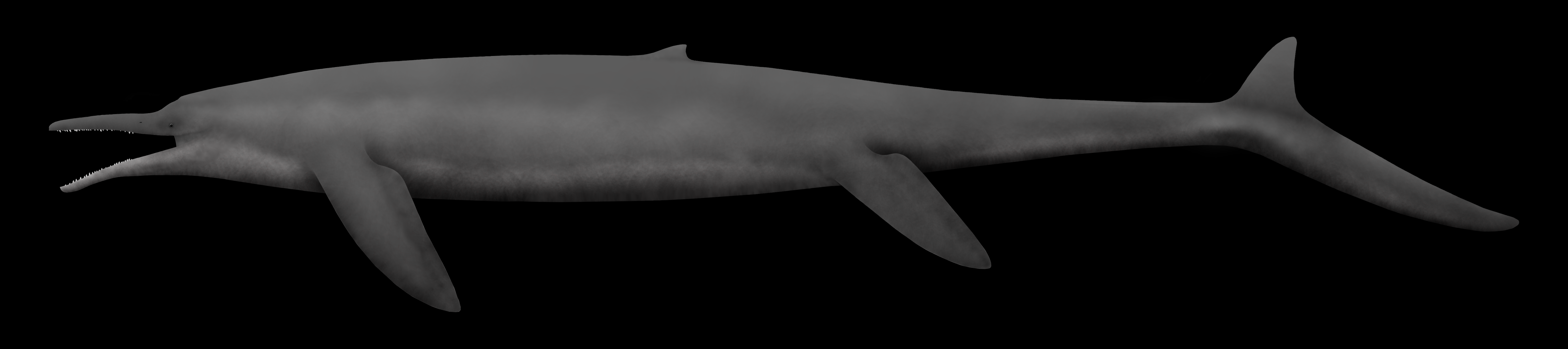


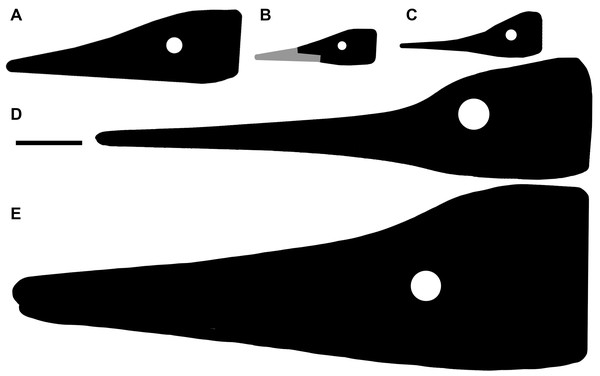


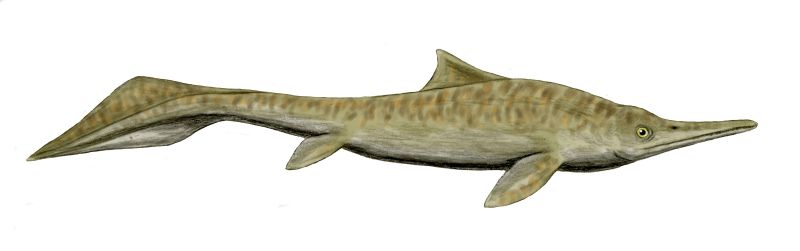
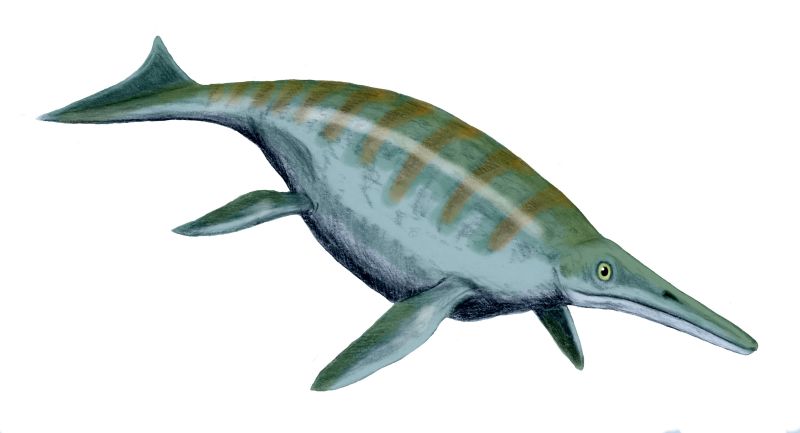
Classic black-and-white reconstruction of Cymbospondylus petrinus by Nobu Tamura (2007), an artistic reference widely used in paleontological literature.
Nobu Tamura / Wikimedia Commons / CC BY-SA 3.0
Ecology and behavior
Habitat
C. youngorum lived in the Anisian of the Middle Triassic, about 246 million years ago, in open sea on the eastern margin of the Panthalassa Ocean. The Fossil Hill Member represents a deep pelagic environment, tens of kilometers from the paleocoast, with carbonate mud sediments deposited below wave base. The ecosystem was dominated by ceratitid cephalopods, bony fishes like Saurichthys, coelacanths, hybodont sharks, and other marine reptiles including Thalattoarchon, Phalarodon, and Omphalosaurus.
Feeding
The skull anatomy suggests a generalist diet: elongated snout with 43 teeth in the upper jaw and more than 31 in the lower, conical with longitudinal ridges. Likely prey included squid, pelagic fish, and possibly other smaller ichthyosaurs. The energetic modeling published by Sander et al. (2021) suggests that the animal actively fed on an abundant cephalopod prey base after the Permian-Triassic extinction. The thick tissue base supporting the teeth is a unique trait among ichthyosaurs.
Behavior and senses
Behavior reconstructed from indirect evidence. The hydrodynamic morphology indicates sustained swimming in open sea, compatible with a lifestyle similar to modern sperm whales. By analogy with C. duelferi (Klein et al. 2020), which preserves three embryos in utero, viviparity is inferred in C. youngorum. No direct evidence of social behavior or pack hunting exists, but coexistence with multiple apex predators suggests niche sharing through specialization.
Physiology and growth
As a derived but basal ichthyosaur, C. youngorum was likely endothermic to some degree. Body size suggests deep dives with large lungs, although the comparatively small eyes indicate hunting in the euphotic (lit) zone rather than the mesopelagic like Ophthalmosaurus. Bone histology studies of Cymbospondylus indicate rapid growth in the early years of life, necessary to reach tens of tons in a short geological time.
Paleogeography
Continental configuration

Ron Blakey · CC BY 3.0 · Triassic, ~90 Ma
During the Anisiano (~247–244 Ma), Cymbospondylus youngorum inhabited Pangea, the single supercontinent joining all modern continents. Climate was dry and hot across much of the continental interior.
Bone Inventory
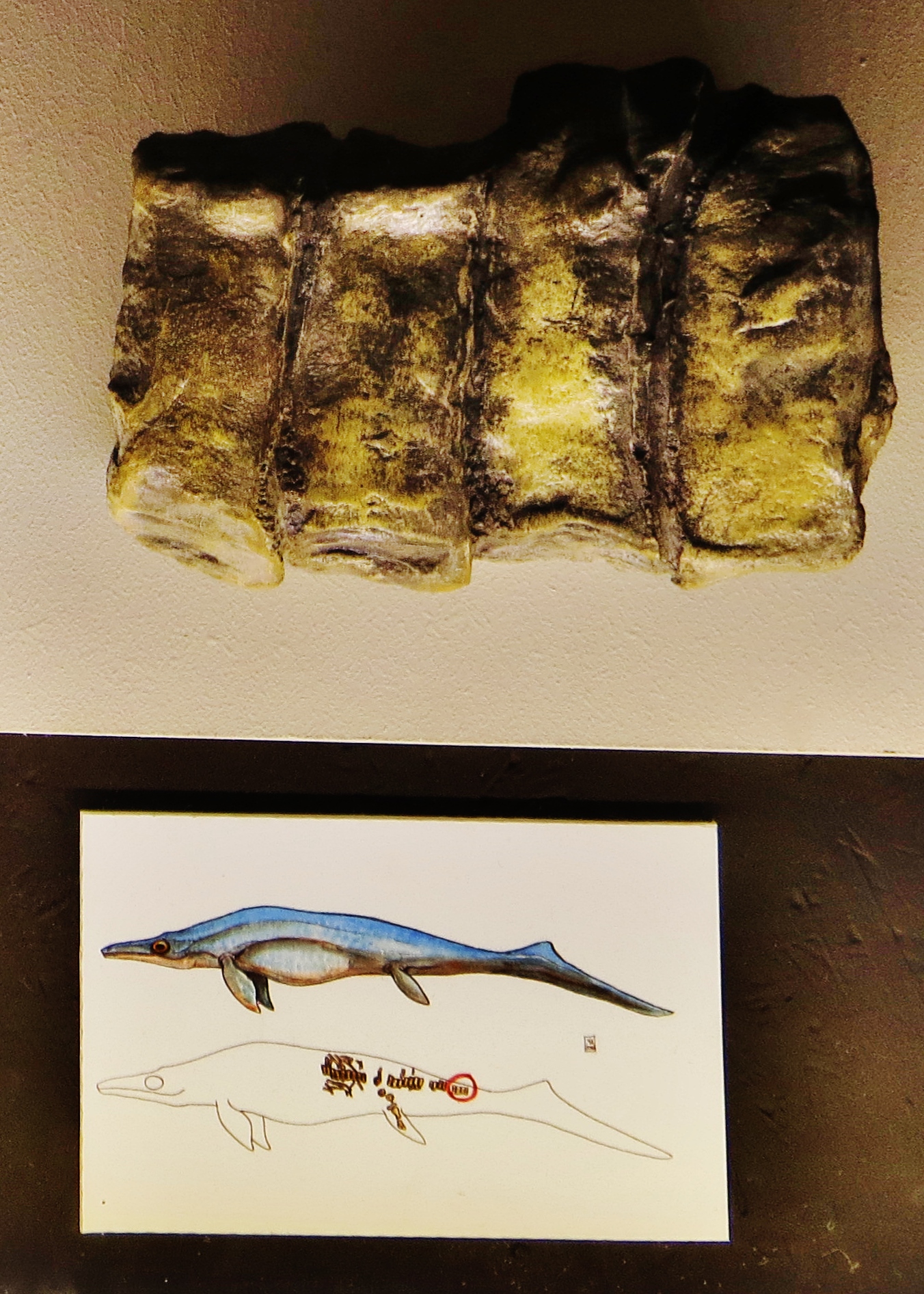
The holotype LACM DI 157871 preserves a complete skull nearly 2 meters long, cervical vertebrae, the right humerus (the second largest ichthyosaur humerus ever recorded), and pectoral girdle fragments. The absence of tail, pelvis, and hind limbs reduces completeness to around 35%, but the exceptional cranial material allowed confident species identification. The 17.65-meter total length was estimated by Sander et al. (2021) from humerus and skull proportions, compared with more complete specimens of the genus.
Found elements
Inferred elements
Scientific Literature
15 papers in chronological order — from the original description to recent research.
Notice of some remains of extinct vertebrates from the Upper Missouri and Pacific railroad surveys
Leidy, J. · Proceedings of the Academy of Natural Sciences of Philadelphia
Joseph Leidy established the genus Cymbospondylus from fossil vertebrae collected in the Middle Triassic of Nevada. The name comes from Greek and literally means cup-shaped vertebra, referring to the concave shape of the vertebral bodies. The type species C. piscosus is today considered a nomen dubium, but the genus has remained valid. This work opened the first scientific window into North American ichthyosaurs and served as the starting point for all subsequent descriptions, including that of C. youngorum in 2021.
Triassic Ichthyosauria, with special reference to the American forms
Merriam, J.C. · Memoirs of the University of California
John Campbell Merriam produced the foundational monograph on American Triassic ichthyosaurs, with detailed osteological descriptions of Cymbospondylus specimens collected in Nevada. The work established the anatomical baseline of the genus: elongated skull, serpentiform body, deeply concave vertebrae, paired fin-shaped limbs. Merriam's descriptions remain mandatory references for any new study of the genus, including the description of C. youngorum. Many specimens described by Merriam are held at the Museum of the University of California, Berkeley.

The large ichthyosaur Cymbospondylus buchseri, sp. nov., from the Middle Triassic of Monte San Giorgio (Switzerland), with a survey of the genus in Europe
Sander, P.M. · Journal of Vertebrate Paleontology
Paul Martin Sander described Cymbospondylus buchseri from specimens at Monte San Giorgio, Switzerland, confirming the transcontinental distribution of the genus in the Middle Triassic. The Swiss specimen preserves tail and fins that are missing in most North American examples, allowing reconstruction of the complete postcranial anatomy. Sander established, through this work, the research lineage that nearly 35 years later would lead to the discovery of C. youngorum in 2021. The paper also includes the first comprehensive survey of European records of the genus.
Cymbospondylus (Ichthyosauria: Shastasauridae) from the Lower Triassic Thaynes Formation of southeastern Idaho
Massare, J.A. & Callaway, J.M. · Journal of Vertebrate Paleontology
Massare and Callaway documented Cymbospondylus material from the Thaynes Formation in the Lower Triassic of Idaho, significantly expanding the stratigraphic distribution of the genus. The discovery suggested that the genus already existed before the Middle Triassic peak, prefiguring the hypothesis of rapid large-size evolution that would be confirmed decades later by the description of C. youngorum. The work also provided comparative parameters for later studies of body size in the lineage.
A new species of Cymbospondylus (Diapsida, Ichthyosauria) from the Middle Triassic of Nevada and a re-evaluation of the skull osteology of the genus
Fröbisch, N., Sander, P.M. & Rieppel, O. · Zoological Journal of the Linnean Society
Fröbisch, Sander, and Rieppel described Cymbospondylus nichollsi from Middle Triassic material in Nevada and thoroughly re-evaluated the cranial osteology of the entire genus. The work identified new diagnostic characters in the skull bones, such as suture patterns and temporal region morphology, that would later be used by Sander et al. (2021) to diagnose C. youngorum. The cranial osteology revision remains the basis for any new species description in the genus.

Cymbospondylus vertebrae (Ichthyosauria, Shastasauridae) from the Upper Anisian Prezzo Limestone (Middle Triassic, Southern Alps) with an overview of the chronostratigraphic distribution of the group
Balini, M. & Renesto, S.C. · Rivista Italiana di Paleontologia e Stratigrafia
Balini and Renesto described Cymbospondylus vertebrae from the Upper Anisian Prezzo Limestone Formation in the Italian Alps, expanding the European record of the genus and providing key data on its chronostratigraphic distribution. The paper presents a synthesis of which Early and Middle Triassic stages the genus appears in, which helped Sander et al. (2021) to temporally position C. youngorum within the history of the clade. The chronostratigraphic distribution of the genus reinforces the thesis that gigantism evolved rapidly.

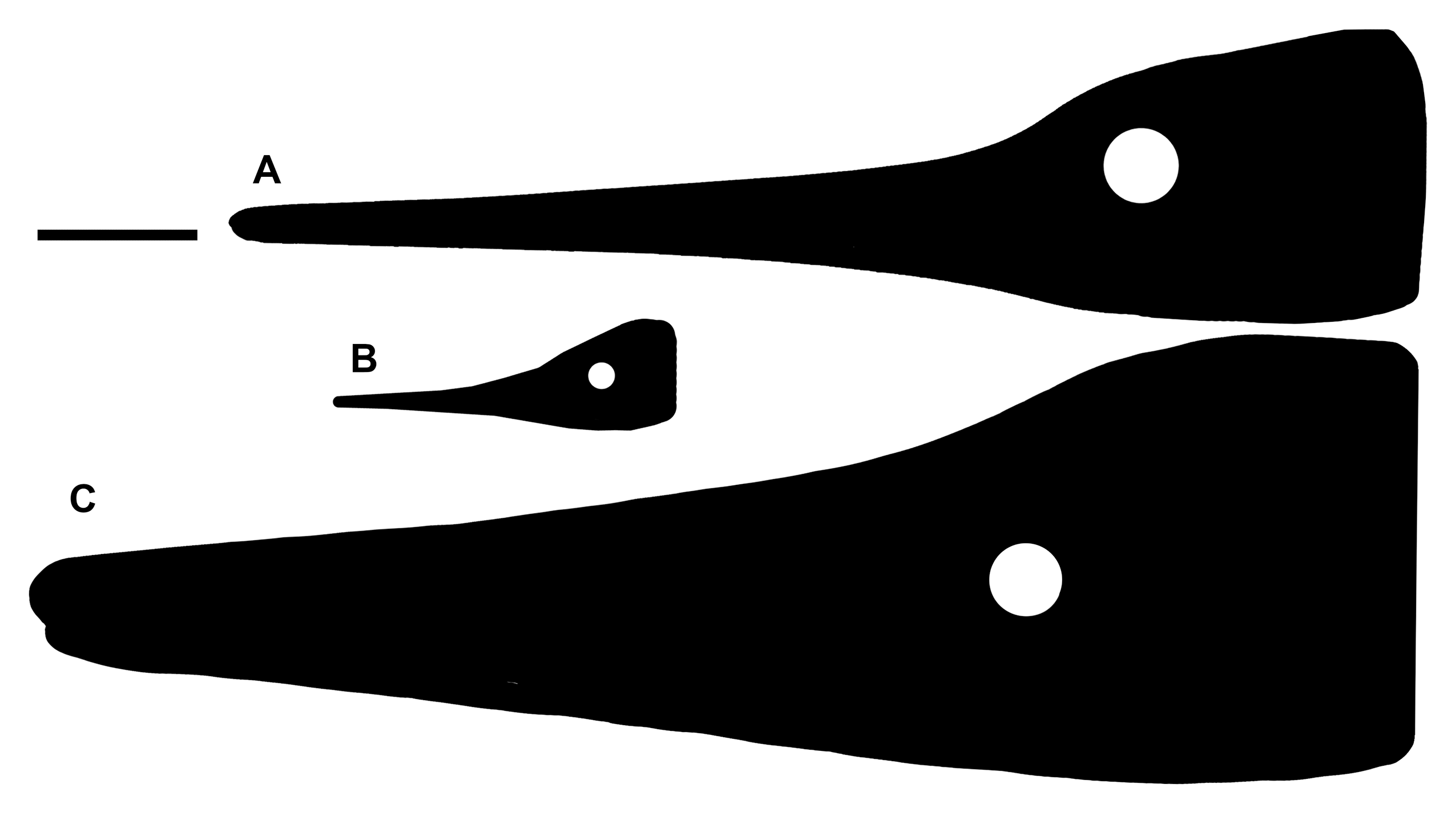
Macropredatory ichthyosaur from the Middle Triassic and the origin of modern trophic networks
Fröbisch, N.B., Fröbisch, J., Sander, P.M., Schmitz, L. & Rieppel, O. · Proceedings of the National Academy of Sciences USA
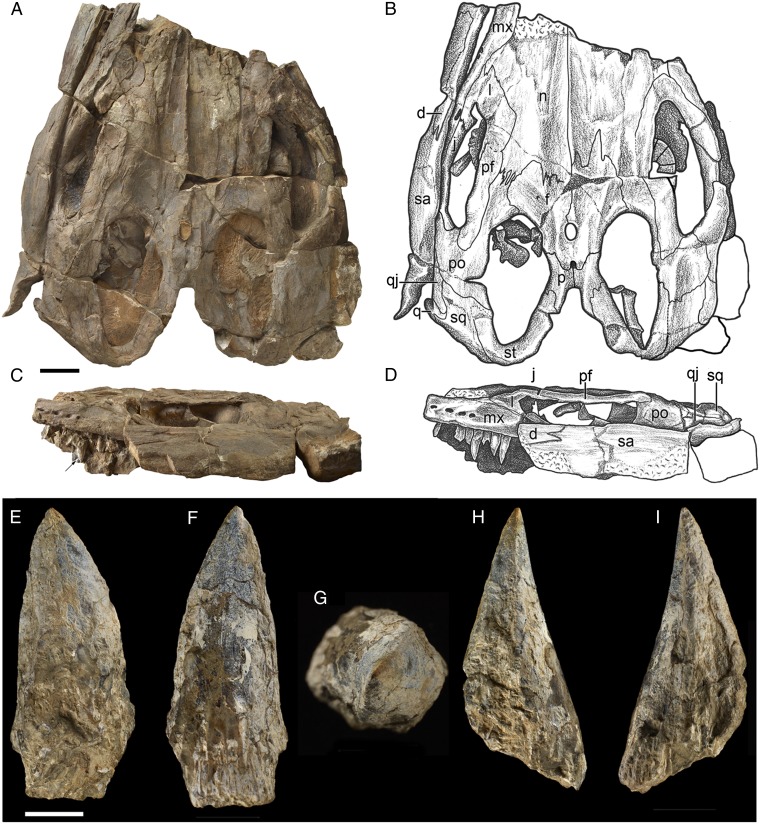
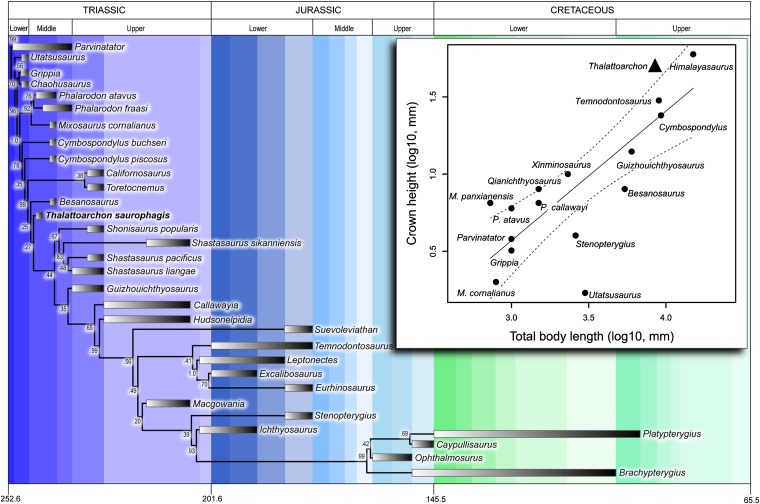
Fröbisch and colleagues described Thalattoarchon saurophagis, the lizard-eating sovereign of the sea, a macropredatory ichthyosaur over 8.6 meters long found in the same Fossil Hill Member of Nevada where C. youngorum would later be discovered. The work showed that the modern marine trophic network, with apex predators hunting prey their own size, already existed only 8 million years after the Permian-Triassic extinction. Thalattoarchon is contemporary and sympatric with C. youngorum and shares the ecosystem described by Sander et al. (2021).


Early Triassic marine biotic recovery: the predators' perspective
Scheyer, T.M., Romano, C., Jenks, J. & Bucher, H. · PLOS ONE
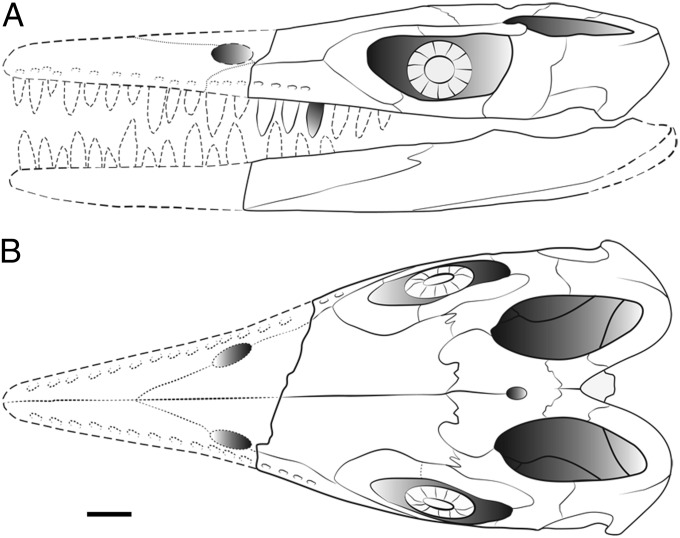
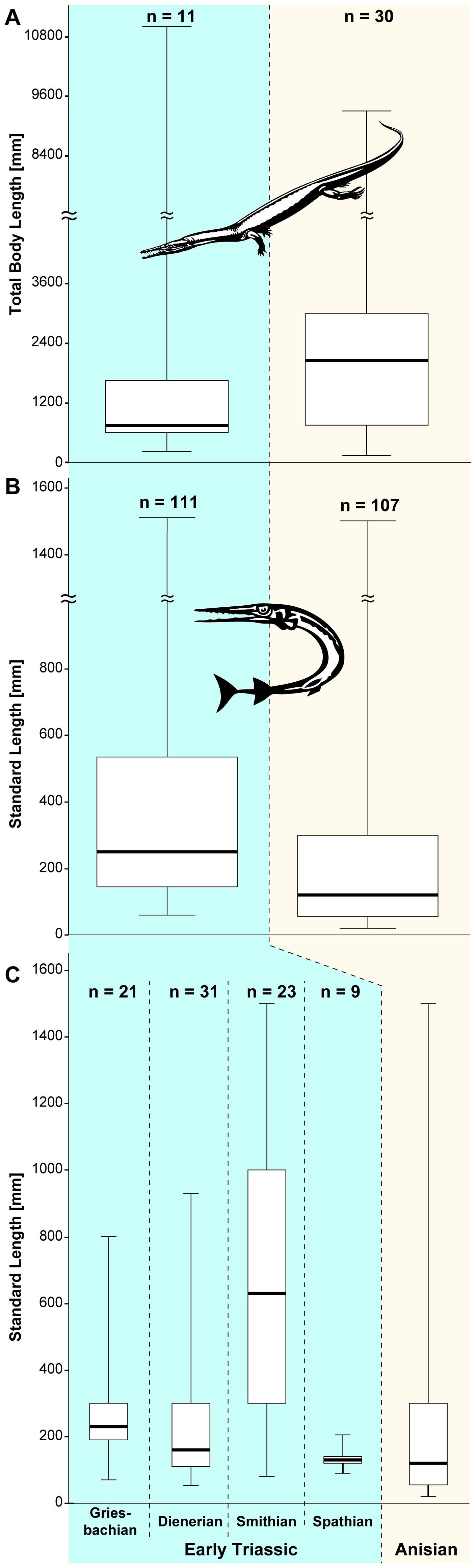
Scheyer and colleagues analyzed Early Triassic marine biotic recovery from the perspective of predators. The authors identified signs of apex predator diversity and complexity much earlier than previously assumed, including evidence of basal ichthyosaurs like Cymbospondylus and a possible giant humerus from the Lower Triassic of Idaho. The article is a direct precursor to the conclusions of Sander et al. (2021): the recovery of marine trophic networks was faster than the classical model predicted, and ichthyosaurs were protagonists of that recovery.

Large-sized ichthyosaurs from the Lower Saurian niveau of the Vikinghøgda Formation (Early Triassic), Marmierfjellet, Spitsbergen
Engelschiøn, V.S., Delsett, L.L., Roberts, A.J. & Hurum, J.H. · Norwegian Journal of Geology
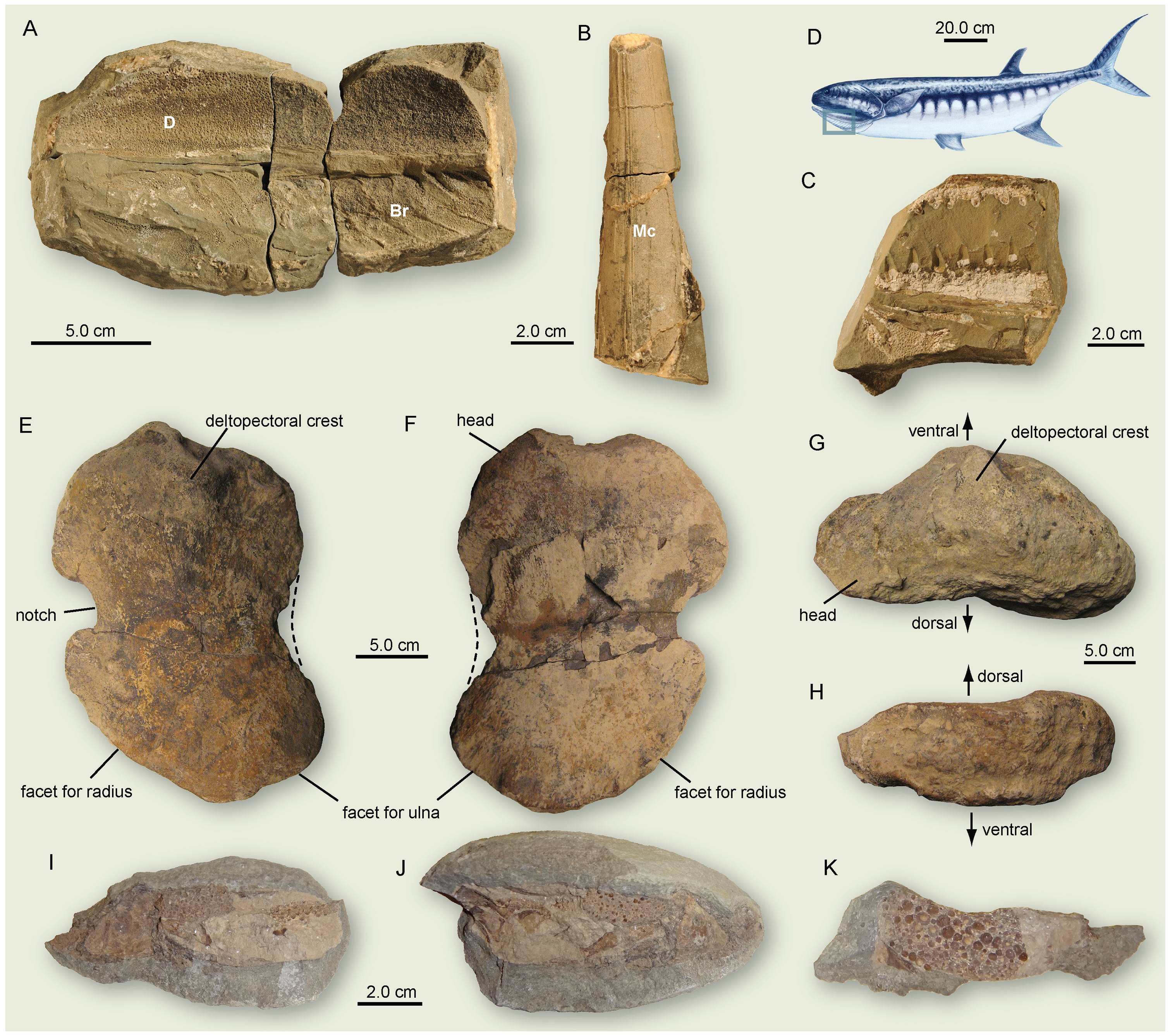
Engelschiøn and colleagues documented remains of large-sized ichthyosaurs from the Lower Triassic of Spitsbergen, in the Svalbard islands of Norway. The authors describe vertebrae and jaw fragments that geographically expand the record of large ichthyosaurs to the Arctic and provide evidence that gigantism was already emerging before the Anisian. This work preceded and supported the thesis defended by Sander et al. (2021) that C. youngorum was the result of a rapid evolutionary escalation beginning a few million years after the Permian-Triassic extinction.

A new phylogeny of ichthyosaurs (Reptilia: Diapsida)
Moon, B.C. · Journal of Systematic Palaeontology
Benjamin Moon published a new comprehensive ichthyosaur phylogeny based on a revised character matrix. Cymbospondylus was recovered as one of the most basal ichthyosaurs, outside Hueneosauria, a position that would later be confirmed by the analyses of Bindellini et al. (2021) and Sander et al. (2021). Moon's work is the modern reference phylogenetic matrix for basal ichthyosaurs and the methodological basis for the evolutionary hypotheses discussed in the description of C. youngorum, including the recovery of Cymbospondylidae as a distinct family.

A new cymbospondylid ichthyosaur (Ichthyosauria) from the Middle Triassic (Anisian) of the Augusta Mountains, Nevada, USA
Klein, N., Schmitz, L., Wintrich, T. & Sander, P.M. · Journal of Systematic Palaeontology
Klein, Schmitz, Wintrich, and Sander described Cymbospondylus duelferi from Anisian material in the Augusta Mountains of Nevada, setting the methodological stage for the description of C. youngorum the following year. The work recovered the Nevadan Cymbospondylus species as a monophyletic clade, separate from European species, and formalized the family Cymbospondylidae. The holotype of C. duelferi also preserves embryonic remains, confirming viviparity in the genus, crucial information for understanding the reproductive biology of the entire lineage.

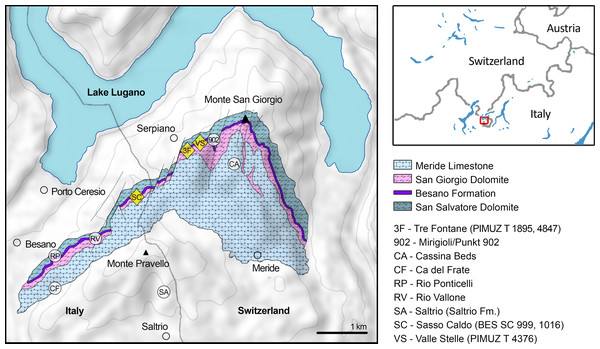
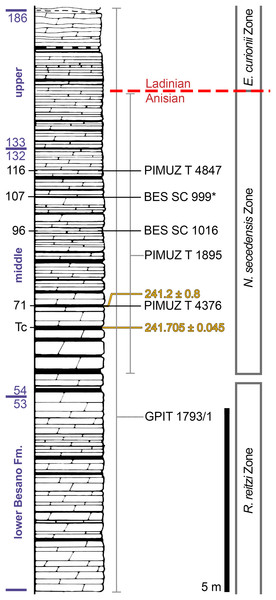
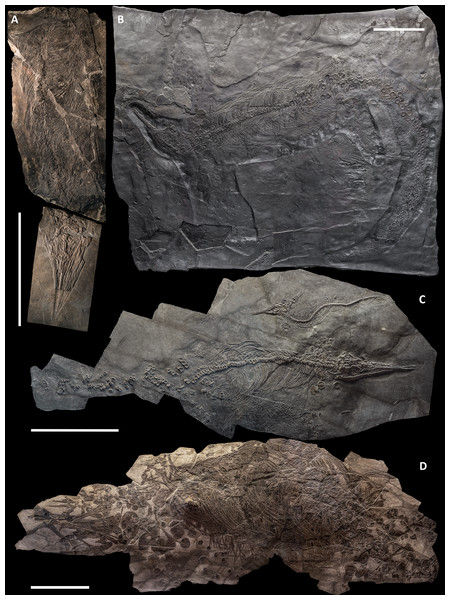
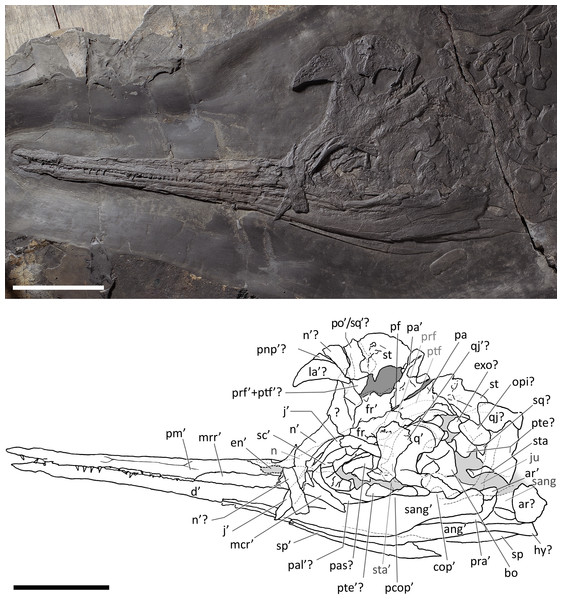
Cranial anatomy of Besanosaurus leptorhynchus Dal Sasso & Pinna, 1996 (Reptilia: Ichthyosauria) from the Middle Triassic Besano Formation of Monte San Giorgio, Italy/Switzerland: taxonomic and palaeobiological implications
Bindellini, G., Wolniewicz, A.S., Miedema, F., Scheyer, T.M. & Dal Sasso, C. · PeerJ
Bindellini and colleagues reviewed the cranial anatomy of Besanosaurus leptorhynchus in a broad phylogenetic analysis that positioned Cymbospondylus as one of the most basal ichthyosaurs, in a more basal position even than Mixosauridae. The work is relevant to C. youngorum because it establishes the phylogenetic framework in which the gigantism of the species is interpreted: if Cymbospondylus is basal, the attainment of gigantism by C. youngorum means that the trait evolved rapidly and independently, without passing through more derived ichthyosaur lineages.

Early giant reveals faster evolution of large body size in ichthyosaurs than in cetaceans
Sander, P.M., Griebeler, E.M., Klein, N., Velez Juarbe, J., Wintrich, T., Revell, L.J. & Schmitz, L. · Science
The founding paper of C. youngorum. Sander and colleagues describe holotype LACM DI 157871, with a nearly 2-meter skull, cervical vertebrae, right humerus, and pectoral girdle fragments, collected in the Fossil Hill Member of the Favret Formation. The authors estimate a maximum length of 17.65 meters and weight of 44.7 metric tons, and show that gigantism in ichthyosaurs evolved approximately twice as fast as in modern cetaceans. The work presents energetic modeling comparing the two groups and concludes that the abundant pelagic prey base in the aftermath of the Permian-Triassic extinction, especially cephalopods, fueled the rapid size escalation.
Early and fast rise of Mesozoic ocean giants
Delsett, L.L. & Pyenson, N.D. · Science
Lene Delsett and Nicholas Pyenson wrote the Perspective commentary in the same issue of Science in which C. youngorum was described. The authors contextualize the discovery within the broader evolutionary history of marine giants, comparing ichthyosaurs, plesiosaurs, mosasaurs, and cetaceans. The main conclusion is that C. youngorum represents a mode of large-size evolution distinct from that of whales: faster, earlier, and apparently linked to a dense pelagic prey base of cephalopods. The article is a mandatory reference for discussions of Mesozoic marine gigantism.


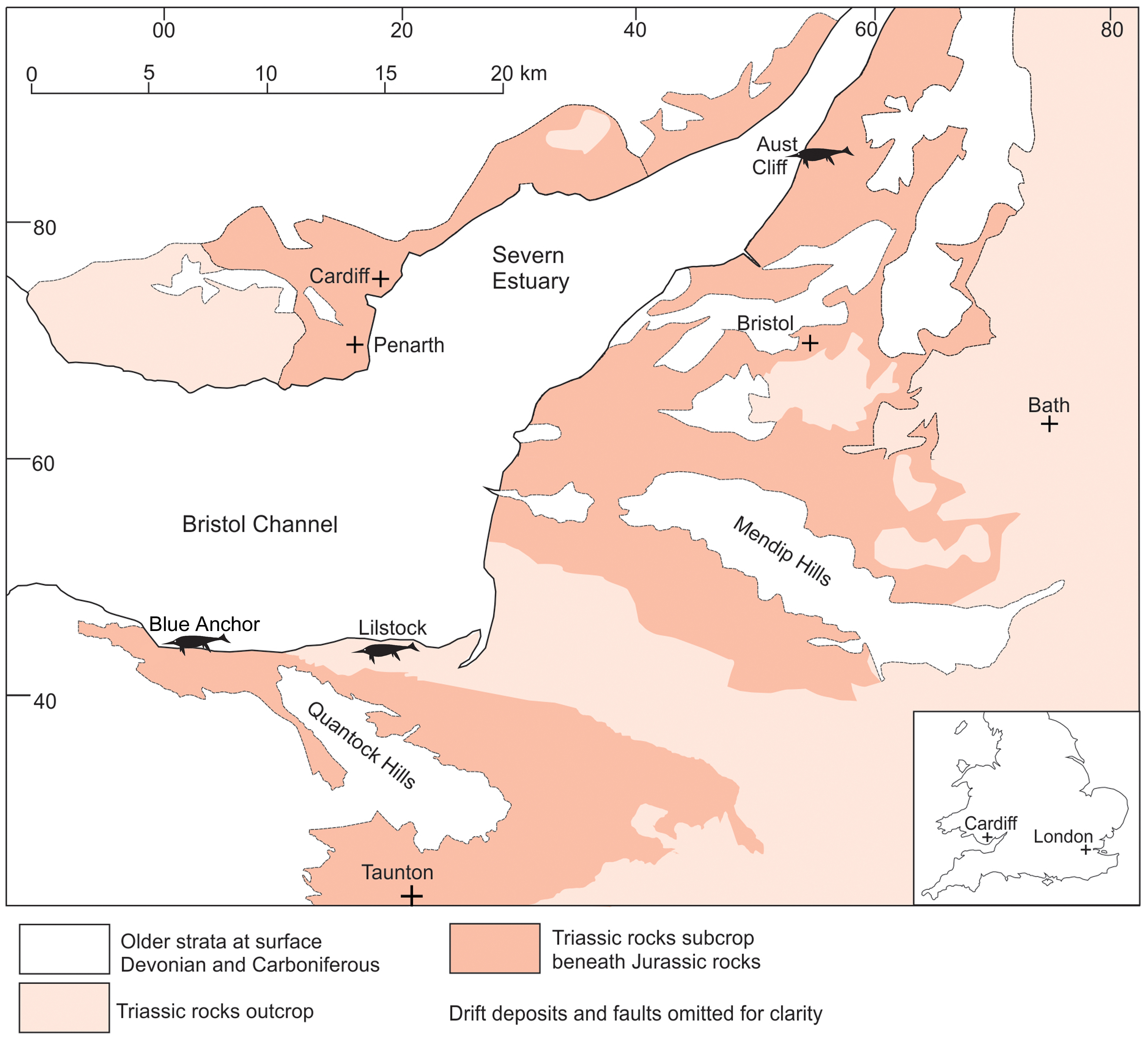
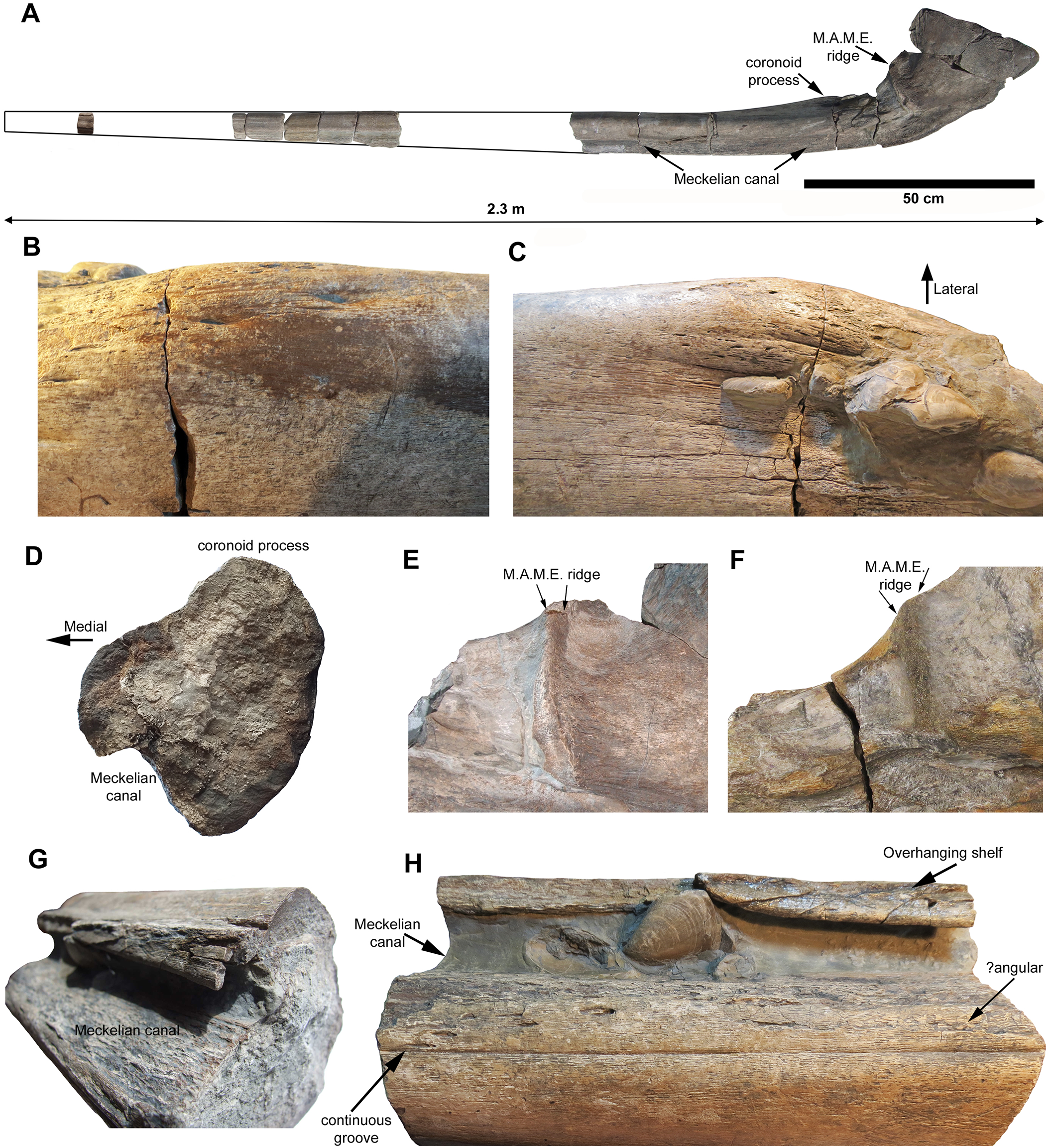
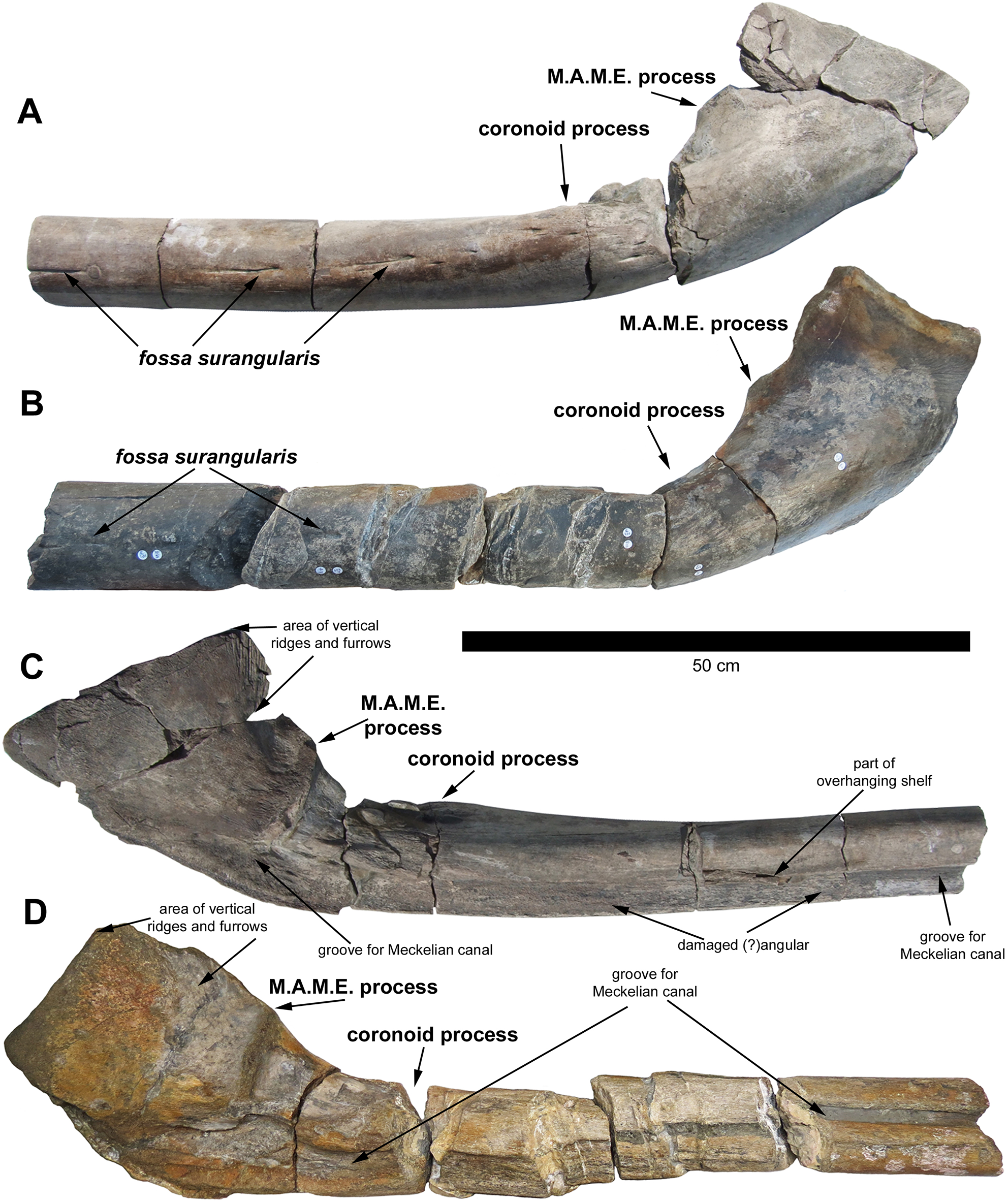
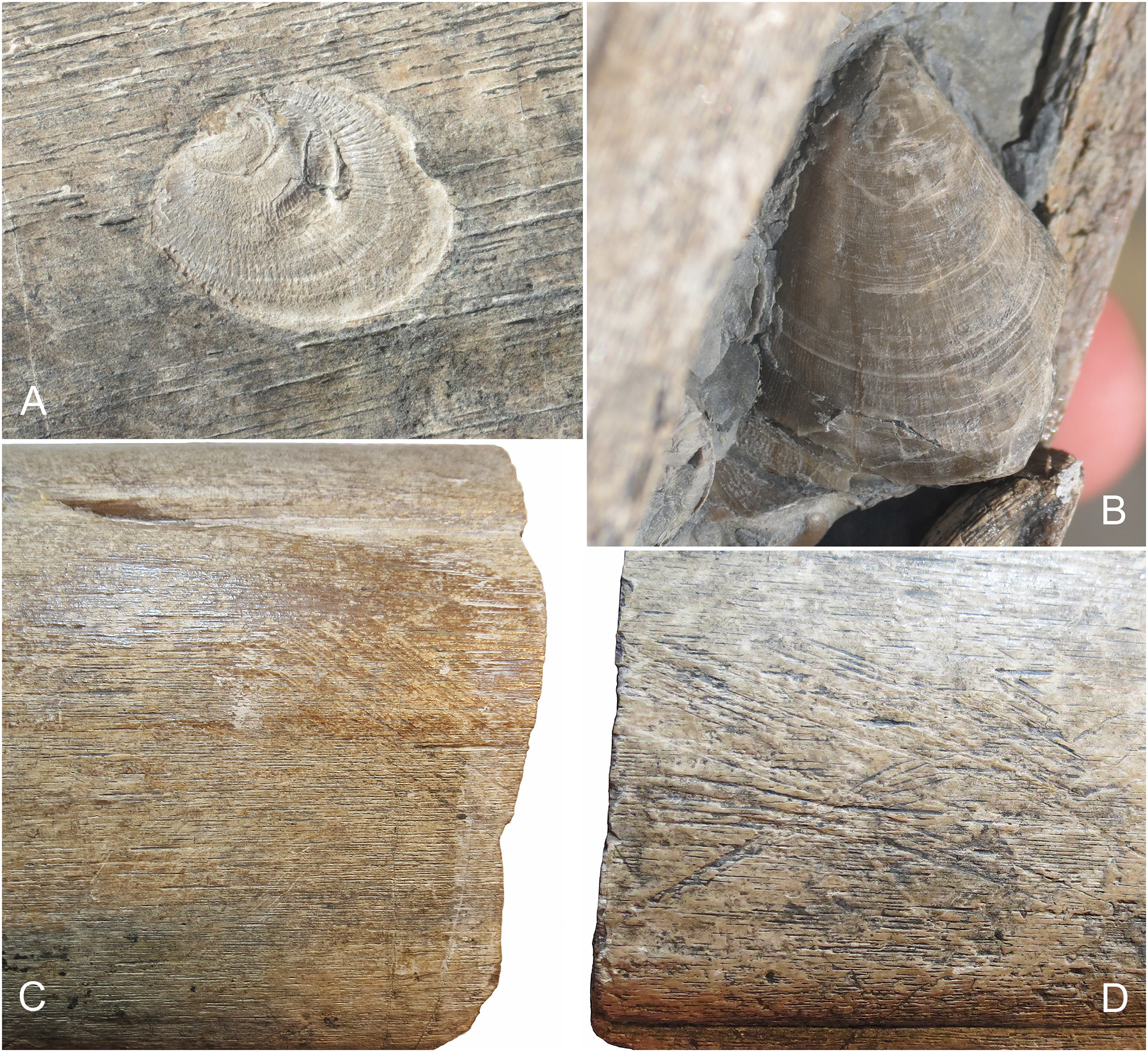
The last giants: New evidence for giant Late Triassic (Rhaetian) ichthyosaurs from the UK
Lomax, D.R., De la Salle, P., Perillo, M., Reynolds, J., Reynolds, R. & Waldron, J.F. · PLOS ONE
Lomax and colleagues described Ichthyotitan severnensis, a giant Late Triassic (Rhaetian) ichthyosaur from the UK, with estimates of up to 25 meters in length. The work is relevant for understanding C. youngorum because it demonstrates that gigantism in ichthyosaurs was not a single event: it reappears throughout the history of the clade, suggesting that ecological pressures and the pelagic prey base allowed repeated size escalations. The Anisian (C. youngorum) versus Rhaetian (Ichthyotitan) contrast frames gigantism as a recurring trait in ichthyosaurs.


Famous museum specimens
LACM DI 157871 (holótipo)
Natural History Museum of Los Angeles County, Los Angeles, EUA
Holotype of Cymbospondylus youngorum, includes a complete skull nearly 2 meters long, cervical vertebrae, right humerus (the second largest ichthyosaur humerus ever recorded), and pectoral girdle fragments. Exhumed between 2014 and 2015 in the Augusta Mountains of Nevada and described in 2021. On permanent display at the museum in Los Angeles.
Cymbospondylus sp. (Seceda)
Museum de Gherdëina, Urtijëi, Tirol do Sul, Itália
European specimen attributed to the genus Cymbospondylus from the Middle Triassic of the Italian Dolomites. The museum also displays a life-size model approximately 9 meters long representing the genus, useful as a comparative visual reference for C. youngorum.
In cinema and popular culture
Cymbospondylus youngorum is a species described in 2021, just five years ago, and has therefore not yet significantly entered pop culture. The genus Cymbospondylus in general has had only one relevant appearance, in the BBC docufiction series Chased by Sea Monsters (2003), where it is shown as a slow, treacherous predator of Triassic seas. Because the discovery of C. youngorum is recent, there has not yet been a specific representation of this species in mainstream films or documentaries like Prehistoric Planet or Life on Our Planet. The greatest media reach of C. youngorum to date was the release of the Science paper itself in December 2021, accompanied by massive coverage in the scientific press (New York Times, Live Science, National Geographic, Sci-News), and the institutional video Earth's First Giant produced by the Natural History Museum of Los Angeles County. Future productions about Triassic marine life will likely include the species now that the title of Earth's first ocean giant has been recognized.
Classification


Discovery
Fun fact
The species Cymbospondylus youngorum was named in honor of Tom and Bonda Young, owners of a Nevada brewery called Great Basin Brewing Company. Tom Young created a beer called Ichthyosaur IPA in tribute to the state's fossils. After the Youngs financed the giant's excavation, the team decided to honor them in the scientific name of the ichthyosaur, making this perhaps the first extinct animal named after a beer.
Last reviewed: April 24, 2026