US · 76–75 Ma
Nasutoceratops
Nasutoceratops titusi
"Big-nosed horned face, honoring Alan Titus"
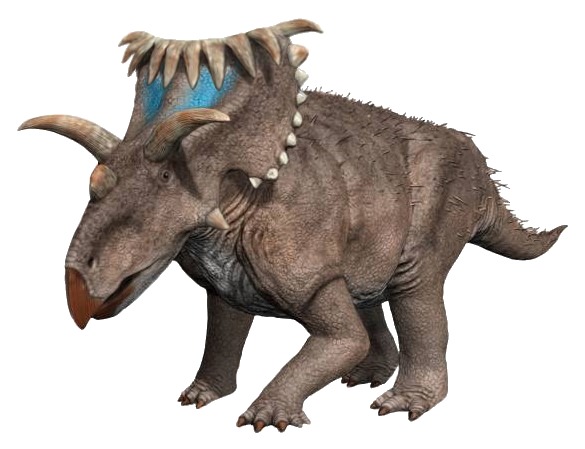
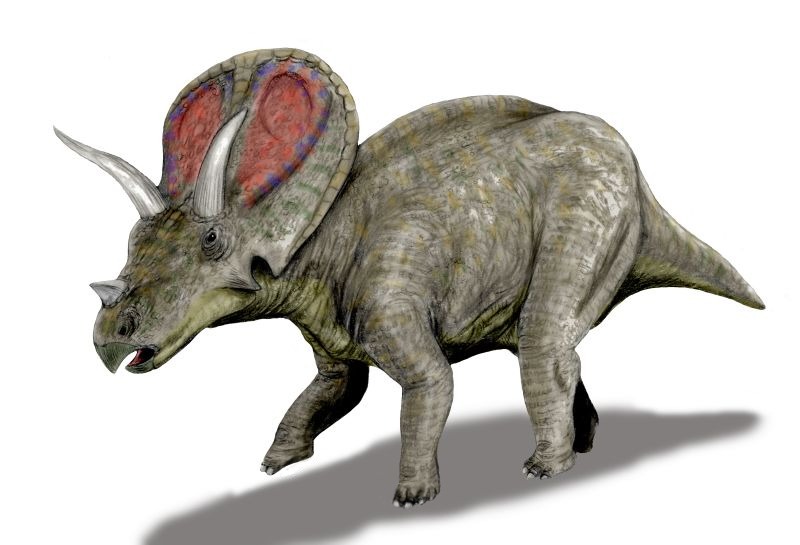
Nasutoceratops titusi is a centrosaurine ceratopsid dinosaur that lived approximately 76 to 75 million years ago, during the late Campanian of the Cretaceous, in what is now southern Utah in the United States. The animal is immediately recognizable by two extraordinary diagnostic features: supraorbital horns that are extremely long, oriented laterally and curved upward and forward over the eye sockets in a pattern that researchers frequently compare to Texas Longhorn cattle, and a hypertrophied nasal cavity that gives the skull a bulbous, short-snouted appearance. No other known ceratopsid combines these two traits so strikingly, and it was precisely this anatomy without parallel that led the describers to erect not only a new genus and species but a new tribe within Centrosaurinae, the tribe Nasutoceratopsini.
The genus name comes from the Latin nasutus, meaning big-nosed, combined with the Greek keratops, horned face. The specific epithet titusi honors Alan L. Titus, the paleontologist at Grand Staircase-Escalante National Monument who supported the field expeditions that led to the discovery. The holotype, catalogued as UMNH VP 16800, was excavated in 2006 by then graduate student Eric K. Lund in the Kaiparowits Formation, within the national monument in Kane County, Utah. The specimen includes a sub-complete skull with mandible, with both supraorbital horns and the nasal region preserved, plus fused cervical vertebrae (syncervical) and associated post-cranial elements. The formal description was published on 10 July 2013 in Proceedings of the Royal Society B by Scott D. Sampson, Eric K. Lund, Mark A. Loewen, Andrew A. Farke, and Katherine E. Clayton.
The evolutionary significance of Nasutoceratops extends far beyond its unusual appearance. The species occupies a basal position within Centrosaurinae, retaining the long supraorbital horns characteristic of the common ancestor of Ceratopsidae, while derived centrosaurines such as Centrosaurus, Styracosaurus, and Pachyrhinosaurus dramatically reduced those horns above the eyes and developed, in their place, prominent nasal horns or bosses. This reverses the traditional intuition that long eye horns would be exclusive to chasmosaurines like Triceratops and Kosmoceratops. The tribe Nasutoceratopsini, formalized by Ryan, Holmes, Mallon, and colleagues in 2017, groups Nasutoceratops titusi, Avaceratops lammersi, and Xenoceratops foremostensis, all sharing this combination of short centrosaurine frill with long supraorbital horns and reduced nasal horn.
Nasutoceratops titusi is also a central piece in the debate over the intracontinental endemism of Laramidia, the island continent formed in the western portion of North America during the Late Cretaceous, when the Western Interior Seaway divided the continent into two landmasses. The fauna of the Kaiparowits Formation, in southern Utah, contains multiple endemic species that do not appear in contemporary northern formations in Alberta and Montana, and Nasutoceratops is, together with Kosmoceratops richardsoni and Utahceratops gettyi, one of the clearest markers of this pattern. The holotype and the mounted skeleton are on permanent display in the Past Worlds gallery of the Natural History Museum of Utah in Salt Lake City.
Cretaceous Herbivore 4.5m