EG · 95–94 Ma
Paralititan
Paralititan stromeri
"Stromer's tidal titan"
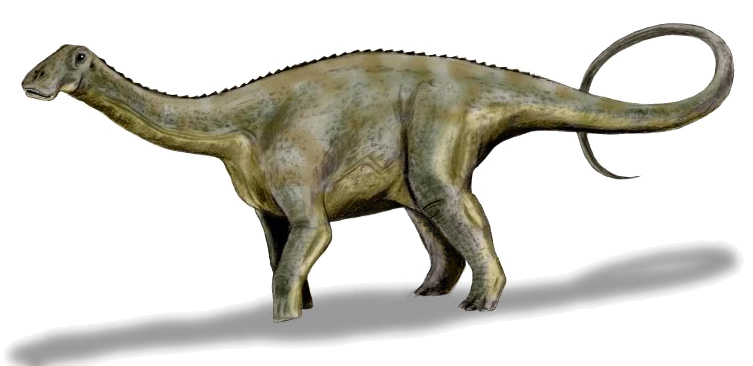
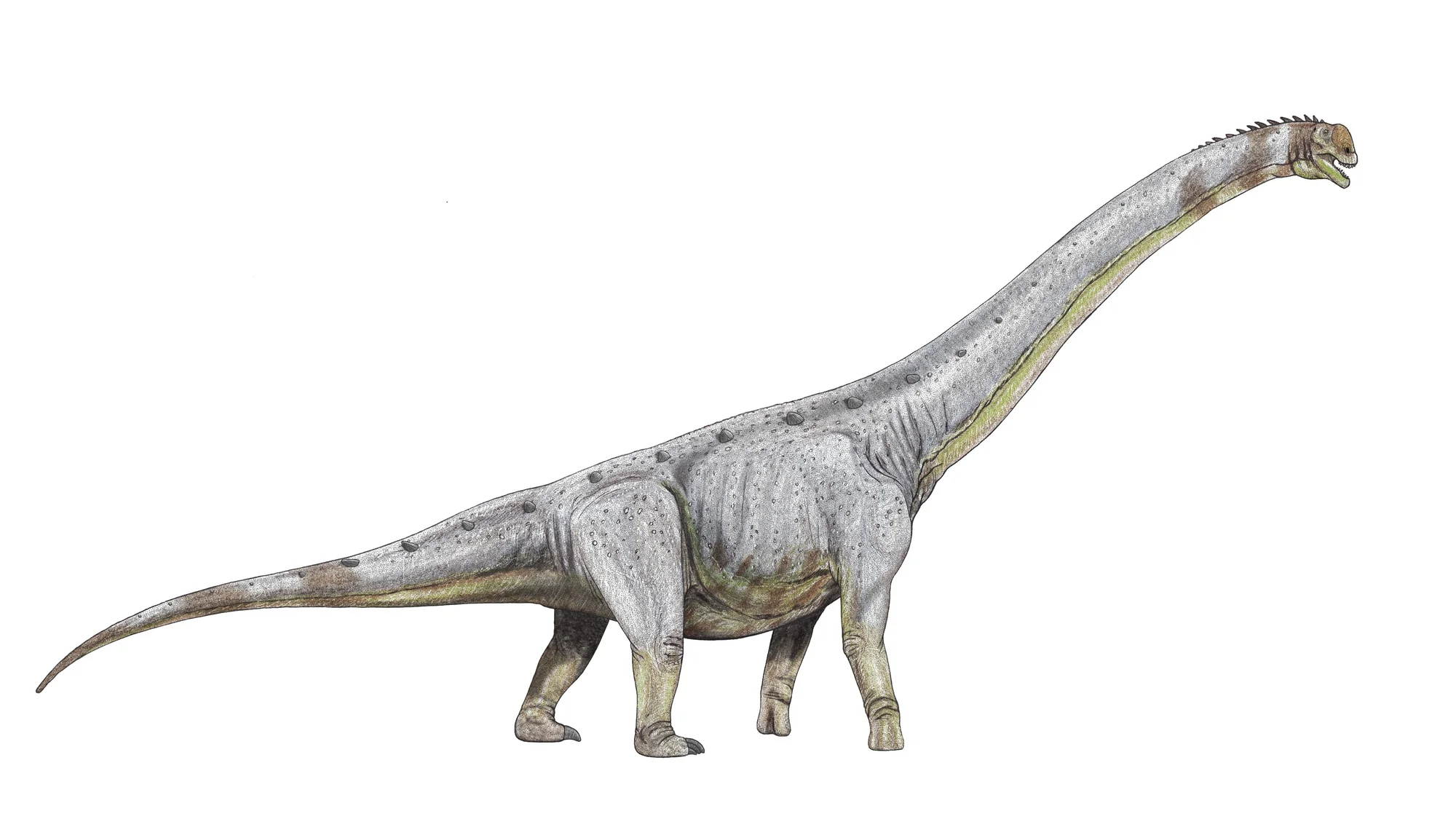
Paralititan stromeri is a giant titanosaur from the Cenomanian (about 95 to 94 million years ago) of the Bahariya Formation in the Bahariya Oasis of Egypt's Western Desert. It was described in 2001 by Joshua B. Smith, Matthew C. Lamanna, Kenneth J. Lacovara, Peter Dodson and colleagues in Science, based on holotype CGM 81119, a fragmentary but significant skeleton including two humeri (the right complete, at 1.69 metres long among the largest ever recovered in a Cretaceous sauropod at the time of description), two sacral vertebrae likely the fifth and sixth, an anterior caudal vertebra, dorsal and sacral ribs, incomplete scapulae and the distal end of a metacarpal. With only around 5 per cent of the skeleton preserved, Paralititan's dimensions are estimated by comparison with more complete relatives. Carpenter (2006) calculated about 26 metres in length using Saltasaurus as guide, while mass estimates vary widely depending on method, between 20 tonnes (Paul 2010), roughly 30 tonnes (Wikipedia, April 2026 revision), 50 tonnes (Gonzalez Riga et al. 2016, via humerus and femur circumference), 30 to 55 tonnes (Paul 2019) and 59 tonnes (2011 estimate). All these values are approximate and reflect the uncertainty intrinsic to fragmentary preservation. The animal lived in a coastal mangrove ecosystem, the first dinosaur scientifically demonstrated to inhabit this type of environment. The deposit preserving the holotype is a tidal flat dominated by the seed fern Weichselia reticulata, and a Carcharodontosaurus tooth associated with the skeleton suggests immediate scavenging of the carcass by a giant predator. Villa et al. (2022), in the description of Abditosaurus kuehnei, recovered Paralititan in an Afro-European clade within Saltasaurinae with Abditosaurus, sister to the South American Saltasaurini clade including Neuquensaurus and Saltasaurus; earlier analyses, such as Curry Rogers (2005) and Mannion and Upchurch (2011), had interpreted the genus as a more basal titanosaur. The Bahariya Oasis is the same site where Austro-Hungarian collector Richard Markgraf gathered fossils between 1912 and 1914, later described by Ernst Stromer in Munich; the rediscovery of the site by Joshua Smith's team in 2000 marked the return of palaeontology to North Africa after nearly 70 years of silence.
Cretaceous Herbivore 26m