Dinosaurs from China

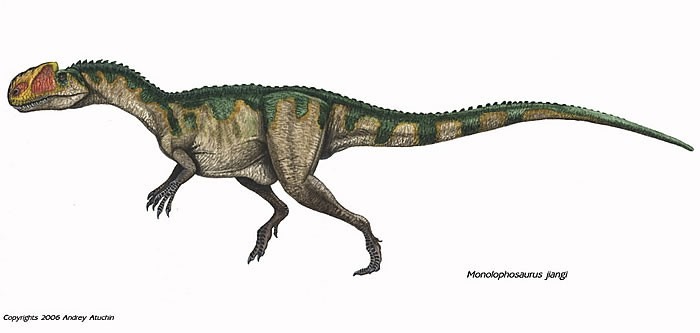
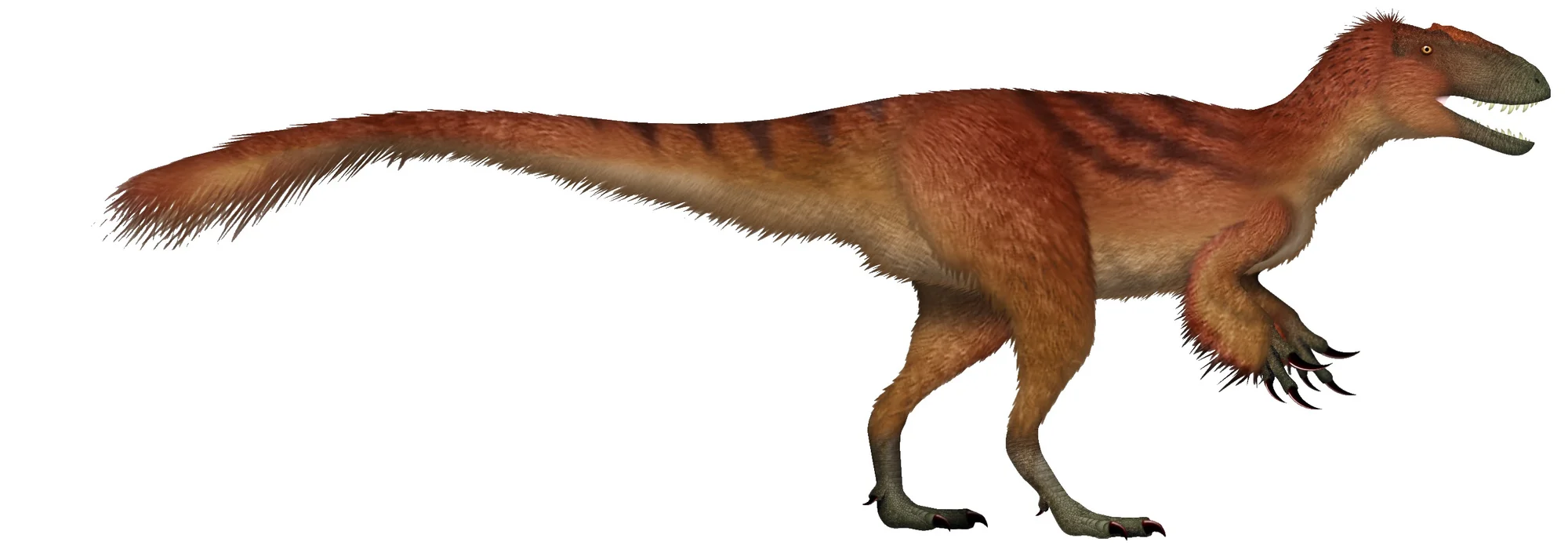
China revolutionized paleontology starting in the 1990s, with records spanning from the Middle Jurassic to the end of the Cretaceous. The Shishugou Formation, from the Middle Jurassic of northwestern China, preserved Monolophosaurus jiangi and the first sinraptorids. The Shaximiao Formation, from the Late Jurassic, hosted Huayangosaurus taibaii and Shunosaurus lii. The Yixian and Jiufotang Formations of Liaoning Province (Early Cretaceous) revolutionized our understanding of feathered dinosaurs thanks to exceptional preservation in lake deposits interbedded with volcanic ash. Yutyrannus huali demonstrated that tyrannosauroids had feathers; Sinosauropteryx prima provided the first direct evidence of color in dinosaurs; Caudipteryx zoui, Anchiornis huxleyi, Beipiaosaurus inexpectus, and Confuciusornis sanctus confirmed the dinosaur-to-bird transition. In the Late Cretaceous, the Nanxiong Formation produced Qianzhousaurus sinensis, and the Iren Dabasu Formation recorded Asian tyrannosaurids.

17 species in the catalog
7 Jurassic
10 Cretaceous
Filter by: 17 species
Huayangosaurus taibaii

CN · 169–164 Ma

Huayangosaurus

Huayangosaurus taibaii

"Huayang lizard (poet Li Bai)"

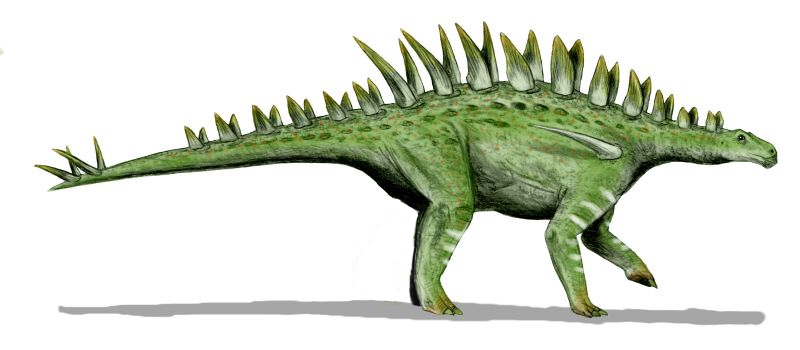
Huayangosaurus taibaii was a small Middle Jurassic stegosaur from southern China, collected at the Dashanpu Quarry near Zigong, Sichuan Province. At roughly 4.5 meters long and about 300 kg, it was much smaller than the famous North American Stegosaurus, yet it carries enormous scientific weight: it is the oldest well-known stegosaur recovered from abundant remains, serving as a key reference for understanding the origin and early diversification of the group. The genus name refers to Huayang, an ancient place name for Sichuan Province, while the specific epithet honors the Tang dynasty poet Li Taibai, also known as Li Bai. Described in 1982 by Dong Zhiming, Tang Zilu, and Zhou Shiwu, the holotype IVPP V6728 includes a relatively complete skull, vertebrae, ribs, caudals, and osteoderms, belonging to one of twelve individuals recovered from the site. This material made Huayangosaurus the best-documented Middle Jurassic stegosaur and the anatomical baseline for comparisons with derived forms such as Stegosaurus and Kentrosaurus. Several traits preserved in Huayangosaurus are regarded as primitive for Stegosauria: it still has teeth in the premaxilla (lost in later stegosaurs), retains open antorbital and mandibular fenestrae (both closed in derived forms), and has a shorter, broader skull. Its dorsal armor consisted of 17 pairs of plates and spikes arranged in two rows, intermediate in shape between the flat plates of Stegosaurus and the long spines of Kentrosaurus, plus a thagomizer with two terminal spike pairs and a distinctive parascapular spine on each shoulder. The forelimbs were proportionally longer relative to the hindlimbs than in Stegosaurus, giving it a less extreme body profile. The animal lived on the warm, humid floodplains of the Lower Shaximiao Formation alongside the sauropods Shunosaurus and Omeisaurus, the small ornithopod Xiaosaurus, and the carnivorous theropod Gasosaurus. Its herbivorous diet, based on ferns, cycads, and low conifers, was consistent with leaf-shaped teeth and a robust lower jaw. As a key early stegosaur on the phylogenetic tree, Huayangosaurus is a genuine link between basal thyreophorans and the Late Jurassic radiation of stegosaurids.

Jurassic Herbivore 4.5m
Yi qi

CN · 163–159 Ma

Yi

Yi qi

"Strange wings"

Yi qi (pronounced approximately 'ee chee') was a diminutive scansoriopterygid dinosaur that lived during the Middle to Late Jurassic, Oxfordian stage, approximately 163 to 159 million years ago, in the region of present-day Hebei, northern China. At only 0.6 meters in length with an estimated body mass of 380 grams, it was smaller than most modern pigeons. The most extraordinary feature of Yi qi is the styliform elongate bony rod projecting from the wrist: a long, pointed skeletal element that, together with a skin membrane (patagium), formed a wing of morphology entirely unlike any other known flying bird or dinosaur. This combination of a membrane wing supported by an accessory bony rod is unique among Dinosauria and finds functional parallels only in bats and flying squirrels among modern vertebrates. The holotype specimen (STM 31-2) was preserved with impressions of contour feathers on the body and filamentous plumage, plus portions of carbonized wing membrane visible around the forelimbs. Histological analysis of the feathers and bones indicates the animal had not reached full skeletal maturity at death, making adult size estimates slightly uncertain. Yi qi had long recurved foot claws consistent with arboreal habits, and simple conical teeth suggesting insectivorous or generalist carnivorous diet. The skull is relatively large in proportion to the body, with broad orbital openings, suggesting acute vision in a forest canopy environment. The phylogeny of Yi qi within Scansoriopterygidae is well-supported, but the placement of that clade within Coelurosauria remains debated: recent analyses alternate between positioning them as basal members of Pennaraptora or as an independent branch of theropods that developed gliding flight convergently and independently from modern birds. If Yi qi's patagium permitted active flight, it would represent a third independent origin of flight among feathered Jurassic dinosaurs, alongside the lineages leading to modern birds (Avialae) and possibly the gliding of Microraptor. Alternatively, aerodynamic analyses suggest the wing morphology was better suited to descending gliding from elevated perches than to sustained flapping. The discovery was announced in April 2015 in Nature by Xu Xing and collaborators, immediately becoming one of the most impactful paleontological finds of the decade.

Jurassic Carnivore 0.6m
Caihong juji

CN · 161–160 Ma

Caihong

Caihong juji

"rainbow with a big crest"

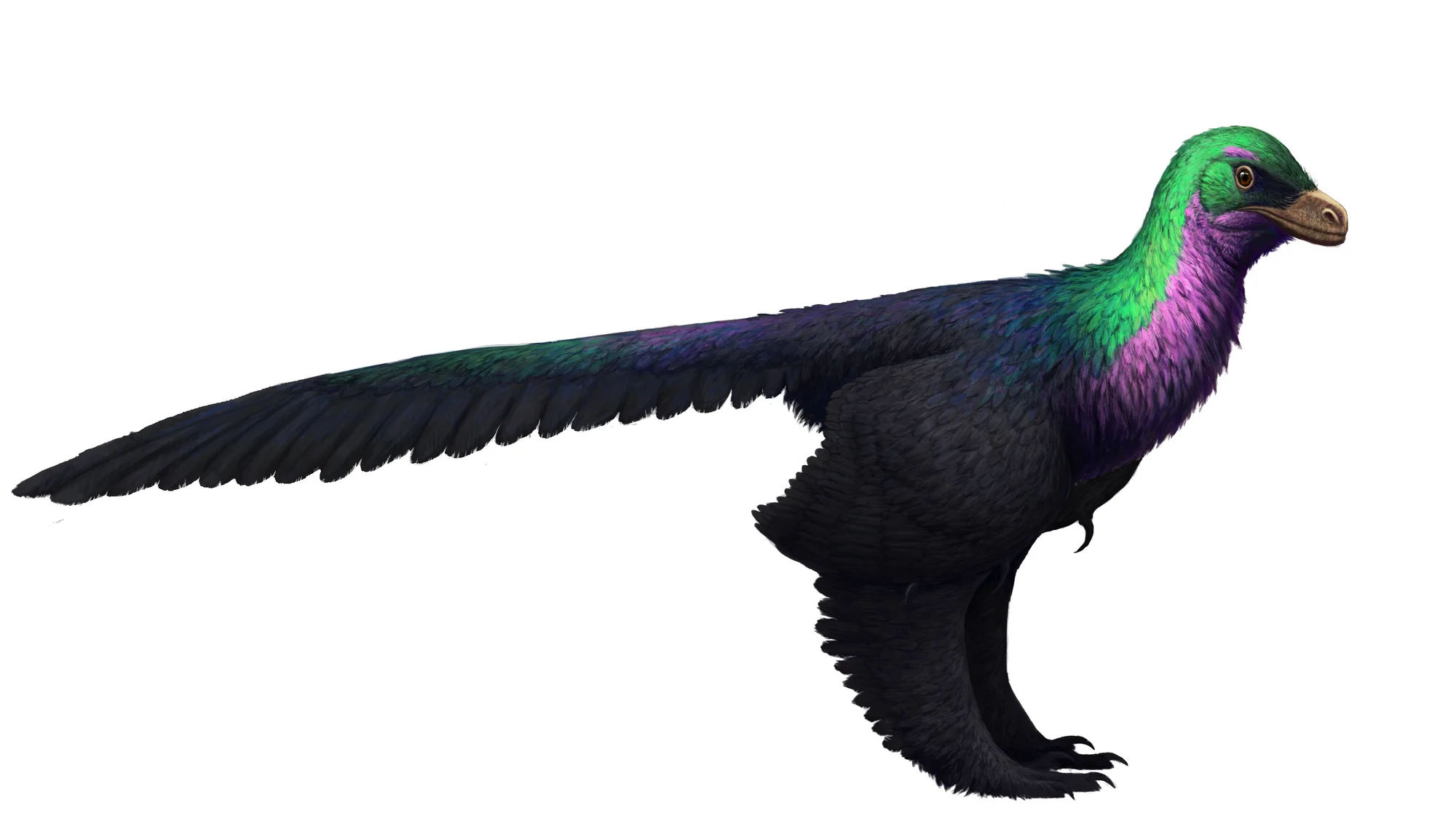
Caihong juji is a small paravian theropod from the Late Jurassic of China whose name comes from Mandarin and means rainbow with a big crest. It measures about 40 centimeters in length and weighs approximately 475 grams, placing it among the smallest known non-avian dinosaurs. The holotype PMoL-B00175, a nearly complete skeleton preserved on slab and counterslab, was found by a local farmer in 2014 in rocks of the Tiaojishan Formation, in the Qinglong Manchu Autonomous County, Hebei Province, and formally described in 2018 by an international team led by Dongyu Hu and Julia Clarke, with Xing Xu, Matthew Shawkey, and other Chinese, American, and European co-authors. Its surprising anatomy includes an elongated bony crest on the snout, formed by expanded lacrimal bones, combined with long asymmetrical pennaceous feathers on the forelimbs and along the entire tail, a morphological package without parallel in the Jurassic record. This geometry suggests Caihong already displayed elaborate ornamental surfaces long before it was capable of sustained powered flight. The most remarkable feature was revealed by scanning electron microscopy: thousands of fossilized melanosomes in feathers of the neck, chest, and base of the tail show a platelet shape, a nanostructure virtually identical to that found in living hummingbirds. In modern birds, this arrangement produces structural iridescence that shifts with the angle of incident light, so that the same individual may appear metallic green, blue, or red with subtle movements. Applying the same principle to the fossil, the authors concluded that parts of Caihong's body shimmered in metallic tones, likely in blue, green, and reddish bands, indeed recalling the rainbow that gives the genus its name. This is the first direct evidence of iridescent plumage in a non-avian dinosaur, pushing back the minimum record of this kind of coloration by roughly 40 million years, which had previously been known only in the Early Cretaceous Microraptor. The simultaneous presence of a bony crest and ornamental feathers indicates that complex visual signals, most likely linked to sexual display or species recognition, were already established at the base of Paraves. Positioned phylogenetically as an anchiornithid close to Anchiornis, Xiaotingia, and Aurornis, Caihong reinforces the idea that the origin of birds was not a linear sequence of aerodynamic innovations, but a parallel evolutionary experiment with multiple small, feathered, visually striking lineages across the Jurassic of Asia. The find also consolidates the Qinglong and Liaoning region as a global epicenter of soft-tissue paleobiology, thanks to exceptional preservation in the volcanic tuffs of the Yanliao Biota, where periodic ashfalls blanketed anoxic lakes and locked feathers, melanosomes, and even subcellular nanostructures into the sediment. For science, Caihong juji marks the moment when we stopped imagining dinosaurs in faded earth tones and began to recognize that some of them competed for mates and chased off rivals by flashing optical sparks very similar to those that today glint on the chests of hummingbirds.

Jurassic Carnivore 0.4m
Wuerhosaurus homheni

CN · 132–125 Ma

Wuerhosaurus

Wuerhosaurus homheni

"Wuerho lizard"

Wuerhosaurus homheni was a large stegosaurid from the Early Cretaceous of northwestern China, collected in the Wuerho (Urho) region of the Junggar Basin in the Xinjiang Uygur Autonomous Region. Roughly 7 meters long and an estimated 4 tonnes in weight, it occupies an unusual spot in stegosaur history: it lived between about 132 and 125 million years ago, tens of millions of years after the group's Late Jurassic peak. Most well-known stegosaurs, such as Stegosaurus, Kentrosaurus, Dacentrurus, and Miragaia, had vanished before the end of the Jurassic, making Wuerhosaurus one of the last well-documented representatives of the clade. The genus name refers directly to the town of Wuerho in the prefecture of Karamay, where the type material was collected, combined with the Greek suffix sauros, meaning lizard. The specific epithet homheni was coined by Dong Zhiming in the original publication. The holotype, catalogued as IVPP V4006, was collected in 1964 by a team from the Institute of Vertebrate Paleontology and Paleoanthropology (IVPP) led by Dong Zhiming and described in 1973 in the volume Dinosaurs from Wuerho, published in the Memoirs of the IVPP. The material includes dorsal vertebrae, pelvic girdle, and fragments of dorsal plates; the skull was not preserved, which limits some fine anatomical comparisons. The specimen comes from the Tugulu Group, probably from the Lianmuqin Formation, a unit whose precise age is still debated but generally placed in the Early Cretaceous, somewhere between the Valanginian and Albian depending on the study. Wikipedia and regional surveys favor a Hauterivian to Barremian position, which we adopt here. The anatomy of Wuerhosaurus is marked by low, broad, rectangular dorsal plates, distinct from the famous tall triangular plates of Stegosaurus. This geometry changed the way paleontologists imagined the diversity of stegosaur armor and was one of the main reasons Dong erected a new genus. Robust femora, a wide pelvis, and vertebrae with low neural spines complete the profile of a heavy stegosaurid, adapted to slow quadrupedal locomotion. Like other stegosaurs, the animal likely carried a thagomizer, the set of terminal caudal spikes used in defense, though those elements were not recovered in the holotype. The systematic status of Wuerhosaurus has been debated. Maidment et al. (2008), in a broad cladistic review of Stegosauria, proposed that W. homheni was a junior synonym of Stegosaurus and should be renamed Stegosaurus homheni. The proposal was not universally accepted: most subsequent reviews, including Raven and Maidment (2017) and regional Chinese syntheses, continue to recognize Wuerhosaurus as a valid genus, given the distinctive combination of low rectangular plates and the survival of the clade into the Early Cretaceous. Dong also described, in 1993, a second species, Wuerhosaurus ordosensis, from the Ordos Basin in Inner Mongolia, which expanded the geographic range of the genus across Asia. Wuerhosaurus therefore remains a key piece for understanding how the stegosaur lineage survived beyond the Jurassic, before the clade's final extinction in the mid-Cretaceous.

Cretaceous Herbivore 7m
Confuciusornis sanctus

CN · 125–120 Ma

Confuciusornis

Confuciusornis sanctus

"Sacred Confucius bird"

Confuciusornis sanctus is the most abundant Mesozoic bird in the world fossil record: hundreds of specimens, many exquisitely preserved with feathers, have been extracted from the Yixian and Jiufotang formations of Liaoning, northeastern China. This unparalleled abundance made Confuciusornis the most studied extinct bird taxon in the world, capable of providing data on morphology, ontogeny, coloration, paleoecology, and social behavior simply not accessible for rarer birds. It lived during the Barremian to Aptian of the Early Cretaceous, approximately 125 to 120 million years ago, and represents one of the most important morphological innovations in bird history: it was the first toothless Mesozoic bird with a true horny beak and a fused tail bone forming a pygostyle. Confuciusornis morphology combines primitive and derived features remarkably. On one hand, the forelimbs retain three functional clawed fingers, and the skull retains some primitive skeletal features relative to modern birds. On the other, the complete absence of teeth, the horny beak, and the pygostyle are innovations we know mainly from modern birds, making Confuciusornis much more externally similar to a modern bird than Archaeopteryx or other contemporaries. The tail, short due to the pygostyle, accommodated in long-tailed forms a pair of very long, narrow ribbon-like rectrices whose function was probably social display. The presence or absence of these tail feathers in different specimens has historically been interpreted as sexual dimorphism, but recent analyses with ontogenetically comparable specimens question this simple interpretation. Confuciusornis flight is considered truly active, not just gliding: the sternum morphology, with well-developed keel for flight muscle insertion, and wing proportions suggest sustained powered flight capability. However, biomechanical analyses indicate the flight pattern would differ from modern birds: the shoulder joint, clavicle position, and relative proportions of humerus and ulna suggest an aerodynamically less efficient flight style compared to neornithean birds. Bone histology studies show Confuciusornis had slower growth rates than modern birds of comparable size, reaching skeletal maturity in one or two years, closer to reptiles than to modern birds.

Cretaceous Omnivore 0.5m
Qianzhousaurus sinensis

CN · 72–66 Ma

Qianzhousaurus

Qianzhousaurus sinensis

"Chinese lizard of Qianzhou"

Qianzhousaurus sinensis is a long-snouted tyrannosaurid from the end of the Cretaceous, recovered in 2010 during excavation at a construction site near the city of Ganzhou, in Jiangxi Province, southern China. The species was formally described in 2014 by Lü Junchang, Yi Laiping, Stephen L. Brusatte, Yang Ling, Hu Hailu and Chen Liu, in a paper published in Nature Communications. The type material, catalogued as GM F10004 and housed at the Ganzhou Museum, includes a nearly complete skull and part of the postcranial skeleton, comprising cervical, sacral and caudal vertebrae, along with hindlimb elements. The holotype individual, still a subadult, reached about 6.3 metres in length and approximately 2 metres in hip height, with an estimated mass between 750 and 757 kilograms; estimates based on allometric comparison with Tarbosaurus bataar and Alioramus suggest that full adults could have reached 7.5 or even 9 metres, although this figure is inferred and not directly supported by fossils. The animal's most striking feature is its extremely elongated and shallow skull, with a narrow premaxilla, rows of long banana-shaped teeth, paired nasal crests forming bumps on top of the snout and a pneumatic opening on the maxilla, features that clearly distinguish it from short-snouted tyrannosaurines such as Tyrannosaurus and Tarbosaurus. Lü et al. 2014 erected the tribe Alioramini to group Qianzhousaurus, Alioramus altai and Alioramus remotus, all gracile long-snouted tyrannosaurines from the Late Cretaceous of Asia. The phylogenetic analysis of Brusatte and Carr 2016, published in Scientific Reports, confirmed this grouping and placed Alioramini as the sister lineage to the massive tyrannosaurines represented by Tarbosaurus and Tyrannosaurus, showing that there was significant ecological diversity among Asian apex predators at the end of the Cretaceous. The set of dental features, with 18 or more teeth in the dentary and narrower teeth than those of the robust tyrannosaurines, suggests a differentiated diet, possibly focused on smaller, nimbler or softer-bodied prey, in contrast to the bone-crushing strategy documented in Tarbosaurus. The animal lived at the same time and broadly in the same region as Tarbosaurus bataar in Mongolia, which supports the hypothesis of ecological niche partitioning between long-snouted and short-snouted tyrannosaurines. The Nanxiong Formation, where the holotype was recovered, also preserves dinosaur eggs, tracks and a rich fauna of oviraptorosaurs, titanosaurs and small theropods, suggesting warm humid fluvial plains in a continental setting of southern China. The nickname 'Pinocchio rex', coined by the international press, popularly summarises the anatomical difference between the slender snout of Qianzhousaurus and the massive snout of its North American cousins. The discovery also reinforced the view that Tyrannosauridae was an ecologically diverse clade, with lineages specialised in different predation strategies, and not only in bone-crushing bites. As of 2026, no referred specimens have been published in peer-reviewed literature, so all known anatomy of the taxon derives exclusively from the holotype, which makes new discoveries in southern China particularly relevant for testing estimates of maximum size and ontogenetic variation of Qianzhousaurus sinensis.

Cretaceous Carnivore 6.3m

0 selected Compare →